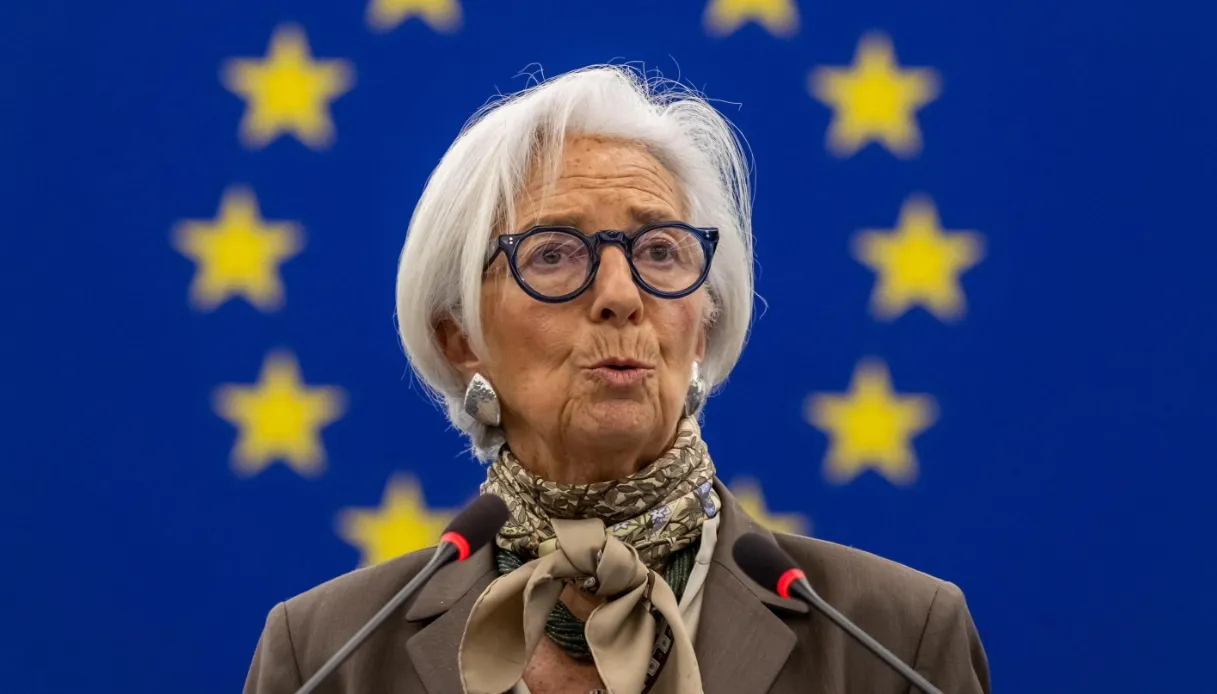
The ECB keeps the wild card of a potential interest rate rise in its pocket and remains to observe the outgoing data, in an attempt to understand whether the effects of the war in the Middle East and the surge in inflation prices will have a more lasting effect and of what magnitude. This is the meaning of the interventions made in recent days by some representatives of the central bank, most recently President Christine Lagarde, who confirmed that all options are being evaluated in an interview given to Bloomberg TV on the occasion of the IMF spring meetings in Washington.
Lagarde: “Agile and ready to move”
The ECB says it is “agile” and ready to “move in the direction required” by the incoming macroeconomic data. Christine Lagarde confirmed this in an interview with Bloomberg TV on the sidelines of the IMF’s work in Washington, confirming that all options are being evaluated to deal with the energy crisis and the moment of great uncertainty.
“We have to be completely agile and move in the required direction and we have to be strictly dependent on the data,” Lagarde said in the interview, explaining “that doesn’t mean we’re going to go one way or the other for sure and it certainly doesn’t determine a rate path that I can point to today.”
The President of the ECB reiterated that the increase in energy costs has moved the Eurozone away from the “baseline scenario” outlined by the Frankfurt Institute, but this deviation still does not justify an increase in interest rates. “We are between the baseline and the adverse scenario,” he added.
IMF outlines three scenarios: inflation could exceed 6%
The considerations of the Eurotower number one come following the review of the IMF’s growth and inflation forecasts, which outlined three scenarios – basic, adverse and severe – formulating different growth and inflation forecasts. For example, in the baseline scenario, inflation is expected to accelerate globally to 4.4% this year and 3.7% next, but in an “adverse” scenario inflation would reach 5.4% and in a “severe” scenario it could exceed 6%. These forecasts are “dominated by downside risks” and lead to the “worst energy crisis of modern times” and “explode political tensions”.
Specifically, the Eurozone should see inflation rise to 2.6% this year, in line with ECB staff forecasts, but the prolongation of the conflict and new surges in energy prices could bring the worst-case scenarios (adverse or severe) closer, seeing inflation fly to 4.2% or even 6%.
The ECB does not rule out rate increases
At the beginning of the week, ECB deputy Luis de Guindos had raised the possibility of a rate increase in the coming months. The next meeting at the end of April (29 and 30 April) should once again confirm a cautious approach, with no rate increase expected, but with the warning that if the situation is prolonged, an intervention is not excluded for May or June.
In any case, de Guindos confirmed that the rate increase will depend on how the surge in prices of oil and other products affects other prices and therefore “second-level effects”.
Act but with caution
Despite the difficult context, the IMF has warned central banks not to act too quickly and to wait for incontrovertible signs of change to change the path of monetary policy.
For the Washington Institute, in fact, central banks should remain vigilant and be ready to act clearly and decisively in line with their mandates and “should guard against prolonged supply shocks that destabilize inflation expectations”, “reserving the possibility of ignoring negative supply shocks, such as the current one, as long as inflation expectations remain well anchored and the stance of monetary policy is already adequately calibrated”.