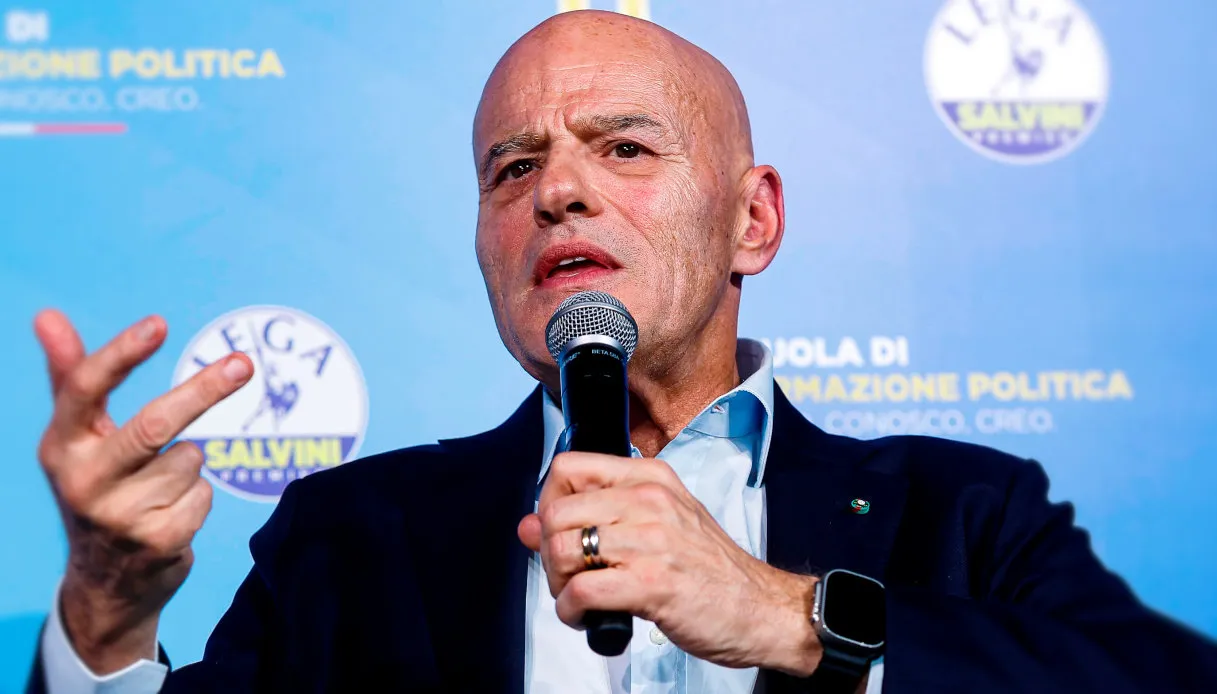
Eni’s CEO, Claudio Descalzi, threw a firecracker into the energy debate by calling for the suspension of the ban on Russian gas imports scheduled for 2027. According to the giant’s CEO, the international context has changed radically and justifies a change of direction: the crisis linked to the blockade of the Strait of Hormuz has reduced global supply and made the balance between demand and availability of energy more fragile. The proposal came from the stage of the League’s Political Training School.
What Descalzi said about Russian gas
The main problem concerns volumes: the European Union would have to give up around 20 billion cubic meters of LNG from Russia, without having immediate alternatives capable of completely compensating for the cut.
This is the concrete risk highlighted by Eni’s CEO: without a temporary revision of the rules, Europe could find itself with a shortage of supplies even as demand remains high. These are the words of Claudio Descalzi:
I think it is necessary to suspend the ban that will come into effect on January 1, 2027 on the 20 billion LNG coming from Russia. And I would also suggest, as the Italian Government is saying, to also review the ETS, the tax on all heavy industry. I’m not saying that it must be cancelled, but it must be suspended or redistributed, so as not to further penalize an industrial sector that already has to pay a lot for energy.
Hormuz effect on oil and gas
The blockade of the Strait of Hormuz represents, according to Descalzi, the most significant event of the last 40 years in terms of impact on energy supply. And the key element is the divergence between financial prices and real oil prices. While futures contracts remain lower, crude oil ready for delivery reaches much higher values. This happens because, in a phase of scarcity, the priority is not the price but immediate availability. Oil cargoes are directed to the most profitable markets, often far from Europe.
While the situation on gas remains manageable in the short term, it is on the fuel front that the greatest critical issues emerge. Over the last weekend, around 600 petrol stations remained without diesel. The problem is not only high demand, but also reduced production capacity. In recent years, Europe has progressively closed numerous refineries, decreasing internal autonomy.
The situation with aviation fuel is even more delicate. Europe imports around 35% of its jet fuel needs, making itself vulnerable to external shocks. The combination of stable demand and reduced supply could have direct effects on flights for the coming months, with an increase in ticket costs and difficulties for international mobility.
Alternatives to Russian gas and current limits
Italy, according to Eni, has already partially diversified its sources, replacing part of its supplies with imports from Africa and the United States. However, this model is not yet replicable on a European scale. Countries such as Angola, Nigeria, Congo and the United States contribute to filling the gaps, but cannot guarantee the same stability as previous flows. The system therefore remains exposed to sudden shocks, as demonstrated by the current crisis.
The energy crisis is already having visible effects on financial markets and the real economy. The increase in energy costs could translate into an economic slowdown, with effects on industrial production, transport and consumption. In a prolonged scenario of scarcity, some countries are already evaluating measures to contain consumption, while the fear of a phase of economic contraction is growing.
What has been all too clear, for years now, is that the world has changed: the model of recent decades with available, relatively cheap and globalized energy has come into question and in its place a more fragmented and more unstable system has emerged, linked to the geopolitical balance of a world in which the succession of shocks seems to have become the norm.