It is common belief that All Saints’ Day and All Souls’ Day (in some parts of the world known as “Day of the Dead”) are the same holiday, but in reality they represent two distinct occasions.
All Saints’ Day, which falls on November 1st, is a Catholic holiday dedicated to the saints and martyrs of the Church, and is a public holiday in all respects. The Commemoration of the Dead on November 2, however, is a day of reflection and prayer for all the deceased, and it is a weekday.
But why do these two anniversaries fall on two contiguous days, and how have their celebrations consolidated over the centuries?
What is celebrated on November 1st: All Saints’ Day
The solemnity of All Saints is a feast of obligation of the Catholic Church dedicated to the glory of all the saints and martyrs of Paradise, including those who do not appear in the official calendar.
In Italy, November 1st is to all intents and purposes a public holiday marked in red on the calendar: schools, public offices and many commercial activities remain closed, guaranteeing a day of rest for workers.
But what are its origins? Like all celebrations, the date of November 1st was not chosen at random, and for a long time it was not even in autumn.
In the Christianity of the first centuries (between approximately 370 and 400 AD), in the eastern provinces of the Roman Empire (Antioch and Constantinople) the martyrs were celebrated on the day of their death, the “dies natalis“, so called because it was believed to correspond to the day of their “birth in heaven”, in paradise.
However, following the persecutions of the emperors Decius and Diocletian, there were so many victims that it soon became impossible to assign a specific day to each of them. Precisely for this reason, already in the fourth century it was decided to choose a single day to celebrate the martyrs and the deceased, which generally fell on the first Sunday following Pentecost, as the patriarch of Constantinople John Chrysostom attested in his written homilies.
Two centuries later, on May 13, 609 (according to some, 610) AD, Pope Boniface IV chose a specific date. This happened because the Byzantine emperor Phocas granted him the ancient Pantheon of Agrippa, a temple dedicated to all the pagan divinities of ancient Rome, and the pontiff decided to convert it into a Christian basilica with the name of Sancta Maria ad Martyrestransferring dozens of loads of bones of unknown martyrs from the catacombs. From that day, May 13 became the official date of the Roman feast of martyrs, remaining linked to the spring calendar for over a century.
Subsequently, as Treccani reports, Pope Gregory III (731-741) consecrated an oratory inside St. Peter’s Basilica, dedicating it not only to the martyrs, but also to the apostles and confessors, and established a new date, that of November 1st.
According to the medieval historiographer Guglielmo Durante, the reasons for this shift of dates by two seasons had to do with the availability of food. In fact, in mid-May, the granaries began to be half empty, because the winter supplies were almost finished. The new crops, however, were not yet ready, and the arrival of pilgrims in Rome for a solemn celebration risked severe food shortages or price surges (unsustainable for the local population).
In November, however, the harvests of wheat, wine, oil and legumes were rich, the harvest was completed and the animals were slaughtered, and it was the perfect period for the arrival of the faithful.
At the same time, between the end of the 8th and the beginning of the 9th century, Carolingian intellectuals such as Alcuin of York attested that in the British Isles and Gaul the monks celebrated the feast of saints as early as the beginning of November. Entering the land of the Celts, it is also worth mentioning a theory that has circulated in recent years, which however has no historical attestation.
According to some beliefs, the festival was moved to the beginning of November to “Christianize” the seasonal festival of Celtic Samhain (which fell on the night between October 31st and November 1st), in which the transition from summer to winter was celebrated with ritual dances, fires and banquets. That night was thought to be liminal, that is, the veil between the world of the living and the dead was thinning. But as the well-known British historian Ronald Hutton pointed out, there are no medieval sources that describe Samhain as the cult of deceased ancestors. Let us not forget that according to the most ancient Irish martyrologies (such as the Martyrology of Oengus, around 800 AD) the collective feast of the saints in the Celtic world was, at least initially, set for 20 April.
In any case, the date of this celebration was formalized for the beginning of November by the Frankish Emperor Louis the Pious in 835 AD at the urging of Pope Gregory IV, who extended it to all the saints.
November 2nd: is the Day of the Dead a holiday?
November 2nd, All Souls’ Day, it is not a public holidaybut a weekday in all respects. Consequently, schools (except for long weekends decided by individual regional or institute calendars), offices and shops remain open as normal.
Unlike the celebration of All Saints’ Day, this is an occasion of prayer, suffrage and recollection for the souls of all those who have left earthly life.
It is also a celebration with very ancient origins: already in the 2nd and 3rd centuries AD the famous Roman writer and philosopher Tertullian reported in his writings the custom of offering prayers and Eucharistic sacrifices for the deceased, both during everyday mass and on the days of their death (oblationes pro defunctis annual die it was the offering for the mass in memory of the deceased).
Between the 3rd and 6th centuries, however, the practice of celebrating masses in memory of the dead at fixed intervals following their passing was consolidated:
- on the third day: it symbolized the resurrection of Christ
- on the seventh day (in the Latin West: Italy, Gaul and North Africa): it was a reminder of God’s day of rest after the Creation
- on the thirtieth day: 30-day mourning was observed by the Jews for the death of Moses and Aaron (Deuteronomy)
- the ninth and fortieth days: this choice was the favorite of Syriacs and Egyptians. The ninth day was a legacy of Greek and Roman funeral rites (novemdiales), while the fortieth day was in memory of Jesus’ forty days of fasting in the desert and of the Ascension.
As time passed, the commemoration went from private to universal thanks to the Benedictine monks, who between the 6th and 10th centuries began to dedicate days in memory of their brothers and deceased benefactors.
The real turning point, however, came in 998 thanks to the Benedictine abbot Saint Odilo of the Abbey of Cluny, who with a statute ordered that all the monks of his congregation celebrate their deceased brothers and all the deceased on the day after the feast of All Saints.
But why had he chosen the day after All Saints’ Day? It was not a random choice, but completely sensible from a theological point of view.
On November 1, those who, being saints and blessed, had entered Paradise (Church Triumphant) were celebrated, while the following day the living would have to humbly lower their gaze and see the reality of the Purgative Church, which reminded the living that the souls of their loved ones were in Purgatory and that prayers, suffrages (works of charity and goodness) and masses in their memory were necessary to help them “ascend” to Paradise.
But there’s a reason why Odilo’s order got this far: his abbey was no mere monastery, but the central hub of the monastic empire, with hundreds of affiliated convents across Europe. It was therefore easy to spread this celebration, which soon spread thanks to local priests.
Why do we often go to the cemetery on November 1st?
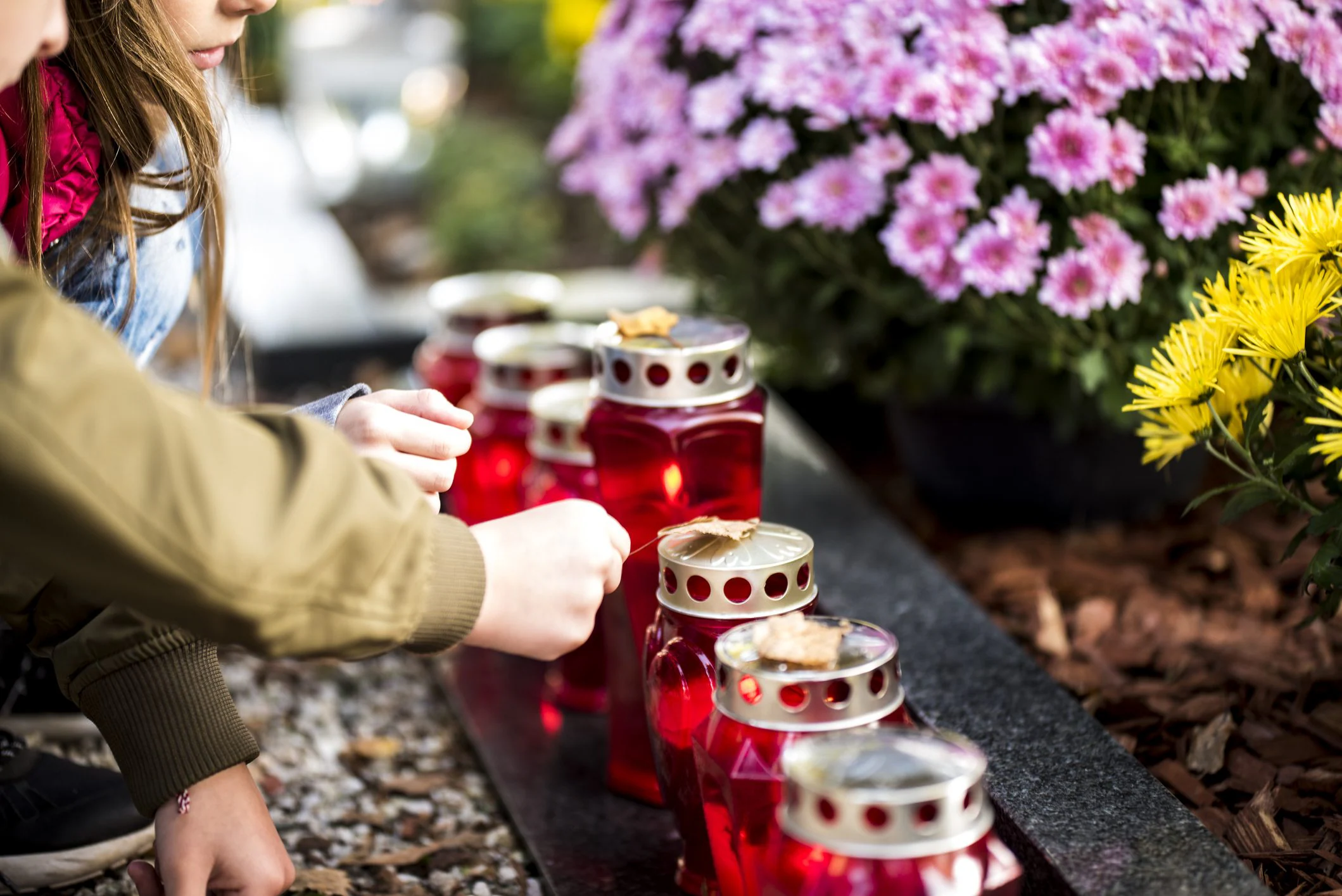
Even though the official anniversary for the deceased is November 2nd, in practice most people visit cemeteries on November 1st, because as it is a holiday, families have time to go and honor their loved ones with flowers (chrysanthemums, especially) and candles. Precisely for this reason, in fact, the two anniversaries tend to merge in common thought, becoming a single celebration.
This time dedicated to remembrance ended up nurturing fertile ground where the liturgy of the Church merged with archaic popular beliefs, transforming the first days of November into a moment of thinning of the veil between the world of the living and the dead.
In Italy and Europe this continuity is found in domestic rituals such as the preparation of the typical “fave dei morti” sweets or the lighting of candles in the window to guide the path of the souls who return to greet them.
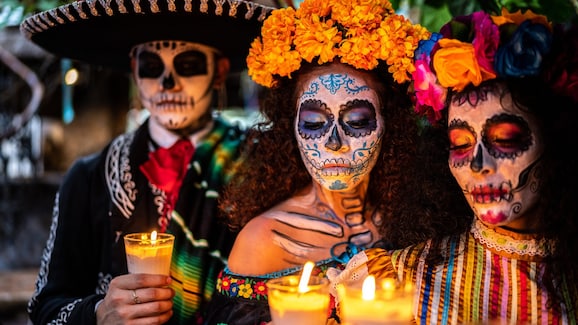
In this sense, the most famous expression of folklore is undoubtedly that of the Mexican Día de Muertos, where the Catholic liturgy introduced by missionaries in the 16th century joined the Aztec celebrations for Mictecacihuatl, transforming the combination of 1st and 2nd November into a celebration in which altars full of food (the one most loved by the deceased in question), sugar calaveras and cempasúchil flowers celebrate the memory not as an end, but as a bond perennial between the living and the dead.