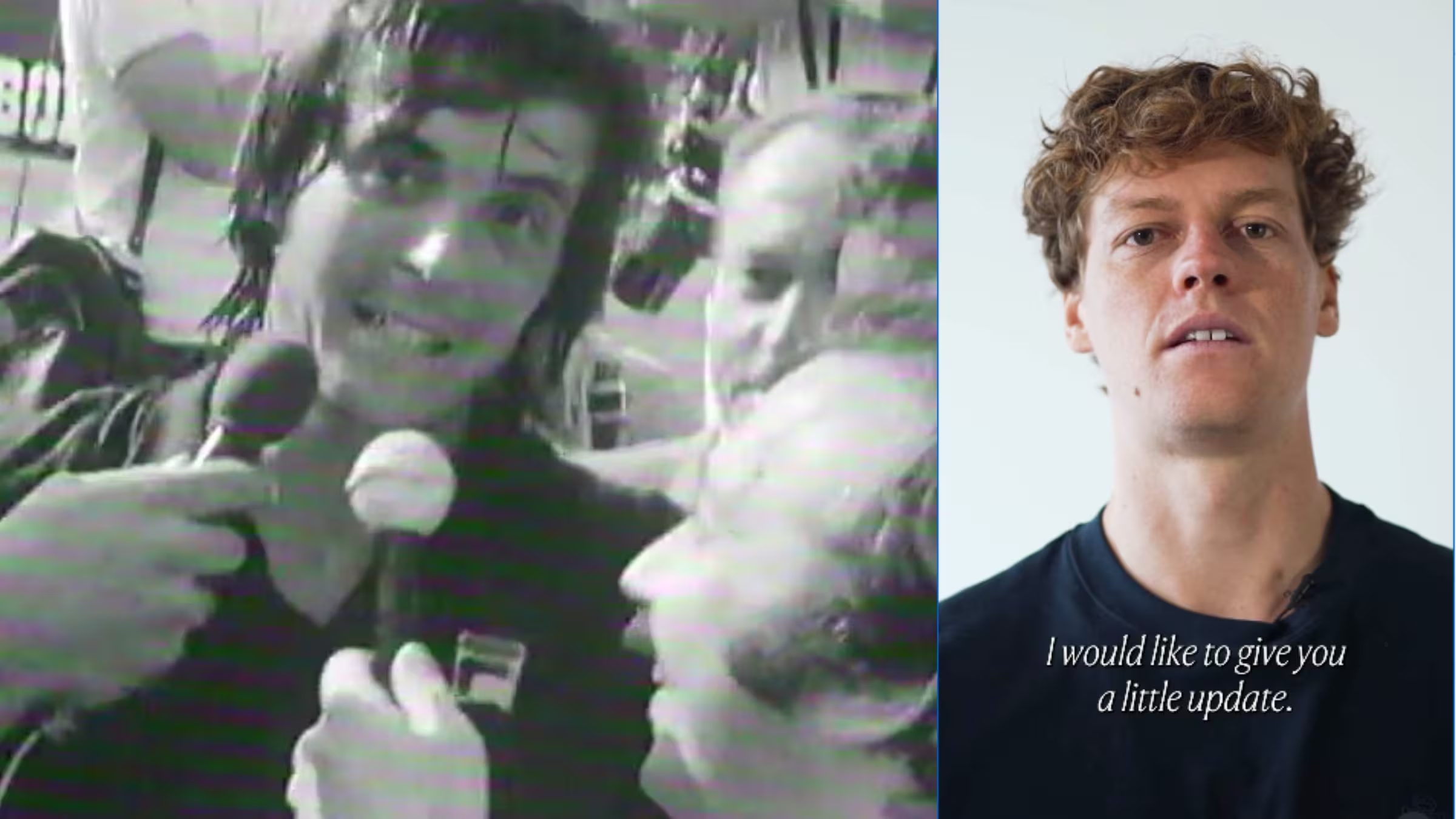
With a video published on his social channels, the No. 1 in the world of tennis, Jannik Sinner announced a few days ago that his 2026 season officially ends three months early due to a knee injury. In 42 seconds, with a close-up shot on a white background, microphone lavalier fixed to the shirt and subtitles, the Italian tennis player archives weeks of indiscretions, rumours, speculations and fake news on his physical condition with a simple and clear message that reaches everyone with a click. No press, no intermediation, zero filters. “Goodbye 2027”. Direct and one-sided, a perfect example of how an athlete’s communication has changed with the advent of Instagram, X, TikTok, Twitch and Youtube.
The story of sport in the last 50 years: from the journalist-friend to the reel on Instagram
It is May 30, 1976, the final of the Italian tennis internationals in Rome. As can be seen in the historic video below, during a change of court the journalist Gianni Minà, microphone in hand, enters directly onto the pitch, dirtying his shoes with clay, to do a short interview with Panatta, future winner of the tournament, live: “Adriano, how do you feel?”.
The journalist Giampiero Galeazzi, on May 10, 1987, overcomes the security of the San Paolo stadium in Naples, sneaks with his cameraman into the changing rooms of the Neapolitans, recently champions of Italy, and between water balloons and choirs becomes the protagonist of a historic show with Diego Armando Maradona.
Both Minà and Galeazzi had the privilege as well as the skill of establishing a unique and confidential relationship with the greatest athletes of their era. For today’s journalists that type of closeness, human and professional, is pure utopia. Victory, defeat, joy, disappointment, anger, frustration are shared, live, by the athlete via his smartphone or that of those close to him such as family, friends or social media managers. Over the decades, figures such as press offices, agents, sponsors and event organizers have been added between journalist and athlete. The messages that were once conveyed by interviews on TV or in print are now mostly entrusted to podcasts or Youtube channels, co-produced with influencers and content creators.
The athlete 2.0: one media company
By leveraging the value of their messages and contents, developing strategic collaborations with other companies and professionals already established in the world of communications, many sportspeople have become real “media companies” with much broader contours such as cinema, television and streaming. One of the first to take this path was the American basketball player LeBron James who founded the company back in 2008 SpringHill Entertainmentnamed after the public housing neighborhood in Akron, Ohio, where “The Chosen One” lived as a boy. Over time, even sports clubs, such as our Serie A clubs, have structured an internal media company for the integrated management of editorial and digital productions, promoted by social media. Interaction with your members exponentially multiplies views and followers, creating engagement and value for sponsors.
Evolution of language: the triumph of spontaneity and social commitment(s)
Thanks to the disintermediation from traditional channels we have moved on to a spontaneous story of the athlete, focused mainly on the human aspect. Storytelling is based on behind the scenes, on everyday life and on overcoming difficult moments in your career (injuries, defeats, retirements). An example was the approach on platforms such as Instagram and TikTok during the last Milan-Cortina Olympics, when athletes went viral not only for the medals won, but for the reviews of the food in the Olympic village canteen, the ironic trends and the intimate moments of anxiety before the competitions. Athletes use their voices and their channels not only to talk about sport, but to take sides on social and cultural issues. Examples are the tennis player Naomi Osaka for mental health or the footballer Marcus Rashford with his strong commitment to the fight against child food poverty.
The negative sides: fake news and the Sinner case
The role of the journalist, of verifying sources with a critical filter, is increasingly bypassed by sports communication. If on the one hand it favors the authenticity of the story, on the other – in some cases – it fuels the proliferation of fake news. Returning to the Sinner case, the lack of information from the Italian athlete’s entourage during the weeks of stoppage (probably also motivated by the uncertainty over the diagnosis of the injury) triggered a frantic chase for the truth on social media, based on the tennis player’s visits to medical centers around Italy, the location of photos with fans and rumors from non-experts about a possible return in the short term. A castle of assumptions collapsed in 42 seconds.