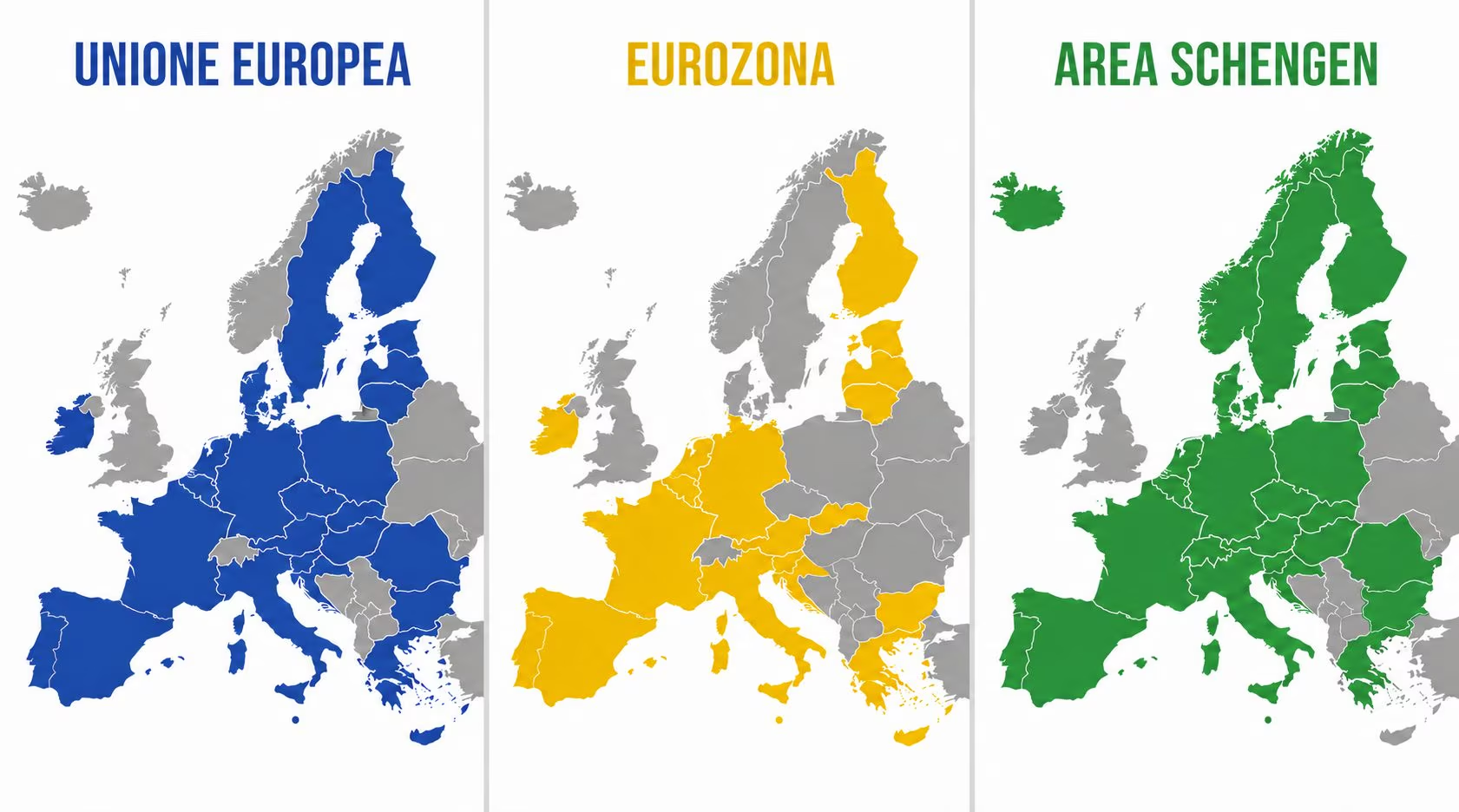
Whenever we talk about Europe, we often use expressions such as European Union, Eurozone and Schengen area as if they were synonymous. In reality, these three terms indicate different things and, above all, include different countries.
For example, not all EU countries use the euro as their national currency, while the Schengen area includes states that are not members of the Union.
In essence, the European Union is the largest container: the Eurozone and the Schengen area are two subsets, with some significant exceptions.
European Union
The European Union is a political and economic organization that today has 27 member states (there were 28 until the United Kingdom left with Brexit). All the countries joined at different times: from the six founding countries (Italy, Belgium, France, Germany, Luxembourg and the Netherlands) which in 1957 gave life to what was called the European Economic Community, up to the expansion to the east after the fall of the USSR. The latest country to join was Croatia, which last joined in 2013.
Being part of the EU means sharing common institutions, rules and policies in areas ranging from trade to the protection of fundamental rights. Each State Party, in fact, must accept the so-called community acquiswhich includes:
- The founding treaties and fundamental principles of the European Union;
- European Union law, which includes regulations, directives and decisions adopted by European institutions;
- The jurisprudence of the Court of Justice of the European Union;
- Declarations, resolutions and international agreements concluded by the EU;
- Common policies for the single market, free movement and commercial and agricultural policies.
More generally,
Eurozone
The Eurozone is the set of EU countries that have adopted the euro as their official currency, which includes 21 out of 27 member states.
This exclusion occurs because to enter the eurozone a state must satisfy the so-called convergence criteria, economic and legal conditions established by the 1992 Maastricht Treaty. Not all EU countries have achieved them, as in the case of Hungary, Poland, Romania, Sweden and Czechia.
Denmark, however, negotiated an opt-out clause and chose to maintain its national currency, the Danish krone. The latest country to adopt the euro is Bulgaria, which joined the eurozone in 2026.
Today the euro is used every day by over 350 million people: it is the second most important currency in the international monetary system, after the US dollar.
Schengen Area
The Schengen area is the largest free movement area in the world. Over 4 million square kilometers where more than 450 million people can move without internal border controls.
It all started on June 14, 1985, when five countries (France, Germany, Belgium, the Netherlands and Luxembourg) signed an agreement in the Luxembourg town of the same name. Italy joined in 1990 and, with the Treaty of Amsterdam in 1997, the Schengen system was integrated into the legal framework of the European Union.
Today the Schengen area includes 29 countries:
- 25 of the 27 EU member states;
- 4 non-EU countries: Iceland, Liechtenstein, Norway and Switzerland.
Who’s left out:
- Ireland, which exercised its right of non-participation;
- Cyprus, where controls have not yet been abolished.
Bulgaria and Romania, after the abolition of air and sea controls in 2024, entered into full force from 1 January 2025 with the suppression of controls also at land borders.
With the Treaty of Amsterdam, signed in 1997 and entered into force in 1999, the Schengen rules were integrated into the legal framework of the European Union.
The Schengen area, therefore, is not about money, but about the abolition of systematic controls at internal borders between member states. This allows you to travel from one country to another without normal border controls, although you still need to bring valid documents with you and respect the entry and residence rules. Furthermore, in exceptional situations, states can temporarily reintroduce controls, as happened in the summer of 2026 between Spain and Italy after the Ceuta crisis.
Below is a summary table with all the particular cases:
| Village | EU member | Eurozone | Schengen Area |
|---|---|---|---|
| Ireland | Yes | Yes | No (right to opt-out) |
| Cyprus | Yes | Yes | No (controls not yet suppressed) |
| Denmark | Yes | No (opt-out clause) | Yes |
| Norway | No | No | Yes |
| Swiss | No | No | Yes |
| Iceland | No | No | Yes |
| Liechtenstein | No | No | Yes |
| Hungary | Yes | No | Yes |
| Poland | Yes | No | Yes |
| Romania | Yes | No | Yes |
| Sweden | Yes | No | Yes |
| Czechia | Yes | No | Yes |