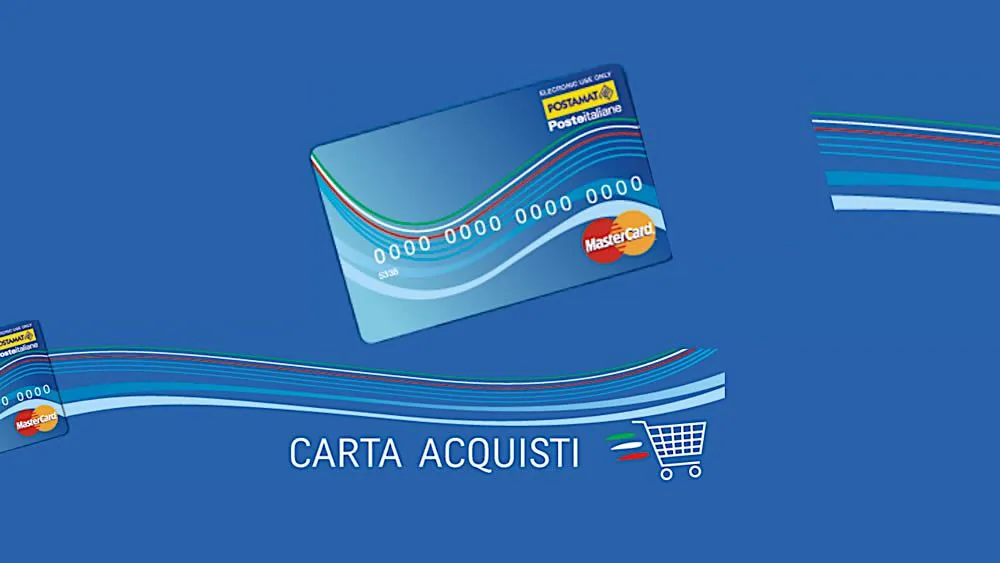
Also in 2026 it will be possible to have the Purchasing Card, provided that the new requirements established by the MEF are met (Ministry of Economy and Finance). This instrument, originally introduced with Legislative Decree no. 112 of 2008, is configured as a state subsidy provided through an electronic payment card, aimed at supporting sections of the population in conditions of economic hardship for food and healthcare expenses and for the balance of domestic electricity and gas utilities. For 2026, the value of the benefit remains confirmed at 40 euros per month, credited every two months for a total of 80 euros per top-up, but the access thresholds determined by the inflation recorded by ISTAT vary.
To obtain the benefit in 2026, it is necessary to respect new income and asset limits: the maximum value of the ISEE (Equivalent Economic Situation Indicator) is set at 8,230.81 euros both for parents of children under 3 years of age and for those over 65. For the elderly population group, a further distinction arises based on chronological age: while for those aged between 65 and 70 the overall income must not exceed the threshold of 8,230.81 euros, for citizens over seventy the overall income ceiling is raised to 10,974.42 euros.
The new requirements for the 2026 Purchasing Card: what to check
Analyzing in detail the functioning and technical specifications of the Purchasing Card for 2026, we find ourselves faced with a welfare system that binds the disbursement of the contribution to the updating of the ISEE parameters. For those who are not familiar with this acronym, the ISEE is theEquivalent Economic Situation Indicatora tool that allows you to evaluate and compare the economic situation of Italian families considering income, assets (movable and real estate) and composition of the family unit. As a result of the regulatory provisions that regulate this measure, starting from 1 January 2026 the limit amounts have been adjusted to the inflation rate recorded by theNational Institute of Statisticsor ISTAT.
We identify three main categories of beneficiaries, distinguished based on age and income situation.
- The first group includes families with children under the age of three: in this case, the formal card holder is the parent, and the fundamental requirement is an ISEE value not exceeding 8,230.81 euros.
- The second group is made up of citizens in the age group between 65 and 70 years. For these, access to the benefit requires that both the ISEE indicator and the overall amount of income received remain below the same threshold of 8,230.81 euros.
- Finally, we observe a differentiation for citizens who are over 70 years of age, and who constitute the third group: while maintaining the ISEE limit unchanged at 8,230.81 euros, the legislator has provided for a higher overall income threshold, set at 10,974.42 euros.
Anyone who falls within these parameters must use the updated forms to submit an application at the Post Offices, available on the Poste Italiane website, on the MEF portal and on the INPS website.
How to use the 2026 Purchasing Card and where it can be used
From a purely technical and operational point of view, the Purchasing Card works similarly to a common electronic payment card, but with intrinsic limitations due to its nature as a subsidy. The card is completely free and has no management costs or transaction fees. It is issued by operating on the international Mastercard circuit and is equipped with a microchip and a magnetic stripe. It is essential to underline that this tool is not enabled for withdrawing cash from automatic teller machines (ATMs); its use is strictly limited to the direct payment of goods and services. Specifically, it can be used at supermarkets, food shops, pharmacies and parapharmacies that display the circuit’s brand, as well as at post offices for the payment of bills relating to electricity and gas supplies.









