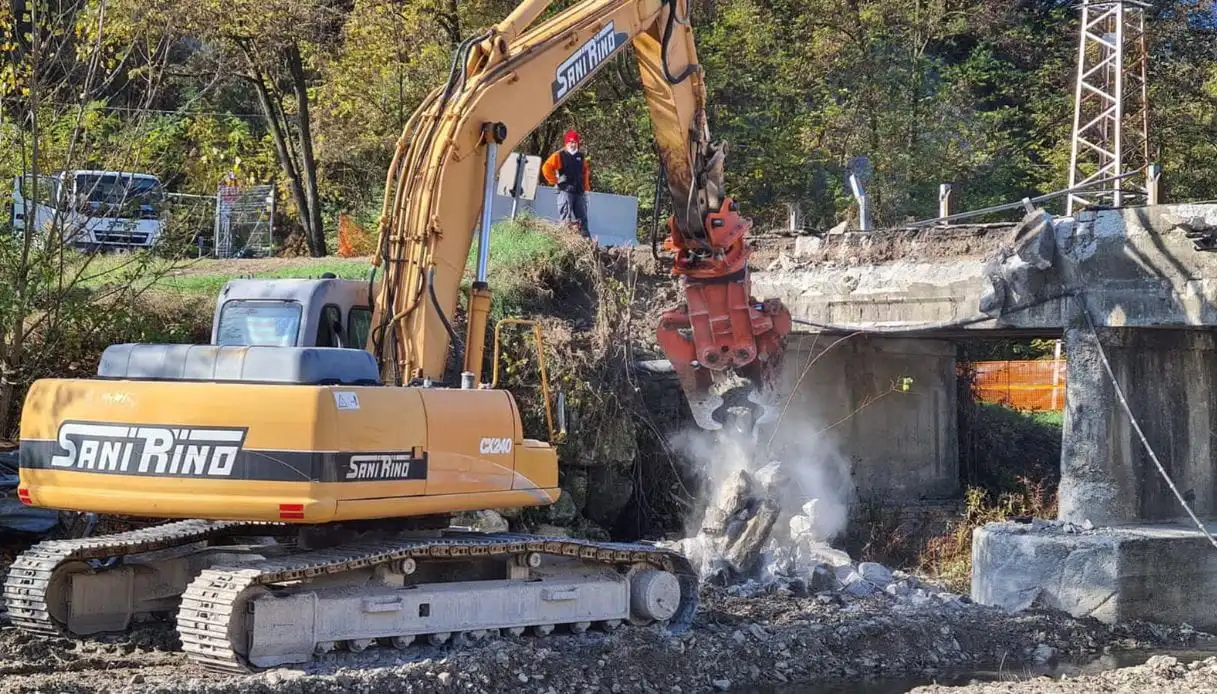
For years the concept of industrial demolition has been associated exclusively with the demolition of obsolete buildings and structures.
Today, however, the sector is experiencing a profound transformation. The growing attention towards environmental sustainability, the optimization of resources and safety on construction sites has radically changed the way of dealing with these interventions, leading to the diffusion of a more advanced and strategic approach.
Companies that need to redevelop production areas, expand factories or reconvert industrial sites are no longer simply looking for a supplier capable of demolishing a building in the shortest time possible. They are looking for a partner capable of managing the entire process, from preliminary design to material recovery, ensuring safety, regulatory compliance and economic efficiency.
In this context, operational models such as that of Sani Rino are emerging, which put engineering planning, selective deconstruction and the circular economy at the centre.
Industrial demolition becomes an engineering process
Modern industrial demolition has abandoned the ways of the past, and with good reason. Each intervention starts from a careful technical analysis phase which allows us to evaluate the structural characteristics of the building, the presence of particular materials, the safety conditions of the site and the most suitable operating methods.
The goal is not simply to demolish a structure, but to do so while minimizing risks to operators, the environment and surrounding activities. This aspect is particularly relevant in production contexts where demolitions often have to coexist with factories that are still operational, technological systems to be preserved or strategic infrastructures to be kept in operation.
The engineering approach allows each phase of the intervention to be planned, defining procedures, timing and operating methods in advance. The use of specialized vehicles, high-precision equipment and advanced technologies also allows us to intervene even on particularly complex structures, guaranteeing a high level of control during all operations.
Sani Rino knows the concept of futuristic industrial demolition well, and directs its know-how towards fewer unexpected events, greater safety and more predictable execution times. Elements apparently taken for granted, but which on balance have a substantial impact on costs.
Deconstruction and strip-out: the new frontier of demolitions
One of the most significant changes in recent years concerns the affirmation of deconstruction and strip-out techniques, increasingly requested by companies and designers involved in industrial redevelopment interventions.
Unlike traditional demolition, which involves the demolition of the entire structure, deconstruction consists of the progressive and selective dismantling of the elements that make up a building. This is a process that allows the different materials to be carefully separated before the actual demolition.
The strip-out often represents the first phase of the operation. In this activity, electrical systems, pipes, false ceilings, technical flooring, windows, insulating panels and all non-structural elements present in the building are removed.
This methodology offers numerous advantages. First of all, it allows us to obtain cleaner and more easily recoverable materials. It also reduces the risk of contamination between different types of waste and simplifies subsequent treatment and recycling operations.
For designers and companies, Sani Rino acts as a point of reference for the strip-out following the planning of industrial demolition. A single interlocutor to be able to operate on many different levels of a process that would otherwise often be too onerous.
Material recovery: from waste to resource
For a long time, the material coming from demolition was considered exclusively a disposal cost. Today the perspective is completely different. Concrete, steel, bricks and other materials can be recovered, processed and reintroduced into the production cycle, generating economic and environmental value.
This approach allows us to significantly reduce landfill and limit the consumption of new raw materials. A particularly important strategy in a historical moment in which the cost of resources and the environmental impact of industrial activities have become central issues for many companies.
Modern crushing and selection technologies make it possible to transform the material resulting from demolition into reusable aggregates for urbanization works, road foundations and numerous other applications.
The value of zero kilometer recovery according to Sani Rino
Many operators like Sani Rino are adopting solutions that allow materials to be treated and valorised directly on site or in the immediate vicinity. The result? Available material, no transport costs and great savings for companies.
The possibility of crushing and sorting the material on site drastically reduces waste handling and speeds up processing times. At the same time it allows the aggregates obtained to be reused directly in new building or infrastructural interventions planned in the area.
This is a model perfectly consistent with the principles of the circular economy, which aims to maintain the value of resources within the territory for as long as possible.
Sani Rino operates mainly in the provinces of Parma, Reggio Emilia and Piacenza and uses an on-site aggregate recovery plant and an innovative recycling plant equipped with double weighbridges (one at the entrance and one at the exit, for punctual and traceable management of the deliveries) and an exit wheel washing system to keep the roads clean. Each waste is also stored in a concrete yard equipped with safe and comfortable boxes.
Circular economy and sustainability as a competitive advantage
Sustainability is no longer just an issue linked to corporate social responsibility. More and more often it represents a real competitive factor.
European regulations are pushing the construction sector towards models based on the recovery and reuse of resources. At the same time, customers, investors and stakeholders are asking companies to adopt increasingly sustainable practices along the entire production chain.
Relying on a partner like Sani Rino, which operates throughout Emilia-Romagna and Northern Italy, in the provinces of Parma, Reggio Emilia, Modena, Piacenza and beyond, up to Mantua and Cremona, is certainly the logical and practical solution that designers and companies can adopt to change the rules of demolition.









