
September has this name, despite being the ninth month of the year, because originally, at the time of the foundation of Rome, it had a different position in the calendar: it was the seventh month of the year. The same explanation applies to the following months, October, November and December, which were the eighth, ninth and tenth months respectively.
In the old Roman calendar, in fact, the year began in March. The beginning was then moved to January 1st in the 2nd century BC. C., but the names of the months were not changed. Since then there has been an inconsistency between the name of September and its position, now being the ninth month of the year.
The shift of the beginning of the year to January 1st was confirmed in subsequent calendars, namely the Julian one adopted in 46 BC. C. and the Gregorian one, which has existed since the 16th century and is still in use.
September was once the seventh month: the Roman calendar
September has this name for a simple reason: it was originally the seventh month of the year, and not the ninth. The explanation of the name must be found in the most ancient history of Rome, the monarchic era: a period on which knowledge is very limited and based mainly on assumptions and interpretations.
According to the most accredited interpretation, at the time of the foundation of the city, during the reign of Romulus, the Roman calendar was adopted, a solar calendar consisting of ten months:
- Martius
- Aprilis
- Shift
- Iunius
- Quintilis
- Sextiles
- September
- October
- November
- December
The names of the first four months were chosen in homage to the divinities (Martius for Mars, Aprilis for Aphrodite, Maius for Maia and Iunius for Juno); the other six were chosen based on their position in the calendar: from Quintilis (our July), which was the fifth month of the year, to December, which was the tenth. September therefore owed its name to the fact that it was the seventh month of the year.
It should be noted that the ten months occupied a total of 304 days; there were another 61 days left that did not belong to any month. In practice, we stopped counting after December and started again in Martius. However, during the reign of Numa Pompilius, the semi-mythical successor of Romulus, the “extra” days were divided into two new months: Ianuarius, named after the god Janus, and Feburarius, dedicated to the Etruscan god Februus. Under Numa, an intercalary month was also added, Mercedonius, which was not present every year and was used to make the duration of the year coincide with the revolution of the sun (the same reason why we have leap years). However, the year continued to begin in Martius, the month in which the new consuls and other magistrates took office.
The moving of the New Year and the new placement of the months
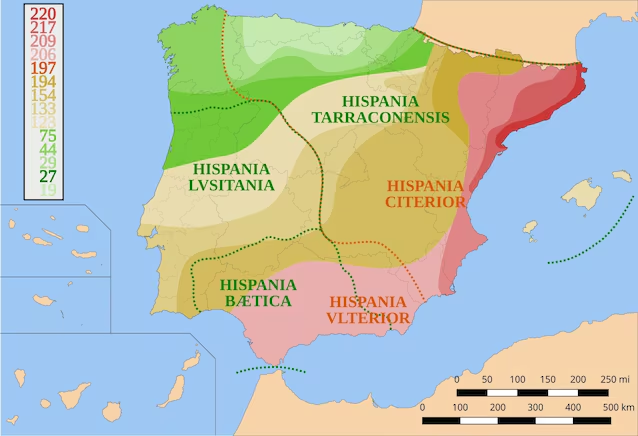
The beginning of the year was moved (or at least, started to move) to January 1st in 153 BC: the Senate established that the new consuls, Quintus Fabius Nobilior and Titus Annius Lucus, would take office on that date, instead of in March, for military needs (they had to have more time to organize the legions engaged in a war in the Iberian Peninsula).
The names of the months, however, were not changed: since then September became the ninth month of the year and the name was found to be “wrong”, as were those of October, November and December. The shift of the beginning of the year to January 1st was confirmed in subsequent calendars: the Julian one, adopted in 46 BC. C. at the behest of Julius Caesar, and the Gregorian one, introduced in 1582 and today used in our country and in much of the world. In the two calendars, however, the names of September, October, November and December did not change, which are therefore in an “incongruent” position. After the adoption of the Julian calendar, only the months of quintilis changed, which became Iulius (July) in honor of Julius Caesar, and sextilis, which became Augustus (August) in honor of Octavian Augustus.