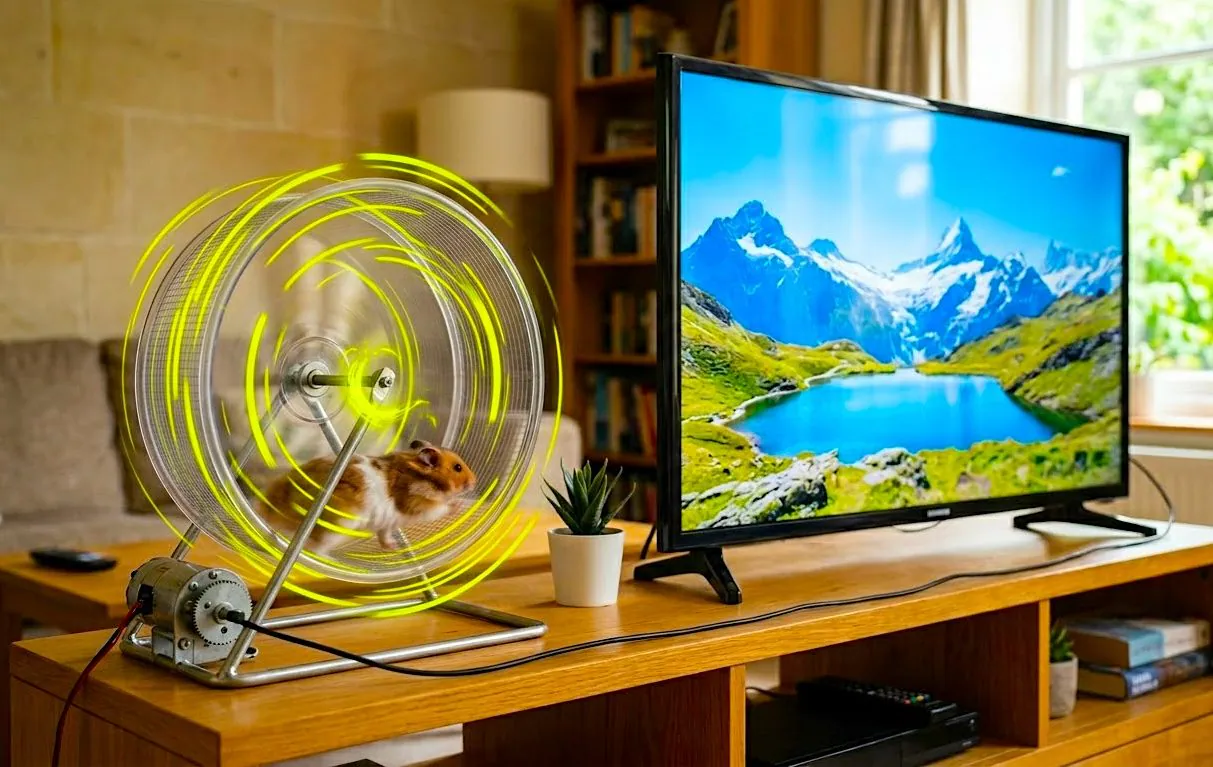
After a few years of use, it can happen that a smart TV starts to show some signs of failure: it no longer responds to commands as quickly as it used to and when you start an application, perhaps that of your favorite streaming service, the startup times are decidedly longer than they were a few months ago. These problems do not necessarily have to be directly attributed to the hardware of the device; much more often a similar scenario is the result of a combination of factors related to software, resource management and the evolution of digital content.
Smart TVs work similarly to other devices we use every day, such as smartphones and tablets: they run processes in the background, use RAM (i.e. the temporary memory used to run apps in real time) and have limited storage space. Over time, these elements can become saturated or less efficient. Furthermore, updates to streaming platforms and the introduction of more advanced video formats can exceed the original capabilities of the television. For all these reasons, even models once considered “top of the range” can begin to suffer a little from a performance point of view over time. Even if it is not possible to work miracles, there are some measures to improve performance and prolong the useful life of the device, thus avoiding its premature replacement. Let’s delve deeper into the topic by first seeing why some smart TVs become slow after a few years and how to “speed them up”.
Because our smart TVs become slower over time
The heart of the problem often lies in the fact that we consider the TV as a simple household appliance, while we should imagine it more like a smartphone or a tablet with a giant screen. Inside there is a more or less powerful processor, a limited amount of RAM and a limited amount of internal storage. In this regard, expert Lee Neikirk observes:
The TV runs app processes in the background, accesses on-board RAM, has usually very limited storage space, and uses cache to store data and speed up various processes. And just like (our smartphones and tablets), it can run out of storage space, slow down due to cache size, and require firmware updates to keep running smoothly.
Furthermore, the cheapest models are basically equipped with low-cost hardware, which almost immediately struggles to manage the various running processes, and even the top of the range models begin to suffer as the years go by. This phenomenon may be attributable to the evolution of streaming services, which today require the management of complex formats such as Dolby Vision or HDR10+, technologies that drastically improve color and contrast, impacting the TV hardware which, in the case of more obsolete models, could start to struggle quite a bit.
How to make smart TV faster
To give some oxygen back to the system and try to make the smart TV a little faster, we recommend that you first turn it off and unplug it. Turning off the TV from the remote control simply puts it into standby, keeping background processes running. Unplugging the plug for about 10-15 minutes, however, forces the closure of all processes and “resets” the system status.
At the same time, it is important to manage your storage space. Smart TVs, especially mid- and low-range ones, have very small internal memories, from 4 to 16 GB (in the mid-range), compared to 128 GB for phones. Uninstalling applications that we no longer use is therefore fundamental: the less data that occupies memory, the more agile the operating system will be in carrying out various operations, such as launching apps, closing them, navigating through the various menus, etc.
Another technical intervention that can be effective concerns cleaning the cache. Every time we use an app, the system saves some temporary data in the so-called cache, i.e. a memory designed to speed up the loading of the most used information. Over time, however, this data can accumulate and take up valuable space, especially on devices with limited memory, ultimately negatively impacting performance. By entering the system menus, it is possible to clear the cache, in one go for all the apps or by acting on the individual installed applications (depends on the system in use on your smart TV).
If you notice that it is only streaming that is causing some problems, the culprit could be a bad Wi-Fi configuration or the presence of an older generation Wi-Fi module in the TV. In this case, switching to a wired connection via Ethernet cable, or using Powerlines (devices that transmit the internet signal through home electrical sockets), could guarantee stability that the wireless signal cannot offer, especially for high definition streaming content.
If none of the solutions we have proposed so far help your smart TV, you could try restoring it to factory settings. This procedure deletes all data on the device and brings it back to its original state. This means that once the factory reset is complete, you will need to reconfigure it and you will also need to update it to the latest software version available.
If even restoring to factory settings does not give a positive result and in any case you do not want to discard your smart TV, there is a last resort you could turn to: purchasing an external hardware device, i.e. an autonomous multimedia streaming device, with which to replace the system integrated into the smart TV with something more updated and performing. Using this type of device is very simple: just insert the device into an HDMI input and establish the connection to the wireless network. Once logged in, the installation is complete. In a few moments, even an older smart TV will get a snappier and more up-to-date interface.