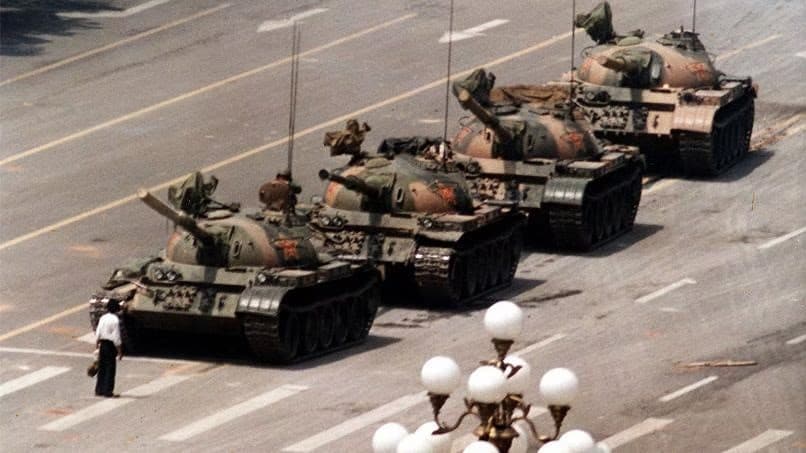
The Tiananmen Square massacre was the repression of the protests that developed in the People’s Republic of China between April and June 1989. Thousands of citizens took to the streets to demand democratic reforms and protest against the corruption of the ruling class. The protest took place in various cities, but had its fulcrum in Beijing and, in particular, in Tiananmen Square and the surrounding streets and the photo on the cover, which represents a young man in a white shirt who, on June 5th, on Chang’an Avenue, tried to prevent the passage of the tanks, has become its symbol.
The repression and massacre, ordered by the leader Deng Xiaoping, began on the night between 3 and 4 June 1989. The army had no scruples in using firearms and shooting at demonstrators. The number of deaths is not known exactly, because the figures released by the Chinese authorities (two hundred victims) are not considered truthful, but there is talk of at least 2-3 thousand people. What is certain is that even today the 1989 protests in China are a taboo topic.
The 1989 protests: from Tiananmen to other cities
In the spring of 1989, the population took to the streets to protest against the political system. The protests began after the death of the reformist leader Hu Yaobang, former party secretary from 1980-87. Hu was in favor of giving citizens limited freedom of expression, but this idea had put him at odds with other party leaders, who forced him to resign in 1987. His death, which occurred from natural causes on April 4, 1989, became the catalyst for the protests.
Thousands of students began to gather in Tiananmen Square, a large square in Beijing, demanding Hu’s rehabilitation, the implementation of political reforms aimed at guaranteeing greater freedom, and the fight against corruption. Originally the demonstrations were not directed against the political system and were patriotic, but over time they took the form of protest: the demonstrators began to criticize the ruling class for the lack of transparency and to demand freedom of expression and association.
From Beijing, the protest spread to numerous cities and involved various categories of people: students, teachers, workers, intellectuals and other citizens. On May 13, some students also went on hunger strike in Beijing.
The situation in China: economic reforms and political authoritarianism
Since the end of the 1970s, China was led by Deng Xiaoping, a leading figure in the Communist Party after the death of Mao Zedong in 1976. In 1989 the international context was not favorable to the People’s Republic of China: the communist regimes had gone into crisis throughout Europe and would have collapsed at the end of the year (the Berlin Wall, as we know, “fell” on 9 November 1989). Two years later, the Soviet Union would also collapse.
In China, however, the situation was different. In previous years, Deng had promoted significant economic reforms, introducing some elements of a market economy and establishing the system known as “socialism with Chinese characteristics”. It had therefore abolished agricultural communes, allowed farmers to sell part of their production on the market and established special economic zones in which business-friendly rules were in force. Thanks to the reforms, the Chinese economy had grown and some sectors of the population had seen an improvement in living standards.
The improvement of conditions meant that a larger part of citizens could attend university and thus form a political conscience. However, the economic reforms were not matched by equally incisive political reforms. Power remained concentrated in the hands of the Communist Party, which governed the country with anti-democratic methods, and citizens were denied any form of freedom of expression. Furthermore, the ruling class was accused of corruption. Here it was decided to take to the streets.
What happened on June 4, 1989 in Beijing: the massacre
The leaders of the Communist Party did not agree on the attitude to take in the face of the protests: some asked to dialogue with the demonstrators, while others, including Deng, called for violent repression of the protests. The repressive line was the winning one and on May 20th martial law was proclaimed. However, the demonstrators, despite the presence of divisions among them, continued their protest. Tiananmen became a sort of occupied city, with the presence of tents and a symbolic statue depicting the Goddess of democracy, destined to become one of the symbols of the protest.
On the night between 3 and 4 June the army received the order to intervene. The tanks reached the square and the soldiers opened fire on the demonstrators. Although the event went down in history as the “Tiananmen Square massacre”, the clashes took place mainly in the streets around the square.
Violent clashes also took place in other cities (with differences depending on the case), although nowhere did the repression cause a massacre as widespread as that in Beijing.
The total number of victims is not known. According to data released by the Chinese government, there were two hundred dead and three thousand injured among the demonstrators, as well as a few dozen victims among the soldiers. Many analysts, however, suspect that these data were underestimated and that the total number of deaths was 2-3000.
The fact is that with the intervention of the army the protest ended. The demonstrators’ demands were not accepted, and even today in China, despite the enormous economic growth, an authoritarian system is in force.
The “unknown rioter”: a boy against the tanks
The symbol of the Tiananmen rebellion is the “unknown revolutionary”, also known as the tank man: a young man dressed in a white shirt who, on June 5, stopped in front of the row of tanks on Chang’an Avenue to prevent their passage. The gesture, of course, was not enough to stop the repression, but the image of the young man (also used as the cover of this article) went around the world and became the most famous symbol of the protest. However, neither the man’s identity nor his subsequent fate are known. According to one hypothesis, he was a 19-year-old student, one Wang Weilin (Wang Lianxi in other interpretations), but the theory has never been proven.
His fate is also uncertain: perhaps he was executed two weeks after the protests but, according to other theories, he was not killed but sentenced to prison. Supporters of this thesis claim that the “unknown revolutionary” is still alive today (perhaps committed to a psychiatric hospital). Chinese institutions, however, have never released official information on the matter. In 1996, the then leader Jiang Zemin, interviewed in the United States, expressed himself in rather ambiguous terms: “I think he was not killed.” There are no other communications from the Chinese authorities.
Moreover, in China the entire Tiananmen uprising is today a topic that cannot be talked about.