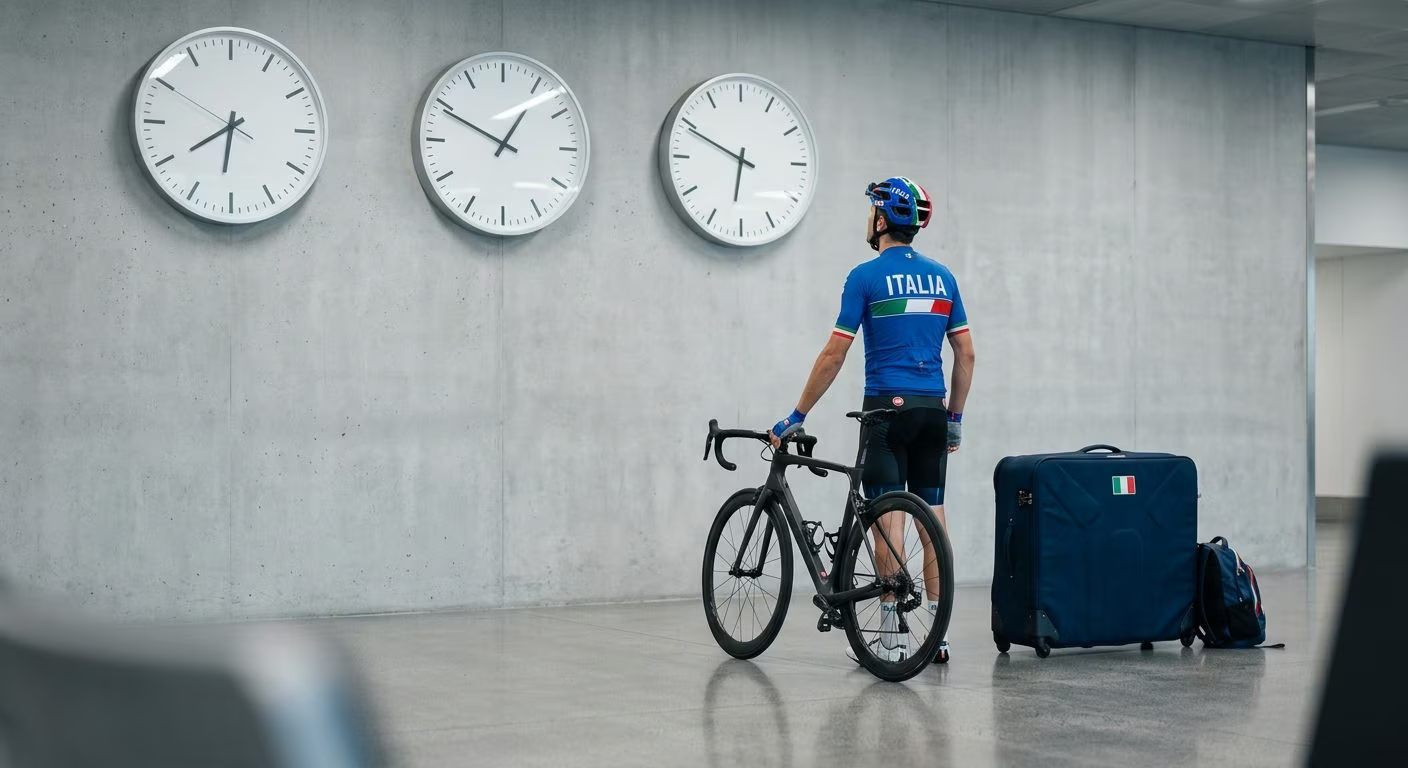
When a European team crosses the Atlantic to compete, they bring with them an internal clock that continues to show home time. At the Road Cycling World Championships in Montreal, from 20 to 27 September 2026, Italian athletes will have a six-hour time difference. The elite men’s road race will start on Sunday 27th at 9:00 local time and should end around 3:30 pm after over 270 km and this means that, for a runner not yet adapted to the time zone, that race will be run between 3:00 pm and 9:30 pm internal time.
In this case, jet lag risks being felt a lot, but it does not weigh equally in all directions. According to the U.S. Centers for Disease Control and Prevention’s time zone disorder guidelines, the body recovers an average of 1.5 hours a day going west and only 1 hour a day going east. Over six time zones that means about four days to readjust flying to America and six to return to Europe.
The body stays at home time: why traveling west is better than east
Jet lag is not simple travel fatigue, but a real misalignment between the internal clock and local time. Regulating our circadian rhythm is a small group of neurons in the hypothalamus, called the suprachiasmatic nucleus, which receives information from the retina and synchronizes every day with the alternation of light and dark. The point is that this clock, left to itself, does not run on exactly 24 hours but on a slightly longer cycle. When you cross multiple time zones in a few hours, the light arrives at the wrong time and it takes days for everything to get back into phase. In the meantime, sleep becomes misaligned, but so does hunger, digestion and body temperature.
Flying west lengthens the day, so it asks the body to go to sleep later. Flying east shortens it and requires you to fall asleep earlier. Considering that our clock already naturally tends to slip forward, lengthening the day is much easier than shortening it.
This was measured in a study that compared the effects of flying eastward and westward on several trained athletes, tested before and after two twenty-one-hour flights across eight time zones between Australia and Qatar. After the trip east, the athletes slept less, felt more tired and performed worse on running tests for at least three days. After the journey west, however, the values remained close to the starting ones.
In endurance sports, the internal time of the race counts: the effects of jet lag
In endurance sports, it’s not just how much sleep you sleep that counts, but also what time you compete inside. Over the course of the day, the body temperature fluctuates by about half a degree, with the minimum just before the usual awakening and the maximum in the late afternoon. When the temperature is higher the muscles are more reactive and the body produces power more easily. For this reason, an athlete’s physical performance tends to peak between 4 and 8 pm.
Then there is a second watch that closely concerns those who compete for hours. The liver, muscles and intestines also have their own rhythm, but it is not light that regulates it, but rather meal times. An athlete who eats at home while training at local times effectively keeps the two systems separate, and this affects the management of glycogen and therefore the moment in which the hunger crisis can arrive. It is also one of the reasons why intestinal disorders increase in races held shortly after an intercontinental flight.
What can happen at the World Cycling Championships in Montreal
For a non-adapted European runner, the road test on September 27th would begin at 3pm local time, i.e. in the middle of the high performance window, but it would arrive on the Mont Royal circuit, where the race will come to its heart, when the biological clock now shows 9pm and the body temperature is dropping. For an already readjusted runner, the opposite is true, because the finish falls in mid-afternoon, close to the moment of maximum efficiency. For this reason, some cyclists arrived in Canada well in advance, participating in the Quebec Cycling Grand Prix on September 11th and the Montreal Cycling Grand Prix on September 13th, and remained in Canada for the last block of pre-World Championship training.
American marathons and the apparent advantage
The same reasoning explains a situation that seems paradoxical. The New York Marathon sees the pros start at 9.05am local time, which to a non-adjusted European is 3.05pm. In Boston the departure corresponds to 3.30pm Italian time, in Chicago at 2.30pm. In all three cases, the European athlete runs a morning race, staying within the best afternoon window, while the local athlete, or one already accustomed to the time zone, competes at a less favorable internal time.
The advantage, however, has a price, which is paid the night before the race: a body still on European time has to sleep when internally it is four in the morning and wakes up very early in local time. The benefit of running close to peak thus risks being eroded by lost sleep, which remains the primary channel through which jet lag impairs performance. Towards the east the mathematics is reversed: the Tokyo marathon starts at 9:10 local time, which for an unadapted Italian is 1:10 at night, the worst time of the entire day. With eight time zones to make up for an hour a day, eight days of adjustment would be needed, a luxury that few calendars allow.
How to limit the damage
The most powerful tool is light, but its effect depends on when you receive it, because evening exposure delays the clock, while morning exposure advances it. Those who go west have an interest in looking for light in the local late afternoon, those who go east should do the opposite, with the real risk of moving the clock in the wrong direction if they get the timing wrong.
Meal times and the training itself also count, which in turn can move the clock depending on when it is carried out. Many teams begin to anticipate or postpone sleep times in the days before departure. However, for none of these strategies there is strong evidence of effectiveness collected on competing elite athletes, and this is probably why the most used countermeasure in top sport also remains the simplest: starting early.









