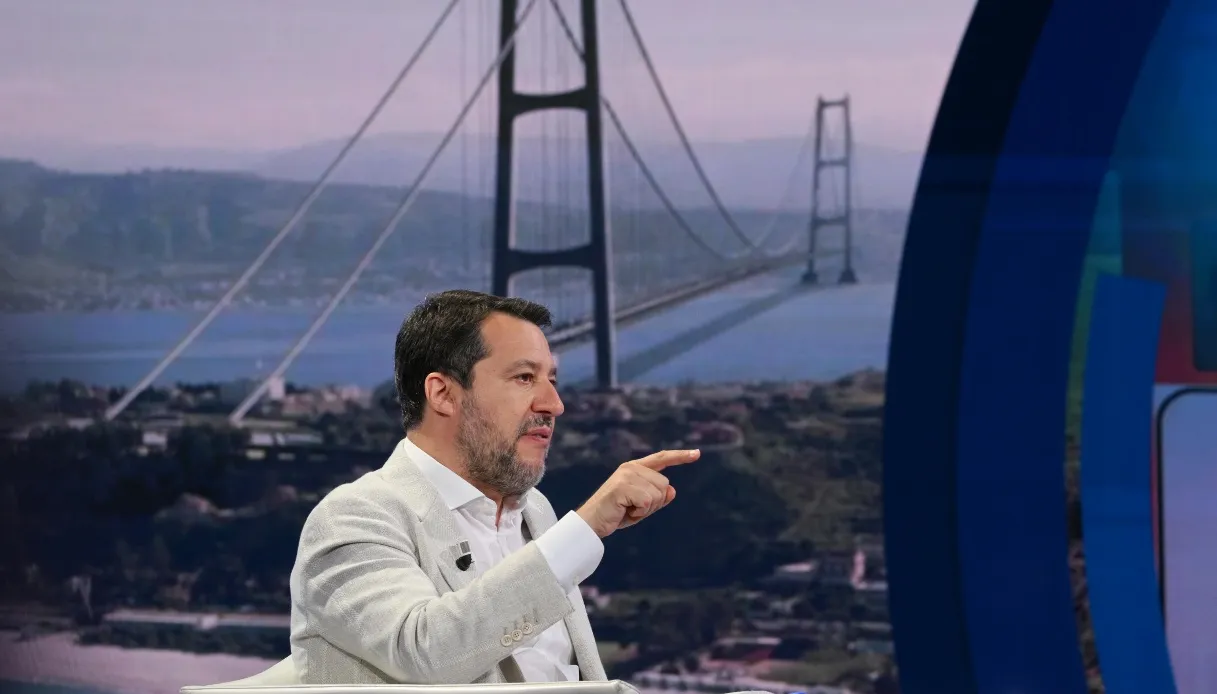
The Strait Bridge has been rejected again. The Transport Regulatory Authority has given a negative opinion on the economic-financial plan of the work, raising doubts about tariffs and tolls.
The new criticism increases the delay of the project. Now the Stretto di Messina company, which had received 12 million euros from the European Union for the design of the work, will have to return it due to the delays.
Bridge over the Strait: doubts about tariffs
The Strait Bridge encounters a new obstacle. While I am working to resolve the points raised by the Court of Auditors, a new rejection arrives. This time by the Transport Regulatory Authority which gave its opinion to the Ministry of Infrastructure on the toll rates for crossing the stable connection between Sicily and Calabria.
The Authority has raised the issue of the management costs of the work and maintains that the plan for the construction of the Bridge over the Strait of Messina, “although it can be considered adequate in the current phase of setting up and starting the project”, will require the introduction or strengthening of some safeguards.
To be considered economically self-sufficient, the infrastructure should be crossed by more than 10 million cars every year. According to government calculations, the management of ordinary and extraordinary maintenance would have been entirely covered by the tariffs.
How much will the toll cost?
It is the Minister of Transport Matteo Salvini himself who has hypothesized tariffs of around 10 euros per car. While the CEO of the Stretto di Messina company, Pietro Ciucci, had hypothesized tariffs between 4 and 10 euros.
Specifically:
- 4 euros for motorbikes;
- 7 euros for cars;
- 10 euros for trucks.
From what we read in the text, however, there should be tariff changes from 2034 to 2063. Thus emerges an average annual tariff per vehicle which in the first year of opening only will be 27.4 euros, and which will rise by 2% per year up to 48.7 euros in 2063.
The price change should be part of the economic-financial plan. According to the Authority, in fact, it cannot be considered a static tool, but must reflect actual costs, traffic forecasts, layout of the road and railway components and risk allocation. All factors that vary over time.
For Ciucci this is not a “slap”. The rate of 27.43 euros for vehicles, indicated by the Authority, is a weighted average between traffic volumes and rates for each type of vehicle, and not the cost of a single passage for cars.
In a note, in which he responds to the new rejection, he also explains that the tariffs for vehicular traffic:
guarantee the economic-financial balance of the concession and the full coverage of operating costs and ordinary and extraordinary maintenance during the period of operation of the Opera, while promoting territorial continuity between Sicily and Calabria with costs significantly lower than the current crossing tariffs.
The Bridge loses 12 million: sum returned
The financial statements of the Stretto di Messina company show the amount of 12 million euros in support, received from the European Union at the end of 2024, for the design of the bridge. Now this sum will have to be returned due to the delays accumulated by the infrastructure.
Angelo Bonelli, MP for Avs, commented on the restitution of the millions to the European Union by referring to the company’s framework. In fact, the balance sheet shows that out of 116 employees, 89 are managers or executives and only 27 are office workers.
Bonelli accuses the operational structure of being an “inverted pyramid paid for with public money”. But above all, hence also the sum to be returned, for not respecting the deadlines set for the design of the work.
Pietro Ciucci also responded to the criticisms. According to the CEO, the refund will be temporary. Declares that:
Taking into account the new timing for the start of the works, it was the Stretto di Messina company itself that started the procedure for requesting early termination.
A step that would allow the company to participate again in the next European tenders, taking into account that “the European judgments that had determined the victory with the highest scores in the 2024 tender remain completely unchanged”.