An artifact found in Antarctica, currently one of the places least rich in dinosaur fossils in the world, was identified in 1985: it is the first dinosaur fossil found in Antarctica. The environmental conditions and the limited exposure of the rocks due to the ice make these finds exceptionally rare. For this reason the description of a new sauropod fossil from 80 million years ago, published by Paul Barrett of the Natural History Museum in London and colleagues on Acta Palaeontologica Polonicarepresents an important contribution to the reconstruction of the continent’s fauna during the Cretaceous, whose climate was warmer than today. The discovery of the fossil dates back 40 years ago, but only today did confirmation arrive that it is a titanosaur.
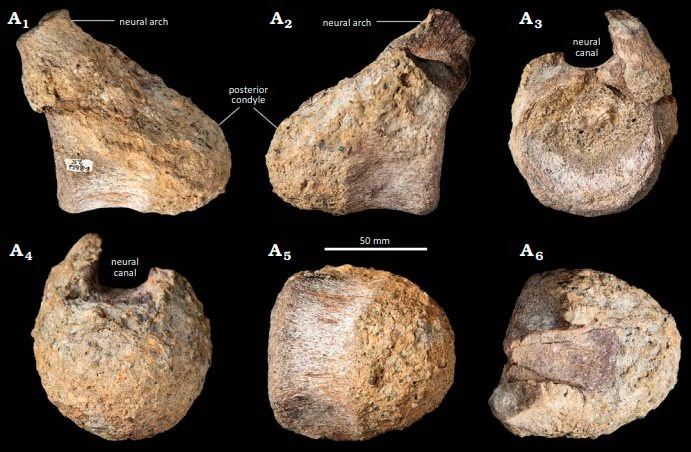
The find consists of a tail vertebra found on James Ross Island, off the Antarctic Peninsula, in rocks of the Santa Marta Formation dating back to about 80 million years ago, in the geological plane known as the Lower Campanian. Although the fossil had been collected as early as 1985 during an expedition of British Anctarctic Surveyhad never been described in detail until today. Anatomical analysis has made it possible to attribute the vertebra to titanosaurs, the group of long-necked herbivorous dinosaurs that dominated the terrestrial ecosystems of the southern hemisphere in the last million years of the Cretaceous. More precisely, the find belongs to a non-saltasaurid euthanosaur, a group that includes forms closely related to dinosaurs already known in Patagonia. The authors point out, however, that the fossil is too incomplete to assign it to a specific genus or species.
The size of the vertebra indicates that the animal was relatively small compared to the giant South American titanosaurs. It could be a young individual or a naturally small species, an aspect that cannot yet be clarified with certainty. The find, among other things, is also of particular importance from a historical point of view. It is in fact the first dinosaur fossil ever collected in Antarctica, even if its scientific description only arrives today.
The study also offers new insights into the paleobiogeography of Gondwana, the southern supercontinent. The fossil’s affinities with titanosaurs that lived in South America and, indirectly, with forms known in Australia suggest that during the Cretaceous, Antarctica was part of a network of terrestrial connections that allowed the dispersal of these large herbivores between the different southern continental masses. In a period in which the climate was much milder than today, the Antarctic continent therefore constituted a habitable environment also for sauropod dinosaurs.