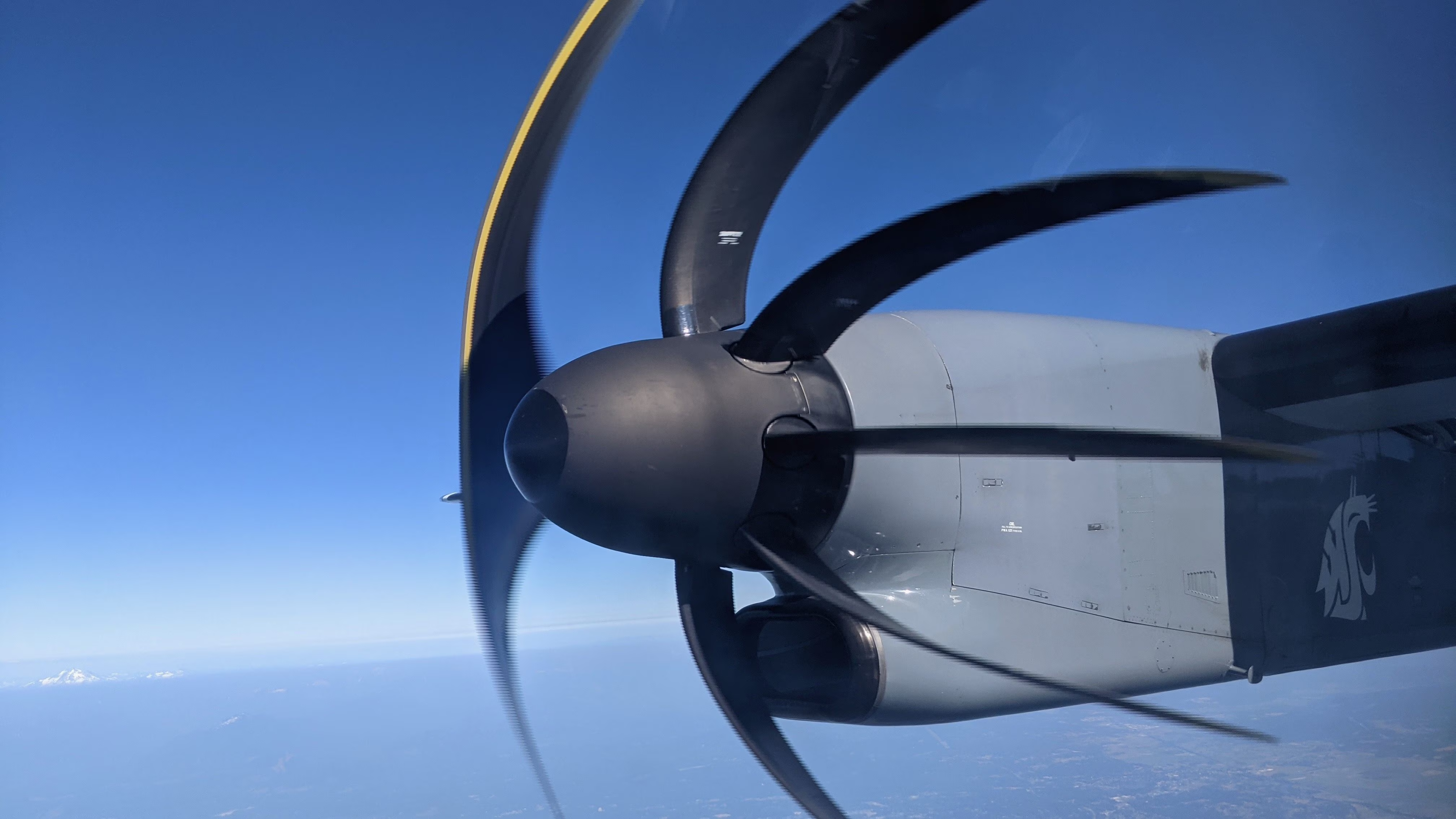
Who among us has never taken a photo from the window of a moving train and found ourselves with a strangely distorted image, in which the light poles appear to be tilted or the buildings appear bent as if they were made of rubber? This phenomenon has a precise name: rolling shutter.
This is an image distortion that occurs when the camera sensor – typically that of a smartphone – does not capture the entire scene in a single instant, but “scans” it progressively, usually from top to bottom. The result is that the different portions of the image are recorded at slightly different times. If in the meantime the camera or the framed subject is moving rapidly, what we see in the final photo is an image composed of slanting lines, of shapes that appear crooked, as if the reality captured by the camera had somehow been “stretched” laterally. This effect is very different from the classic photographic blur: it is not a blur, but a real geometric distortion of the image.
How the smartphone camera really works
To understand why this happens we need to recall some notions about the functioning of modern photographic sensors. Most modern smartphones and digital cameras use CMOS sensors configured with rolling shutter type reading, in which the image is acquired line by line. Rolling shutter is not an intrinsic characteristic of CMOS: there are also sensors (CMOS and, in the past, CCD) with global shutter.
When we are still and photograph something static, this progressive scanning does not cause any visible problems: the time differences between the reading of the first and last lines are so small as to be imperceptible. But when there is movement, both of the subject and of the camera itself, the situation changes radically. Let’s imagine filming the blades of a helicopter in flight: the blades rotate so quickly that, in the time it takes for the sensor to scan the frame from top to bottom, they are already in a completely different position compared to when the first row of pixels was read. The result is that the blades appear deformed, curved, almost liquid.
The same principle applies perfectly to the classic photo taken from the window of a moving train. While the vehicle runs on the tracks, the camera moves horizontally quickly. The upper lines of the sensor capture the landscape at a given moment, the lower ones capture it a fraction of a second later, when the camera has already moved. The result is a diagonal inclination of the image: the vertical elements of the landscape (poles, trees, buildings, etc.) appear bent forwards or backwards with respect to the direction of movement.
How to avoid this effect: the Global Shutter
There is a technical alternative that eliminates this problem: the global shutter, which exposes all the pixels of the sensor at exactly the same instant, like a traditional photographic shot. Cameras equipped with global shutter do not suffer from rolling shutter distortion, and for this reason they are widely used in professional fields such as sports shooting or high-speed cinema, as well as in traffic control cameras. Their main limitation has long been cost and some compromises in dynamic range and sensitivity, although newer technologies are rapidly reducing these differences.
It must be said that the rolling shutter is not always considered a defect. Some photographers and videomakers deliberately exploit it to create particular and surreal graphic effects, transforming what is a technical limit (at least on paper) into an expressive, artistic tool.