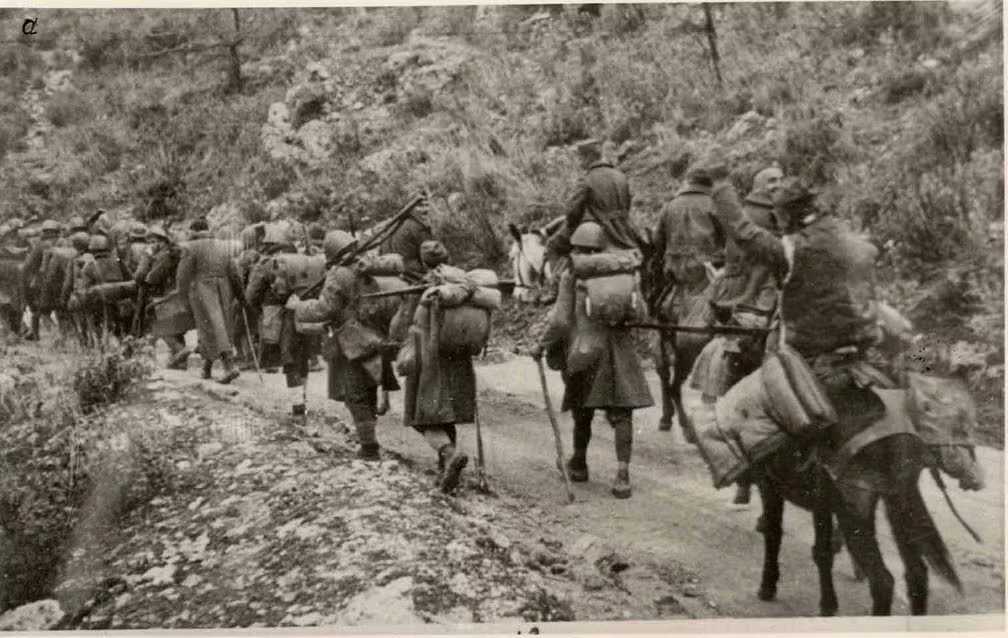
The Italian Greek campaign was a military operation conducted during World War II by fascist Italy. It lasted from 28 October 1940 to 23 April 1941. Mussolini ordered Italian troops to invade Greece because he was frustrated by Nazi Germany’s victories, which put him in the background compared to Hitler. The dictator expected an easy victory, but found himself faced with tenacious resistance from the Greeks. When Italian troops invaded Hellenic territory from Albania, the Greek army was able not only to resist, but also to counterattack and conquer a sector of Albanian territory. Greece was defeated in April 1941 by Germany, which intervened to save its ally. The defeat suffered by the Italian army in Greece demonstrated the failure of fascism: for twenty years the dictatorship had imposed the militarization of Italian society and had boasted of having transformed Italy into a great power: now it discovered that its warmongering propaganda had no foundation.
Italian-Greek relations and the reasons for the attack
In the interwar years, relations between Italy and Greece were relatively relaxed. After a diplomatic incident in 1923, relations had become cordial. In 1936, the dictator Ioannis Metaxas came to power in Greece and made no secret of his admiration for fascist Italy. On a diplomatic level, however, Greece was pursuing a pro-English policy.
In 1939, as we know, fascist Italy conquered Albania, thus finding itself bordering Greek territory, and in June 1940, it entered the Second World War alongside Nazi Germany. Mussolini had a strong envy of the successes that the Germans were achieving and imagined conducting a “parallel war”, that is, achieving his conquests without the direct involvement of Germany and without even informing Hitler of his moves. He began to evaluate the possibility of attacking Greece immediately after entering the war and unleashed a press campaign against the Hellenic country, taking the issue of Ciamuria (a Greek coastal region in which ethnic Albanian people lived) as a pretext.
The decision to attack Greece was made in October, after Nazi Germany stationed its troops in Romania without notifying Italy, creating further frustration for Mussolini. According to the diary of Foreign Minister Galeazzo Ciano, the dictator reacted in this way:
Hitler always confronts me with a fait accompli. This time I’ll pay him the same money: he will know from the newspapers that I occupied Greece. Thus the balance will be restored.
Military operations: the failure of fascist Italy
The attack was scheduled for October 28, the anniversary of the March on Rome. Two days earlier the Italian army staged a fake border incident, following which the government delivered a deliberately unacceptable ultimatum to Metaxas. Even before the ultimatum expired, Italian troops, led by General Visconti Prasca, invaded Greek territory from Albania.
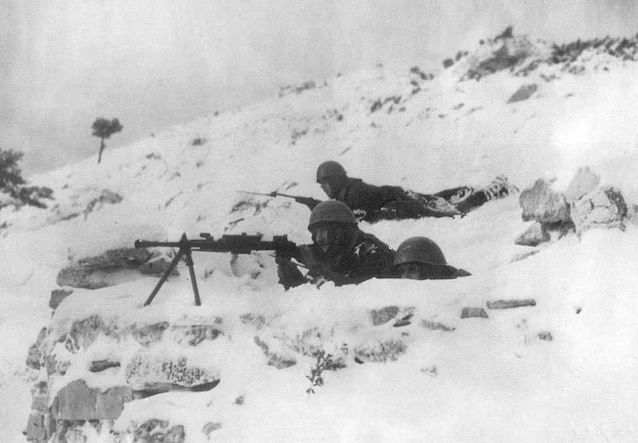
The plan called for a march through Epirus and arriving in Athens in a few weeks. It was supposed to be a triumphal march but the reality turned out to be very different. The Greek army, supported by English supplies, instead of falling apart showed great resistance: it was able not only to repel the Italian assault, but to counterattack and penetrate deeply into Albanian territory, occupying a vast swathe of territory.
For fascism and for Mussolini the humiliation was complete: throughout the twenty years of fascism he had imposed a militaristic education on the Italians and had boasted of having transformed them into a warrior people; now he discovered that “his” soldiers were unable to defeat even a very weak army like the Greek one. Italian soldiers were sent to die in a war conducted without an adequate plan and under the orders of generals not up to their role. It is no coincidence that one of the most poignant war songs is linked to the Greek campaign: On the Perati bridge.
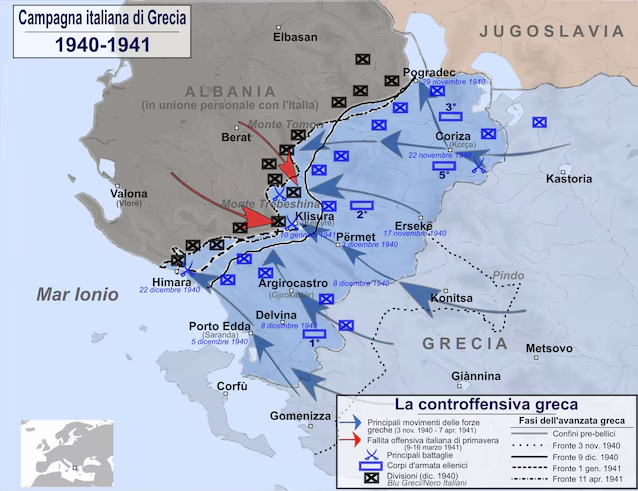
In November 1940, less than a month after the attack, fascist Italy found itself on the verge of having to ask for surrender. However, the Greek advance petered out and the front stabilized for a few months. At the head of the Italian troops Visconti Prasca was replaced first by General Soddu and then by General Geloso. The chief of general staff also changed: Pietro Badoglio was replaced by Ugo Cavallero.
The attack on Greece was judged very negatively by Hitler, who wanted to leave the Balkan Peninsula out of the conflict, at least immediately.
The German intervention and the Greek defeat
In 1941 Mussolini, also taking advantage of Metaxas’ death in January, still hoped to be able to reverse the humiliation he had suffered. In March he ordered the army to attempt a new offensive and personally went to Albania, hoping to witness a victory for “his” troops. However, he found himself faced with a new defeat, because the Greeks repelled the attack.
The situation was worsening and risked creating problems for Germany too. Hitler had realized that, before the attack on Russia, which he had already planned, he had to solve the problem created in the Balkans by his ally.
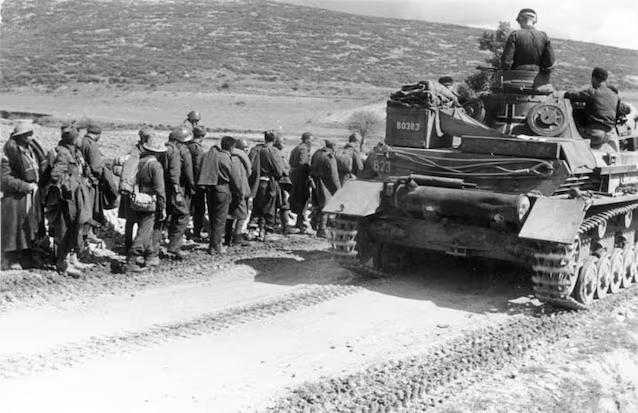
On April 6, German troops invaded Greece (as well as Yugoslavia), starting from Bulgaria and advancing rapidly towards Athens. The Italian army played no role in the advance. On April 21 the Greeks surrendered and two days later the armistice was signed. Hellenic territory was occupied by Italian, German and Bulgarian troops.
The meaning of the Italian Greek campaign
For Italy, the Greek campaign marked the end of the idea of parallel warfare. More generally, the defeat demonstrated all the limits of the fascist dictatorship, which instead of transforming Italy into a power, had led it to bitter humiliation.
For the Greeks, the resistance shown to the Italian invasion entered national mythology. Even today, October 28th is a national holiday, celebrated as Ochi Day, that is, the day of No, due to the negative response to the fascist ultimatum.