Taxes are necessary to make the state function and guarantee services to citizens. Think of healthcare, schools, roads, safety and many other services, which are only possible thanks to the financial contribution of citizens, which should be paid based on each person’s income. Not all taxes are equally perceived as useful, in particular indirect ones (i.e. not modulated based on income) which affect basic necessities and certain lifestyles.
In the history of Italy there are taxes that have been overcome over the years, but which tell a lot about our history, either because they are particularly hateful or because they are “curious”. Let’s examine the taxes on mill, celibacy and playing cards.
- 1The tax on ground coffee
- 2The celibacy tax
- 3The tax on playing cards
The ground tax
The tax on grist was introduced in 1868 and came into force from January 1 of the following year. You paid when you brought grains and other products to the mills for grinding. After the introduction of the tax, all mills had to be equipped with a counter that counted how many revolutions the millstones made. When a person brought produce for milling, the miller kept both the milling cost money and the tax money. The amount varied depending on the product being ground: from fifty cents per quintal for chestnuts, to two lire per quintal for wheat. The tax also affected cereals imported from abroad.
The tax on mince was, in essence, a tax on bread, the price of which, not surprisingly, increased significantly. If we consider that nineteenth-century Italy was a poor country, in which large sections of the population lived in conditions of poverty and could only eat inexpensive foods, such as bread, it is clear that the tax was particularly hated. It was called the “poverty tax” or “hunger tax” precisely because it had the most severe effects on the poorest citizens.
The tax was introduced at the behest of the historic Right – the political faction that governed Italy from 1861 to 1876 – with the aim of restoring public finances and achieving a “balanced budget”, that is, ensuring that state revenues were equal to or greater than expenditure. The tax caused discontent throughout the country and in several regions was the origin of protests and popular uprisings. The tax was abolished, in successive phases, by the historic Left, which came to power in 1876: the governments of the Left first reduced the amount and in 1884 abolished the tax completely.
The celibacy tax
During the fascist regime, unmarried men had to pay a special tax: the celibacy tax. The tax, introduced in 1927, affected male citizens aged between 25 and 65 (with the exclusion of priests and some other categories), who, if they had not contracted a regular marriage, were required to pay an annual tax. You paid both a fixed fee (70 lire up to 35 years; 100 lire from 36 to 50 years; 50 lire from 51 to 65 years), and a variable supplementary contribution based on income. The amount was increased twice, in 1934 and 1937.
The tax was introduced with the aim of encouraging men to marry and have children, based on the idea, widespread in the years between the two world wars, according to which a state is stronger the more its citizens are. The tax weighed only on men because, according to the prevailing mentality at the time, only they could have uncertainties about marriage and choose whether to marry or not; women, it was believed, longed to get married and regarded marriage as an unavoidable goal. Furthermore, the tax was proof of the totalitarian aspirations of fascism, which claimed to interfere in the private sphere of citizens and decide how they should live.
The tax on celibacy was not enough to reverse the demographic trend and stop the decline in average fertility (i.e. the number of children per woman), caused by social changes and the slow, but unstoppable, modernization of the country: the rate went from 3.64 children per woman in 1926 to 3.07 children in 1939, to further decrease during the Second World War. The celibacy tax was abolished in 1943, after the fall of the fascist regime.
The tax on playing cards
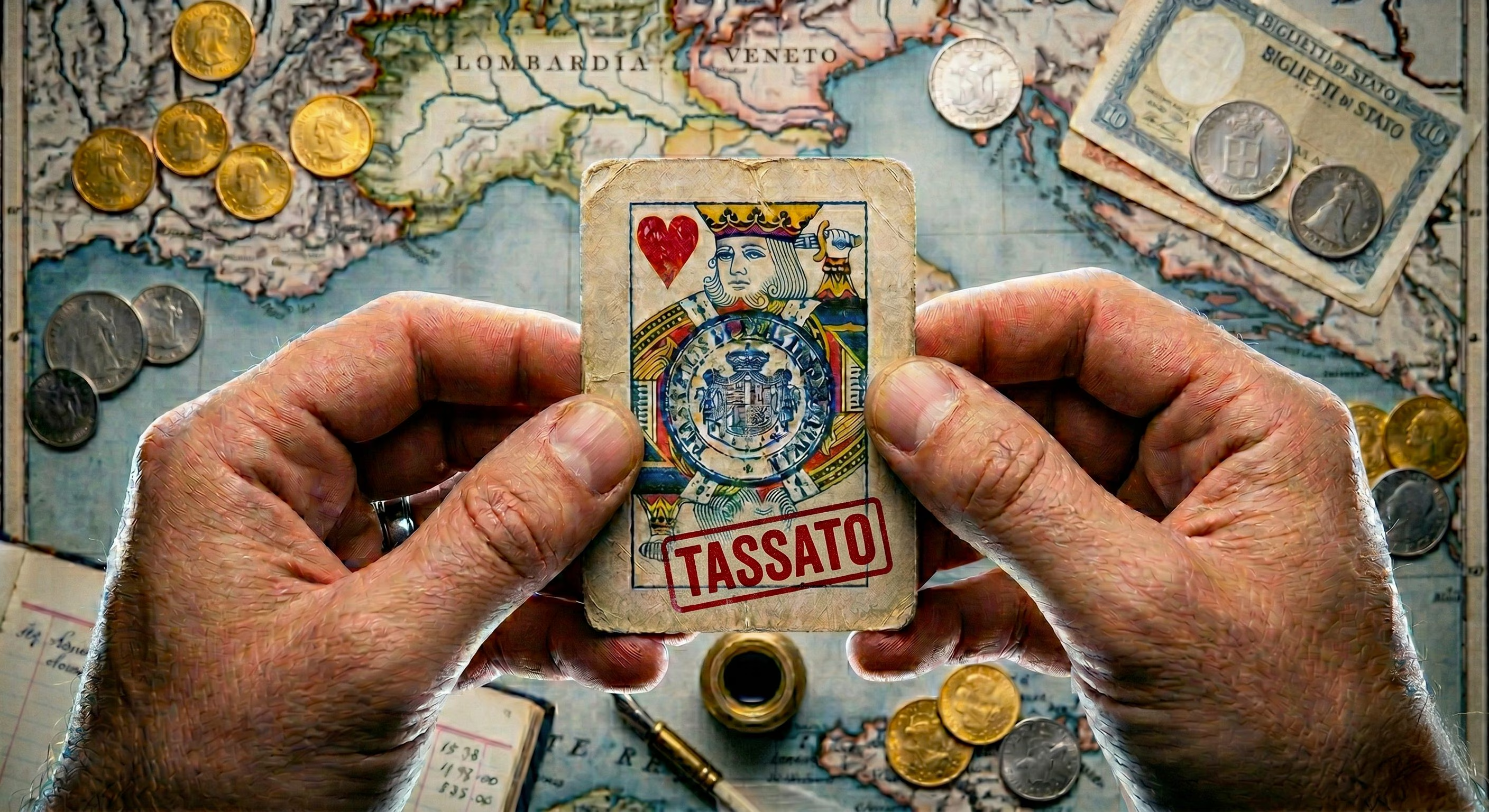
For more than a century, Italy has had a tax on playing cards. The reason is the following: gaming was considered a “suspicious” activity, due to the possible degeneration into gambling, and the institutions believed that it was right to discourage it, making those who played and those who produced the materials and profited from them pay a tax. In all pre-unification Italian states a tax was therefore foreseen. There were two systems for collecting it: in some cases, the institutions sold the watermarked paper required to make the cards at a higher price (it was illegal to make them with non-watermarked paper); in other cases, producers paid the State a specific tax for each deck they produced and, to prove payment, a stamp was placed on one of the cards. The latter system was adopted by the unified Kingdom of Italy: in 1862 it was established that the tax amounted to 0.30 lire for each deck of up to 52 cards; at 0.50 lire for decks with a greater number of cards. The stamp was placed on the ace of hearts in French cards, on the ace of coins in Neapolitan ones.
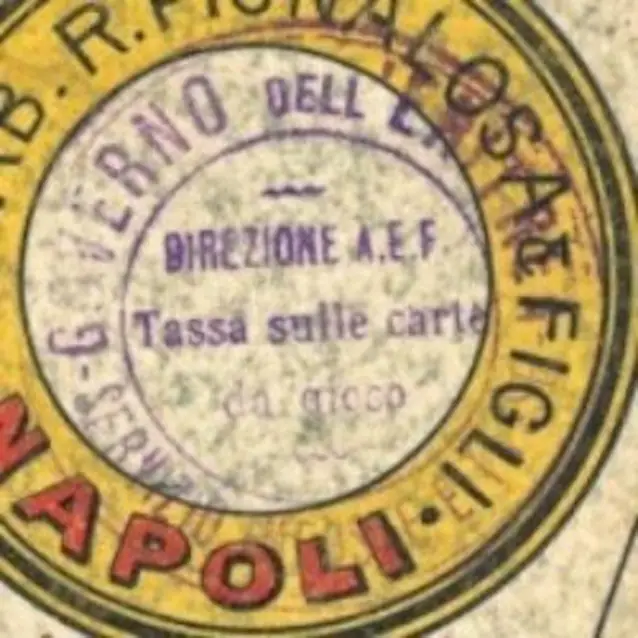
The law was updated several times, also to combat the frequent counterfeiting of the stamp, until 1972, when it was abolished. Since then, the production and trade of playing cards have not been subject to specific taxation.