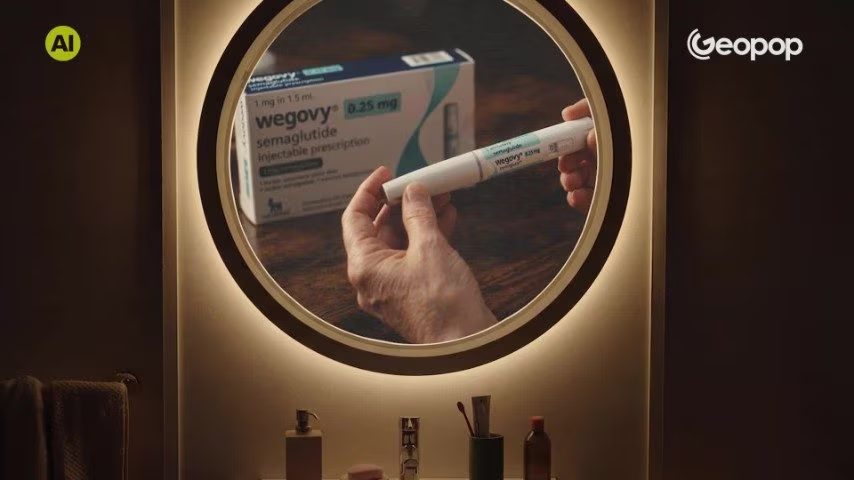
It is not a deception and artificial intelligence has nothing to do with it. We are talking about a drug created to treat type 2 diabetes, but which today has become the object of global desire for another purpose: fast weight loss. It is the GLP-1R agonist known commercially as Ozempic®. But this is not just a pharmaceutical story, it is the story of how our relationship with the body, food and beauty standards is changing. It’s a story about who has the money to afford thinness and who doesn’t. And, ultimately, it concerns us all.
Between viral trends on TikTok and an increase in prescriptions off-label (i.e. for indications other than those approved) there are risks to health and society. It is essential not to reduce everything to a social scandal. Obesity is a complex chronic diseaseoften not solvable with diet and gym alone for metabolic and genetic reasons. According to the WHO, one in eight people in the world suffers from obesity (in Europe the figure rises to 60%). For these patients, GLP-1 drugs are revolutionary tools: they reduce cardiovascular risk and concretely improve the quality of life. The problem, therefore, is not the drug itself, but its abuse in purely aesthetic contexts.
To learn more about the mechanism of action, history and side effects of these drugs from a scientific point of view, we have dedicated an ad hoc article which you can find at this link.
Attention: This article is for informational purposes only. For any medical information it is essential to contact your doctor.
What is GLP-1, what is it for and how Ozempic was born
GLP-1 (Glucagon-Like Peptide-1) is a hormone that our intestines naturally produce every time we eat. Its job is to regulate glycemia (blood sugar level), stimulate insulin production and send a satiety signal to the brain. In people with type 2 diabetes, the blood sugar regulation mechanism does not work as it should. For this reason, researchers from the Danish pharmaceutical company Novo Nordisk have developed semaglutide, a molecule that mimics the action of natural GLP-1 but lasts much longer in the body, requiring only one weekly injection. Ozempic was therefore born as a treatment for diabetics. And it works very well. Then, however, the unexpected happens.
Doctors noticed that diabetic patients treated with semaglutide lost a lot of weight, almost automatically. How come? GLP-1 also affects areas of the brain that regulate appetite and reward. It doesn’t just slow down the emptying of the stomach but lowers interest in food. Turns off what in English is called “food noise“, which is the constant background noise of thoughts about food, cravings and guilt. The result is that you ingest fewer calories, without conscious effort.
In clinical trials, with high-dose semaglutide – the one marketed as Wegovy®specific for obesity – we are talking about an average reduction of 15-20% in body weight. For a 100 kg person, we are talking about 15-20 kilos in a year.
Ozempic is not alone. An entire family of drugs was born around semaglutide and similar molecules:
- Ozempic® and Wegovy® (Novo Nordisk): same molecule (semaglutide). The first approved for diabetes, the second for obesity.
- Rybelsus®: semaglutide in oral tablets.
- Mounjaro® and Zepbound® (Eli Lilly): they use tirzepatide, which works on two receptors simultaneously (GLP-1 and GIP), offering even more marked results in some studies
This is a huge pharmaceutical competition, where every new piece of data moves billions of dollars on the stock market.
The “Ozempic Face” phenomenon: the hollowed faces of Hollywood stars
If these drugs were created for specific pathologies, how did they end up on social media around the world? The answer lies in prescription off-labela legal medical practice (also in Italy) that allows a specialist to prescribe a drug for indications other than those approved, at the expense of the patient.
The cost? In Italy a pack of Ozempic costs between 120 and 180 euros; in the United States it exceeds 1,000 dollars. The real problem emerges when the drug is used without continuous medical supervision, for aesthetic purposes only. On TikTok, videos with the hashtag #ozempic have generated millions of views. The “before and afters” are very popular, while very little is said about the side effects. Even celebrities have played their part: from Oprah Winfrey to Serena Williams, up to the suspicions over Kim Kardashian (who appeared 7 kg thinner in three weeks at the 2022 Met Gala). An implicit and very powerful advertisement.
Like any drug, it is not without risks. The most common side effects are gastrointestinal (nausea, vomiting, diarrhea). Rarer and more serious ones include pancreatitis and hypoglycemia. In the USA, between 2022 and 2023, there were 25 thousand emergency room visits linked to semaglutide.
Then there is the phenomenon of“Ozempic FacAnd”: faces hollowed out and suddenly aged. It is not a chemical reaction, but the mechanical effect of too fast weight loss which empties the skin of structural fat, causing it to lose tone and elasticity. Also, what happens if you quit? Studies show that, one year after suspension (which often occurs due to high costs), on average, 60% of the weight lost is recovered. A devastating psychological repercussion.
The situation in Italy still sees lower public awareness than in the USA, but the prescriptions off-label they are on the rise. And when prices drop with the arrival of generics, access will expand dramatically. This scenario leaves us with a profound question. If losing weight became cheap, simple and effective for everyone, the Body Positivity would it be definitively archived? And, above all, if one injection a week is enough to conform to aesthetic standards… who will establish what the limit is to stop wanting to be thinner and thinner?