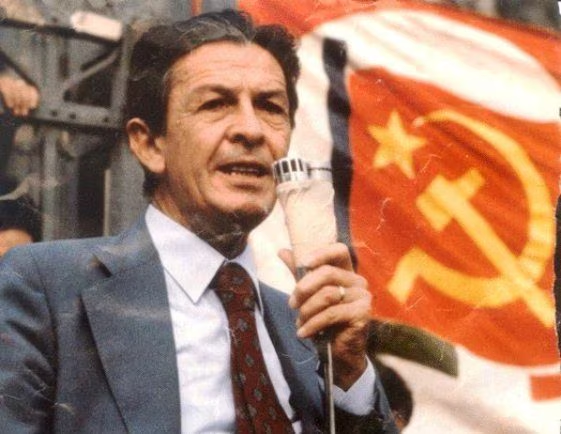
Enrico Berlinguer, born in Sassari on 25 May 1922 and died in Padua in 1984 due to a cerebral hemorrhage, was an Italian communist political leader.
After spending his childhood and adolescence in Sardinia, where he was active in local anti-fascist movements, he moved to Rome in 1944 to work as an official of the Italian Communist Party (PCI) of which he was a member. He quickly rose through the ranks of the party and was its national secretary from 1972 until his sudden death on 11 June 1984 and caused by the consequences of a stroke that struck him a few days earlier, on 7 June, during a rally in Padua.
Among the most important leaders of the twentieth century, he stood out as a promoter of historical compromise and Eurocommunism, claiming the autonomy of the PCI from the Soviet Union. He achieved great electoral successes, significantly increasing the PCI’s consensus, and was a member of the Chamber of Deputies of the Italian Republic.
Biography of Enrico Berlinguer: birth and education
Enrico Berlinguer was born in Sassari on 25 May 1922 into a very prominent family. His father, Mario Berlinguer, was an anti-fascist with liberal-socialist ideas and would become a senator and deputy after the Second World War. On his mother’s side, Enrico was related to Francesco Cossiga, future President of the Republic.
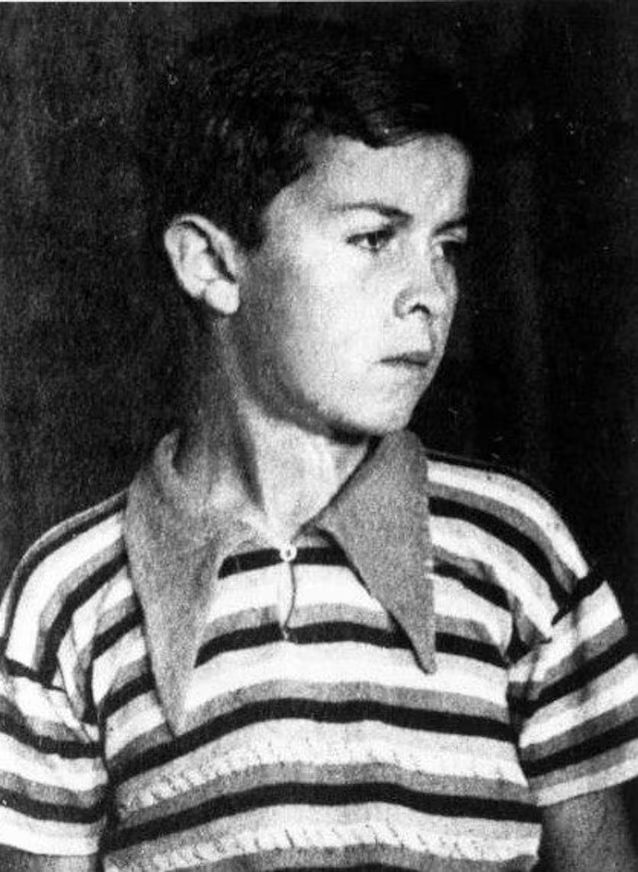
As a teenager, Berlinguer studied in Sassari, where he obtained his classical high school diploma in 1940. He later enrolled in the Faculty of Law, but abandoned his studies without obtaining a degree to dedicate himself entirely to political activity: in fact, he developed anti-fascist and communist ideas very early. In 1943 he joined the Sassari section of the PCI. The following year he was arrested and detained for four months as a promoter of popular demonstrations for bread.
In 1944 he met Palmiro Togliatti, secretary of the PCI, and obtained a job as an official of the party’s youth federation. He therefore left Sardinia and moved to Rome. From an ideological point of view, he supported the idea of progressive democracy, proposed by Togliatti, i.e. imagining that socialism in Italy had to be established through democratic means.
Career in the Italian Communist Party
Berlinguer soon stood out for his qualities and quickly rose through the ranks of the party. In 1947 he visited the Soviet Union for the first time and two years later was elected secretary of the Communist Youth Federation.
He held the position until 1956. The following year he married Letizia Laurenti, with whom he had four children.
After his marriage his political career continued. In 1958 he became part of the national secretariat of the party and had the opportunity to work alongside Togliatti until the latter’s death in 1964. In 1968 he was elected deputy for the first time: running as a candidate in the Rome constituency, he achieved great personal success, collecting over 150,000 preferences. He will remain in the Chamber until his death, being elected in all the electoral consultations with great consensus.
In the PCI he assumed an intermediate position between the two tendencies that emerged after Togliatti’s death: that of the right, headed by Giorgio Amendola, and that of the left, led by Pietro Ingrao. Berlinguer, without taking a clear position, acted as a mediator between the two groups. In 1968, when the Soviet Union and the other Warsaw Pact countries invaded Czechoslovakia, he had no scruples in expressing explicit criticism of the invasion, rejecting “the concept that there can be a single model of socialist society valid for all situations”.
Berlinguer secretary of the PCI and the historic compromise
In 1972, the XIII congress of the PCI elected Enrico Berlinguer national secretary in place of Luigi Longo.
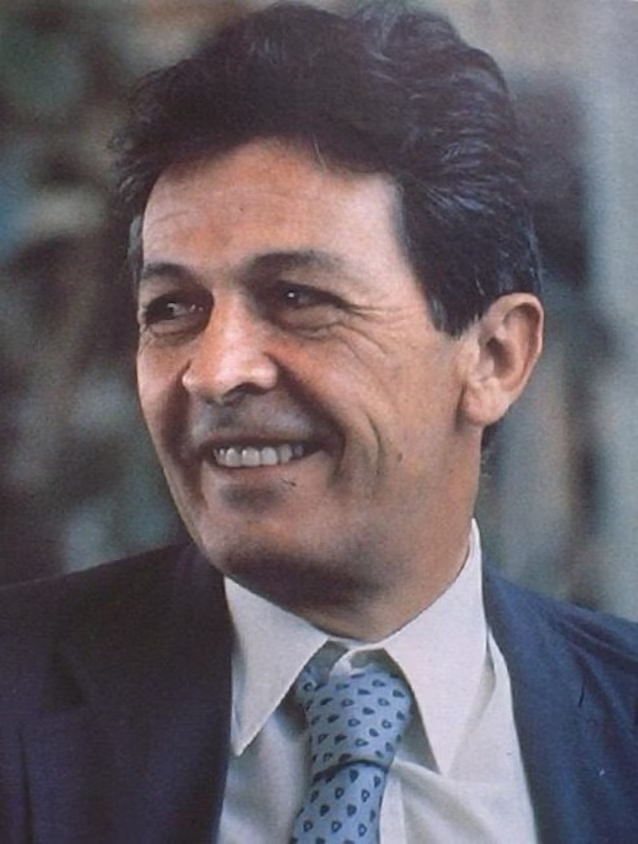
The following year the secretary proposed an innovative idea: the historical compromise. Until then the PCI had always been in opposition, while the government was made up of the Christian Democrats and some minor parties, including, since the 1960s, the socialist one. The communists had always hoped to come to government by winning the elections and taking over from the DC.
Berlinguer, reversing this line, put forward the thesis according to which the democratic forces had to unite to govern the country together, therefore proposing that the communists enter the governments led by the DC. The secretary had realised, after the coup d’état in Chile in 1973, that the United States would never allow communists to govern in Italy and thought it was necessary to seek an agreement with the other political forces. The idea found the support of one of the most prominent Christian Democratic leaders, Aldo Moro.
The historic compromise was not fully realized and the communists never entered the government, but between 1976 and 1979 the PCI supported (or, at least, did not oppose) the executives led by the DC. The “national solidarity” governments, also thanks to the support of the communists, approved important reforms and the voters rewarded the PCI’s new strategy, which significantly increased its support in the elections. In 1979, after the kidnapping and death of Moro, the experience of national solidarity ended and the PCI returned to opposition.
The separation from the Soviet Union and Eurocommunism
As the years passed, Berlinguer accentuated the PCI’s distance from the Soviet Union. Together with the communist parties of Spain and France he launched the proposal of Eurocommunism, that is, the idea according to which communism had to take democratic forms in Western European countries. From the end of the 1970s he renounced the funding that the USSR paid to the PCI (but the Soviets continued to finance the branch of the party closest to Moscow). In 1982 he had no scruples in declaring that the “driving force” of the October Revolution had exhausted itself.
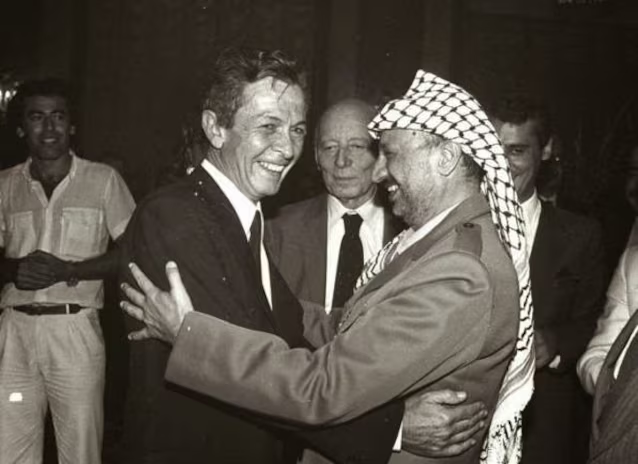
At the same time, Berlinguer relaunched the PCIi’s commitment to social struggles. In 1980 he personally went to the Fiat gates to bring support to the striking workers. He also supported the claims of the peoples of the South of the world and the Palestinian cause, cultivating close relations with President Yasser Arafat.
Death and funerals: what happened
Berlinguer died suddenly in 1984. On 7 June, while he was holding a rally in Padua, in Piazza della Frutta, as part of the electoral campaign for the European elections, he suffered a stroke – despite the signs, visible in the video of his last public appearance on stage, he wanted to finish his speech before falling into an irreversible coma. Taken to hospital, he died on 11 June. The body was brought to Rome by the President of the Republic, Sandro Pertini, on the presidential plane. The funeral, held on the 13th, turned into a large popular demonstration, in which more than a million people took part, including numerous representatives of foreign institutions and political leaders.