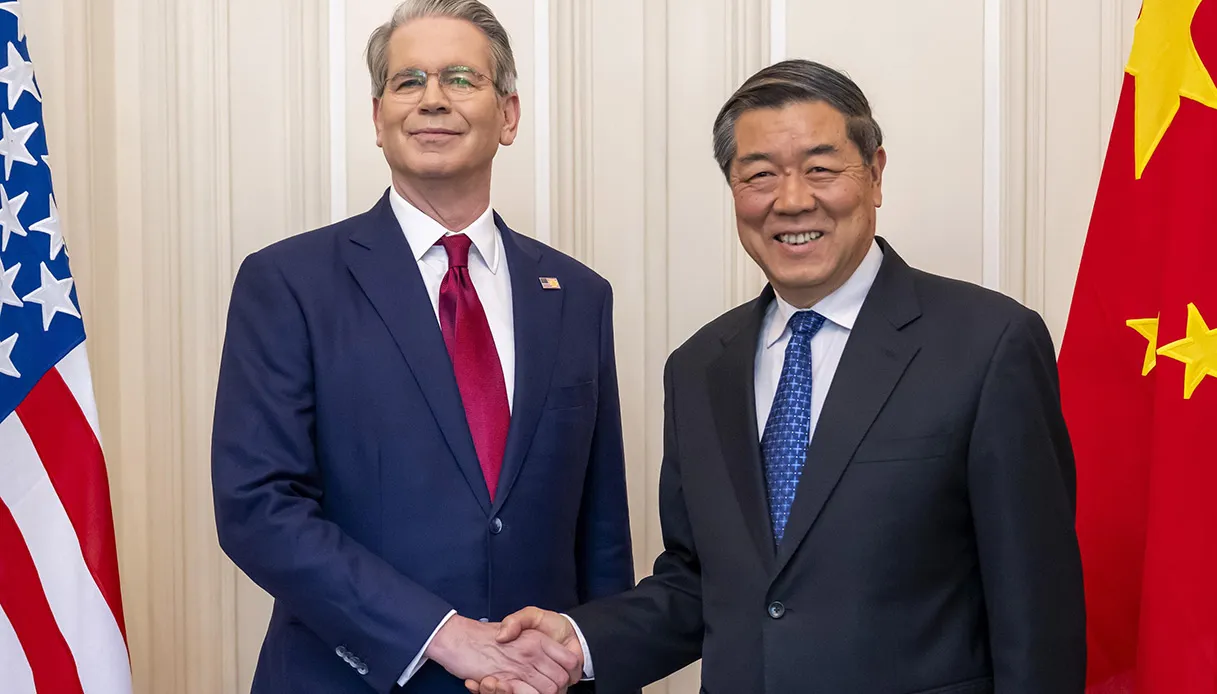
The United States and China keep the dialogue open, but the trade turning point has not yet arrived. The New York talks between the US Treasury Secretary Scott Bessent and the Chinese vice prime minister He Lifeng prepared the September 24 summit between Donald Trump and Xi Jinping without producing, at least for now, a definitive agreement on tariffs and strategic supplies.
Asian stock markets are moving mainly upwards, supported by the demand for semiconductors linked to artificial intelligence and the decline in oil prices. The movement should not, therefore, be read as an unconditional approval of the negotiations.
The most significant political-financial signal comes, however, from yuan, which rose to around 6.696 per dollar: the strongest level since January 2023. China thus presents itself at the meeting in Washington with a stable currency and an export machine that, despite the tariffs, continues to grind out results.
What Bessent and He Lifeng decided
The two delegations described the discussion as frank, in-depth and constructive. However, the diplomatic formula does not hide the essential fact: a comprehensive agreement has not been announced.
Washington has put forward a proposal to create a mutual notification mechanism on AI-related incidents that could have consequences for national security. The channel should allow the two major technological powers to discuss cyber attacks, strategic infrastructure and possible military uses of AI.
On trade, the United States and China intend to make the Board of Trade, a technical table already outlined in previous meetings. The objective is to evaluate a possible reduction in duties on products not considered strategic.
Chinese consumer goods and, in the opposite direction, American energy, agricultural products and medical devices could be included in the negotiation.
However, the most delicate dossiers remain open:
- Chinese exports of rare earths and magnets
- American restrictions on advanced semiconductors
- Chinese purchases of US agricultural products
- possible orders for Boeing aircraft
- duration of the trade truce expiring in November
- relationships between economic security, Taiwan and technology.
The absence of new retaliations reduces the immediate risk, but does not equate to a normalization of relations.
Asian stock markets, what’s happening
The first reaction of the markets is positive, even if some lists are still open and values may change before closing.
| Market | Morning indication | Dominant factor |
|---|---|---|
| South Korea – Kospi | Approximately +1.5% | Chips, memories and AI-related questions |
| Mainland China – CSI 300 | Approximately +0.6% | Strong Yuan and lower trade risk |
| Hong Kong – Hang Seng | Negotiations in progress | Chinese technology, internet and foreign flows |
| Japan – Nikkei | Bag closed | Futures up about 0.5% |
| Asia-Pacific excluding Japan | Approximately +0.8% | Technology and oil on the decline |
The Tokyo Stock Exchange is not open for the Silver Week holiday. The rise in Nikkei futures is an indication, not regular session performance.
In Hong Kong the Hang Seng remains particularly sensitive to large internet and technology groups. In mainland China, however, the CSI 300 includes a more substantial presence of banks, industry and state-owned companies.
The surprise is China’s commercial strength
The summit does not come in a phase of weakness in negotiations for Beijing. China’s trade surplus is headed for a second consecutive year above one trillion dollars.
Additionally, more than half of the approximately 6,500 product categories exported from China to the United States in early 2026 saw higher volumes than the previous year. The tariffs have changed the routes and composition of trade, but have not stopped China’s export capacity.
Part of the goods passes through intermediate countries; other productions were moved to Southeast Asia. Beijing has also expanded its presence in Europe and emerging markets.
For Italian companies this means greater competition on international markets and the risk of an increase in Chinese exports to Europe if access to the United States becomes more difficult. It is the mechanism associated with dumping and import dependence.
Yuan at its highest, because it’s important
China’s central bank set the reference exchange rate at the strongest level since February 2023, showing less resistance to currency appreciation.
A stronger currency can help create a financial climate conducive to negotiation and reduce American accusations of competitive devaluation. However, it does not prove that Beijing wants to initiate a permanent reassessment.
The value of a currency depends on rates, inflation, market demand and economic policy decisions.
Rare earths, the problem remains unsolved
No specific progress on rare earths emerged from the talks. The dossier remains crucial for electric cars, turbines, electronics, robotics, defense and semiconductors.
The Chinese advantage is not limited to extraction. Beijing mainly controls the activities of separation, refining and production of magnets. A mine located outside China may, therefore, equally depend on Chinese facilities to transform the ore into a usable component.
What changes for European investors
Even those who do not own Chinese stocks can be exposed to the US-China clash. A global portfolio can include American technology, Asian semiconductors, European automakers, and mining companies.
In the short term, a longer reprieve could support chip, auto, luxury and industrial stocks. A new crackdown on rare earths would, however, increase volatility and put pressure on companies with limited supplies.
Gold stays around 4,380 dollars per ounce, held back by the increase in American yields, while Brent lost around 2%, although remaining above 100 dollars. These are movements also influenced by monetary policy and the Middle East, not just China.
The conclusion is, therefore, more prudent than that suggested by the rise in the stock markets: the talks avoided an immediate escalation, but did not remove the causes of the dispute. The Trump-Xi summit will have to clarify whether détente can be transformed into verifiable concessions or will only remain a truce useful to both powers.









