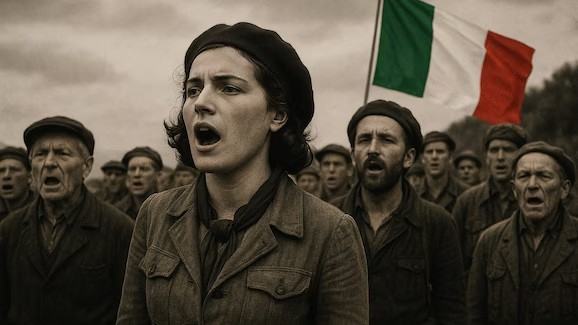
The ANPI is an association of citizens who intend to protect the memory of the Resistance and support the application of the Constitution. There are approximately 170,000 people active within it, of whom only a few fought in the war of liberation in 1943-45. Since 2006, in fact, the ANPI has also opened registration to those who, despite not having fought, share the principles and values of anti-fascism. The partisans, who for age reasons are disappearing, have in a certain sense “delegated” other people to continue their battles for the protection of the memory of the Resistance and for the application of the Constitution. ANPI has existed since 1944 and has always been active since then. It is mistakenly considered a left-wing association, but in reality it is open to anyone who declares themselves democratic and anti-fascist.
What is ANPI and who can have the card today
The National Association of Partisans of Italy is a partnership that fights to preserve the memory of the Resistance and to support the principles that animated it. The ANPI is therefore committed to defending the Constitution of the Republic which, having been written by anti-fascist political exponents and former partisans, is considered the most important legacy of the Resistance.
To pursue its aims, ANPI organizes activities at both a national and local level, through provincial committees and territorial sections present throughout the country.
In the past, membership was open only to those who had been part of the partisan formations during the Second World War, but since 2006, membership has been open to all those who recognize the values and principles of the Resistance. There are currently around 170,000 members (2025 data).
ANPI is financed mainly through membership and with the contribution of members and supporters, who can pay 5 per thousand of their personal income tax to the Association. As an association recognized as a moral body, it also receives contributions from public bodies.
History of the association born before the end of the war
The ANPI was founded in Rome on 6 June 1944, two days after the city was liberated from Nazi occupation, on the initiative of the partisans who had taken part in the fight for the liberation of the city. In 1945, when the rest of Italy was liberated from occupation and fascism, an Upper Italy committee was born and the ANPI became a national association.
The aims of the Association were multiple: to prevent the return of forms of dictatorship such as the fascist one, to bring the voice of the partisans into the development of public policies; help former partisans who were looking for work.
The ANPI immediately became an important player on the public scene and obtained the right to appoint 16 members of the National Council (a sort of Parliament, which existed from 1945 to 1946). In the following years she was active in the defense of the partisans who were put on trial for their actions during the Resistance. In 1947 it celebrated the first national congress, during which Arrigo Boldrini was elected president: he had been one of the leaders of the Resistance in Emilia Romagna with the nom de guerre of Bulow and would remain in office until 2006.
Originally the ANPI brought together all the partisans but between 1948 and 1949 it underwent a split between exponents of the Catholic and liberal-socialist areas, who gave birth respectively to the Italian Federation of Volunteers of Freedom and the Italian Federation of Partisan Associations. The split was due to the fact that, although all the anti-fascist forces had led the Resistance together, the Cold War had caused irreparable fractures between the political forces (in the same period, a similar split occurred in the trade union sphere, because the CISL and UIL separated from the CGIL). In the ANPI, above all, the partisans linked to the Communist Party and the Socialist Party remained: since they had been the most numerous in the Resistance, the ANPI was the association with the largest number of members.
In the following years, the Association was active in the political debate and in 1952 it founded its own periodical, Patria Ineditore, which still exists today. Over the years, the ANPI has stood up for peace, against rearmament, against Franco’s Spain, for the protection of the Constitution. It obtained an important result in 1958, when the Volunteer Corps of Freedom (the “army” that brought together the partisans) was recognized as a corps belonging to the Armed Forces. In 1978 one of the honorary presidents of the Association, Sandro Pertini, was elected President of the Republic.
Because today there is an association of partisans
As time passed, the number of partisans, for natural reasons, progressively decreased. ANPI was destined to disappear. His disappearance would have been a problem because, as the years pass, memory inevitably fades. The importance of liberation from the fascist dictatorship and Nazi occupation would have been perceived with ever less intensity, with the risk that similar forms of oppression could recur, albeit in a new form.
To help avoid this danger, in 2006 the partisans decided to admit into the ANPI even those who had not fought in the war of liberation, having been born later, but who shared its spirit and values. The partisans, in other words, entrusted to other people the protection of the memory of the Resistance and the defense of its principles: a move not sufficient to completely avoid the danger of the return of fascism, but which allowed the creation of another democratic “antibody”.
Therefore, although the fighting partisans had decreased, the ANPI was able to continue its activities. In recent years, she has been responsible for organizing the celebrations of April 25th throughout the country, has actively participated in the campaigns for the No referendum on the Constitution in 2006, in 2016 and has promoted numerous other initiatives. In recent times she has been particularly involved in initiatives against the genocide in Palestine, for the No vote in the 2026 referendum on justice and for the defense of peace.
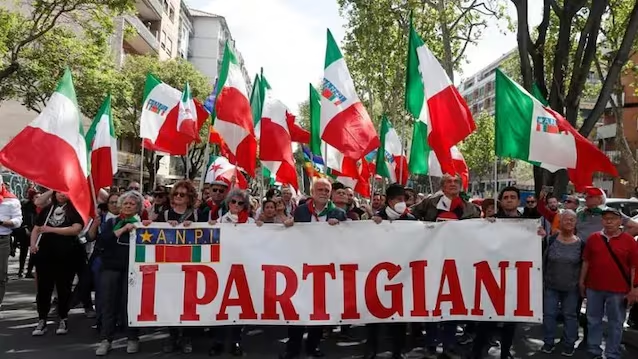
The ANPI has also been involved in controversies due to some positions expressed by the national secretariat, such as those taken on the war between Russia and Ukraine, and in some cases it has been affected by internal conflicts. It is often perceived as a left-wing political party and is actually made up of a majority of people with progressive ideas. The Association, however, is not a political party and is open to anyone who considers themselves anti-fascist.