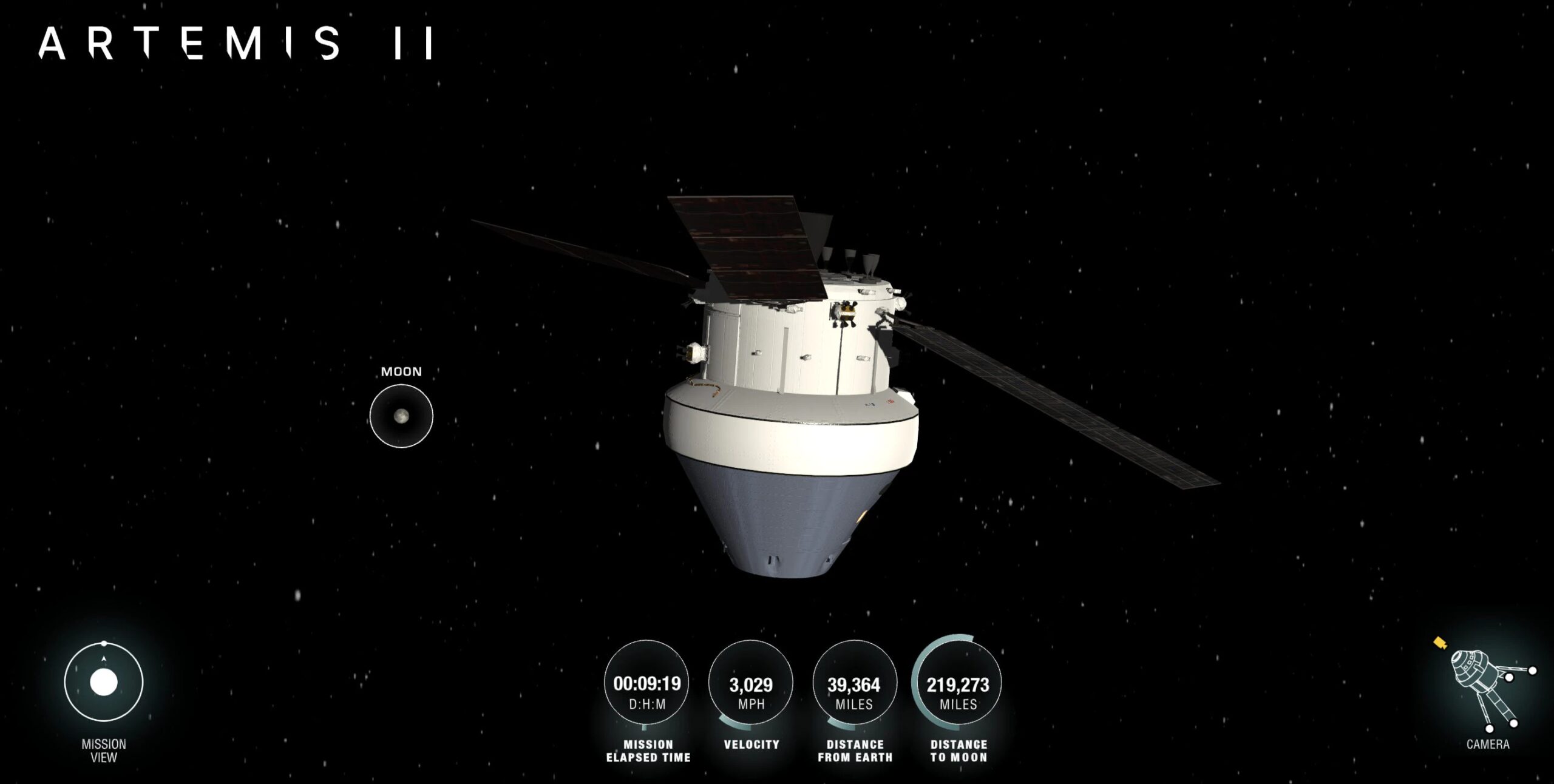
Are you curious to know where exactly the four Artemis II astronauts (Reid Wiseman, Christina Koch, Victor Glover and Jeremy Hansen) are after the launch of the space mission and the beginning of their 10-day journey to the Moon and back? Well, NASA has made AROW available to everyone (Artemis Real-time Orbit Website), a free tool that tracks the position of the Orion capsule in space in real time.
How AROW, NASA’s Artemis II mission tracker, works
The Orion capsule is equipped with onboard sensors that continuously collect the spacecraft’s telemetry data (for example, position and speed) from approximately one minute after liftoff until the end of the mission. The AROW system collects this data and radios it to the mission control center at the Johnson Space Center in Houston, Texas. From there, they are made available in real time to anyone with an internet connection both from the NASA website (nasa.gov/trackartemis) and via a dedicated app (downloadable here).
Through the interface it is possible to view Orion’s position with respect to the Earth and the Moon at any time, as well as offering a series of useful information: the distance from the Earth and the Moon, the speed of the capsule, the time elapsed since the start of the mission and the main objectives of the flight plan. With the button MISSION VIEW at the bottom left it is possible to choose between different types of visualization: we can see the capsule in its position in real time and within its flight profile, while with the button ROOM at the bottom right it is possible to obtain a simulation of the views of the cameras installed outside the capsule.
The mobile version of the app adds a particularly interesting feature: an augmented reality tracker. After a short calibration, the smartphone indicates in which direction of the sky to point the phone to view where Orion is at that precise moment compared to our position on Earth. This feature becomes available approximately three hours after launch, once the capsule has separated from the SLS rocket’s upper stage.
Technical data on the Orion capsule’s journey to the Moon
AROW also makes the so-called state vectors available: these are the technical data that precisely describe the position and motion of Orion in space at any moment. This data can be used by enthusiasts, developers and creatives to build custom tracking applications, physical models, animations or original visualizations.
Once the mission began, NASA also made available for download the complete trajectory data, known as ephemeris (also used by astronomers to determine the positions of celestial bodies). With this data it is possible to follow Orion with an amateur telescope, or integrate it into any space simulation software.