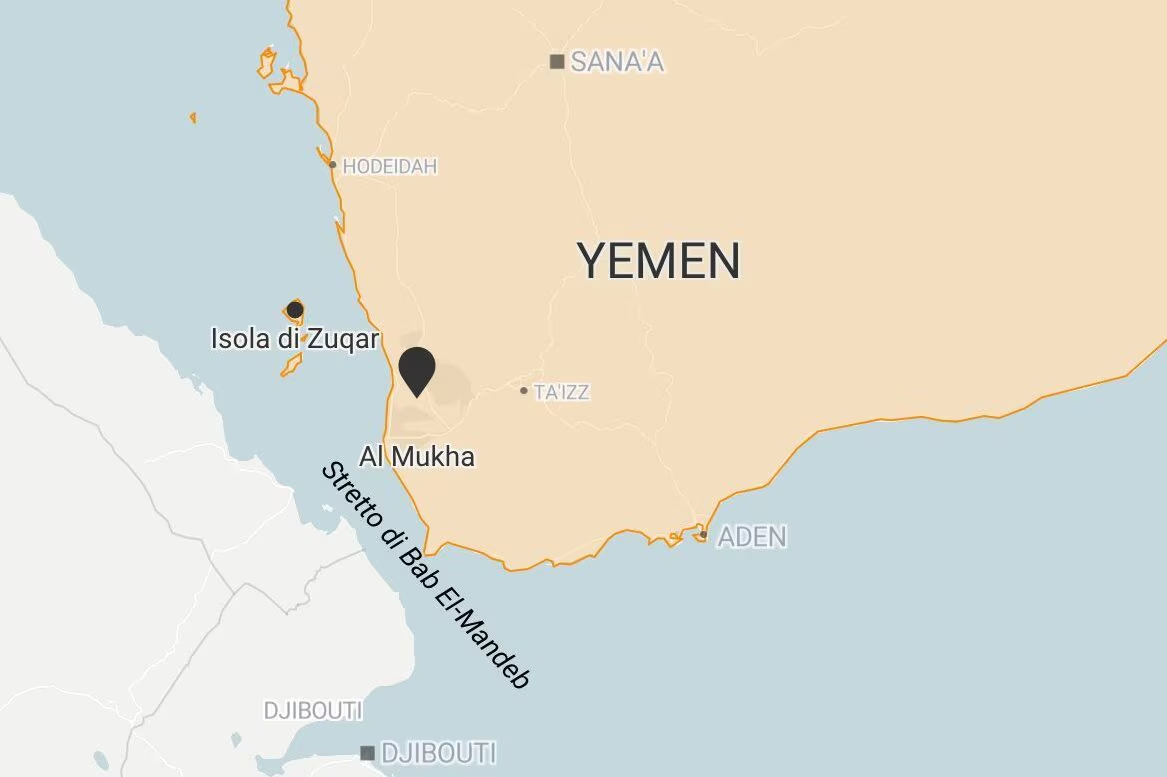
The war in the Middle East between the United States and Iran is moving towards a new one chokepoint strategic, the Strait of Bab el-Mandeb: the Houthis, the Yemeni armed movement supported by Iran, took control of the historic port city of Mocha (located less than 80 km from the strait) and launched attacks against the strategic islands of Hanish, in the Red Sea, pushing the Yemeni government forces supported by Saudi Arabia southwards up to Dhubab, a city that directly overlooks the strait, just opposite the island of Perim.
The Houthis’ strategy is clear: whoever controls the Yemeni coast overlooking the Red Sea is strengthening their grip on one of the busiest and most disputed maritime passages on the planet, the Strait of Bab el-Mandeb, which has acquired even more importance after the blockade of the Strait of Hormuz.
Last July, the group had already declared a naval blockade against Saudi Arabia (the world’s largest oil exporter), and Houthi dominance of the canal would further isolate Gulf oil producers from their key shipping routes. Also due to the worsening of the attacks between the USA and Iran, the price of oil soared above 105 dollars a barrel, with Saudi crude oil production falling by 1.9 million barrels a day to 6.238 million, the lowest level since 1990.
If both straits (Bab el-Mandeb and Hormuz) were to be closed at the same time, about 30% of global seaborne oil would become stuck. The problems, however, do not only concern oil: around 10% of global trade also passes through the Bab el-Mandeb Strait, with numerous containers arriving from China, India and other Asian countries and headed towards Europe.
It must be said, however, that control of the city of Mocha is not sufficient to completely control Bab el-Mandeb (which also depends on Djibouti and Eritrea and on the international naval presence), but could have important implications on the risks of navigation through the Strait.
What is the Bab el-Mandeb Strait and what is it like?
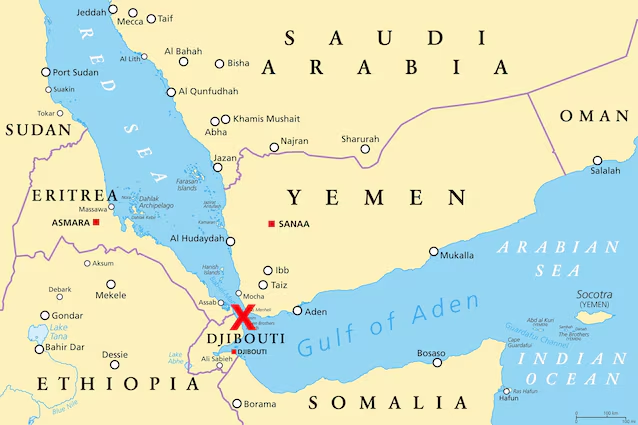
The Bab el-Mandeb Strait is located at the southern end of the Red Sea, sandwiched between two continents. On one side there is Yemen, on the Arabian Peninsula, on the other there is Djibouti and Eritrea, on the African coast. This maritime bottleneck represents the point where the Red Sea connects to the Gulf of Aden and, from there, to the Indian Ocean. It is located on the opposite side of the Arabian Peninsula from the Strait of Hormuz, the other major passage that ended up at the center of the war between the United States and Iran.
The most striking thing is its size. At its narrowest point, the strait measures approximately 18 miles (approximately 29 kilometers) and is naturally divided by the Yemeni island of Perim (Mayyun, in Arabic) into two channels: international maritime traffic transits mainly in the western channel, approximately 26 km wide and approximately 200 meters deep. The eastern canal, however, which reaches just 30 meters deep and 3 km wide, is used for local traffic and small boats.
Some islands of volcanic origin appear within the arm of the sea and the maximum depth is around 300 metres: it is no coincidence that in Arabic Bab el-Mandeb means “Gate of Tears”, a nickname due to the notoriously treacherous navigation conditions in this stretch of sea. Further north are the Hanish Islands, located between the ports of Hodeidah and Mocha. The Houthis actually already control Hodeidah, which they have used as a base for their campaign of attacks against trafficking in the Red Sea.
According to a Yemeni military source, in addition to Mocha, the Houthis also conquered the island of Zuqar, south of the Red Sea, after missile attacks and a land assault conducted with the help of boats carrying fighters.
Why such a small strait matters so much (even for Europe)
Such a narrow and busy maritime passage is defined in jargon as a “chokepoint”, that is, a bottleneck, a bottleneck through which an enormous share of world trade is forced to pass and which, for this very reason, becomes a weak point.
Bab el-Mandeb is the southern gateway to the Suez Canal, which connects the Red Sea to the Mediterranean. To be clear, it is the hub that allows goods and raw materials to travel directly between Asia and Europe, without having to circumnavigate the whole of Africa via the Cape of Good Hope. 12% of world trade passes through this stretch.
In addition to goods, however, oil and fuel also pass through Bab el-Mandeb heading from the Gulf to the Mediterranean: now that the Strait of Hormuz is closed, Saudi Arabia has in fact tried to redirect its oil exports towards the Red Sea. More specifically, Riyadh has pushed its East-West oil pipeline (the so-called Petroline) to full capacity, redirecting crude oil from eastern fields to the Red Sea port of Yanbu overland. To ensure that Saudi crude oil reaches Asian countries, however, ships must necessarily pass through the strait in question.
The numbers help to understand its importance. According to what was reported by the US Energy Information Agency (EIA), the volume of oil transiting through the Bab el-Mandeb Strait went from 5.7 million barrels per day in 2020 to as much as 9.3 million barrels per day in 2023. After the start of the Houthi attacks in the Strait, the transit of crude oil through this checkpoint instead fell, falling to 4.1 million barrels per day in 2024 (about 5% of oil traded by sea globally) and to 4.2 million barrels per day in the first half of 2025.
The problem is that if this passage were to become blocked, ships would be forced to divert around the Cape of Good Hope at the southern tip of Africa, adding weeks of travel and huge costs to an otherwise linear route.
And this situation has already occurred in the past: with the Houthi attack campaign starting at the end of 2023, logistics and energy giants diverted their ships away from the Suez Canal, making them circumnavigate Africa. The result was immediate: skyrocketing transportation costs and much longer travel times. And more time and money to move goods means, at the end of the chain, higher prices and inflationary pressures that trickle down to European consumers as the cold season approaches.