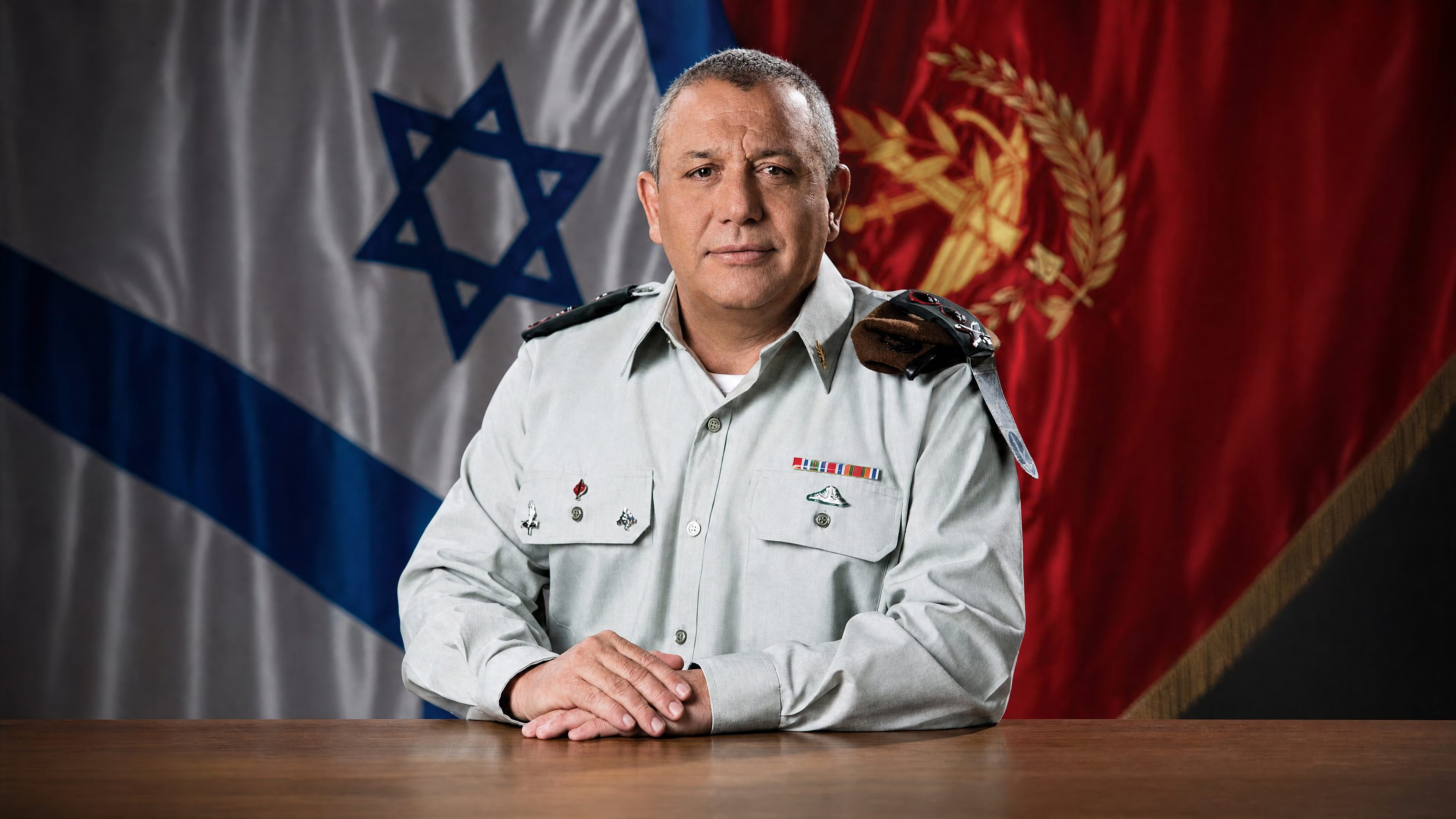
With the opening of the polls on Tuesday 27 October 2026, Gadi Eisenkot’s challenge to Benjamin Netanyahu for the position of prime minister of Israel and the majority of the Knesset (parliament) officially begins. These are the first political elections after 7 October 2023, a date that marked a definitive watershed in the escalation of relations between Palestine and the Jewish State.
Gadi Eisenkot, former IDF Chief of Staff, officially joined the Israeli government on 12 October 2023 in the role of minister without portfolio and war cabinet observer, but resigned in June 2024 because he disagreed with the line of the governing coalition in the Gaza Strip. Just over a year after his resignation, in September 2025, he founded the Yashar party (which in Hebrew means “straight” or “honest”), with the specific aim of becoming a valid alternative to today’s government. But let’s take a closer look at who this political figure is, who could perhaps oust the disputed Israeli Prime Minister.
Eisenkot’s career: his rise to the top of the IDF and the dangerous Dahiya Doctrine
Eisenkot, 66 years old, is the son of Moroccan immigrants, and was born in Israel (specifically in Tiberias, in the historical region of Galilee) on May 19, 1960. Raised in the city of Eilat, he specialized in maritime studies, and after graduating (1978) he joined the Israeli army (IDF).
His career in the IDF, which lasted forty years, was a real climb up the ranks of power, because from being a simple team leader he became a platoon leader (following a course for infantry officers) and deputy company commander. A young officer during the First Lebanon War (1982), Eisenkot was then appointed commander of the rifle company of the 51st Golani Battalion.
During the Second Lebanon War (summer 2006), Eisenkot headed the IDF’s operations directorate, coordinating soldiers’ operations during the conflict. Following harsh criticism of the commander of the northern front Udi Adam regarding the chaotic management of ground operations (coordination was terrible and there were several failures against the rockets launched by Hezbollah), Eisenkot took over command of the front (at the end of the war). Two years later, in 2008, he developed the Dahiya Doctrine, which had the stated goal of “countering the threat of Hezbollah in Lebanon”.
The doctrine in question is based on a military strategy of asymmetric warfare which involves the massive use of a military force much greater than the threat received, with the aim of creating strong deterrence. But not only that: the doctrine also provides for the systematic damage and demolition of civilian assets (houses, hospitals, electricity networks, aqueducts, sewers) in territories controlled by “hostile forces” (such as Hezbollah and Hamas).
The doctrine resulting from Eisenkot was then formalized and used in its maximum expression in the Gaza Strip, despite countless criticisms from humanitarian organizations, the International Committee of the Red Cross and legal experts who made it clear that the doctrine violates international humanitarian law and the Geneva Conventions due to potential war crimes and because it lacks long-term strategic validity (with such a strategy it is unlikely to achieve lasting peace or political stability).
In any case, at the top of his career Eisenkot became chief of staff (from 2015 to 2019) in the service of the Netanyahu government.
His mandate, however, was not without controversy, culminating in the spring of 2016 in a very controversial episode, that of Sergeant Elor Azaria. The latter, on March 24th ten years ago, shot and killed the Palestinian Abdel Fatah al-Sharif, who in turn – during a scuffle – had injured an Israeli soldier with a bladed weapon. Although the attacker was now on the ground disarmed and immobilized, Azaria shot him in the head from close range. Although a series of members of the Israeli radical right had asked Eisenkot not to support an investigation into the matter and not to open a military trial, Eisenkot chose to do so “to defend the discipline of the army”, and the sergeant was tried by a military court, found guilty and sentenced to 18 months in prison (of which he served only half, in actual terms) for manslaughter.
Entry into politics before 7 October 2023 and resignation
Despite the inconvenient Azaria episode, Eisenkot managed to rehabilitate his figure, and in 2022 he entered politics as a deputy candidate, and was elected to the Knesset.
After the events of October 7, 2023, he joined an emergency war cabinet together with Benny Gantz in the role of strategic observer. However, it soon proved to be a castrating role for both, because they disagreed with the prime minister’s line of “total victory”. Eisenkot, in particular, defined it as “an illusion devoid of real political and military strategy”, and wanted to give absolute priority to the release of the hostages, even at the cost of prolonged truces.
Given the prime minister’s decision-making paralysis and the absence of concrete plans, the two resigned in June 2024, and Eisenkot left Gantz’s party (National Unity), which he did not consider a suitable alternative to overthrow the government in this year’s elections.
Since then, Eisenkot has become one of the main opponents of the Israeli prime minister, frontally criticizing his management of the war, which has led the country to an increasingly clear position of isolation from international public opinion.
Eisenkot and Netanyahu: political vision compared
In September last year, Eisenkot founded the Yashar party, which is based on a series of increased security measures and a series of radical changes, especially for the ultra-Orthodox.
His policy, although considered more moderate than that of the current Prime Minister Benjamin Netanyahu (the longest-serving Prime Minister in the history of Israel), is nevertheless essentially clear-cut.
On the military front, Eisenkot supports the hard line against Hamas, Hezbollah and Iran, and has never made a secret of this. Regarding the Gaza Strip, Eisenkot categorically ruled out the birth of a sovereign Palestinian state, but with respect to Bibi he declared himself against the Jewish recolonization of Gaza. His desire, after the destruction of Hamas by every possible means, is that of a moderate Palestinian civil administration supported by a coalition of moderate Arab countries (Egypt first and foremost). Security, however, would always and in any case be the prerogative of Israel.
As regards the thorny issue of Jewish settlements in the West Bank, however, Eisenkot has repeatedly proven evasive. As the Guardian also reported, he opposes the proposed E1 settlement block, but has generally been in favor of settlements. However, he does not agree with Netanyahu’s decision to entrust the management of the region to far-right minister Bezalel Smotrich, as this decision has seen a surge in settler violence against Palestinian civilians. His (declared) objective is to put the army back in command of the West Bank, even if historical evidence proves violence against the Palestinian population also by members of the IDF.
At the level of international relations, Eisenkot would like Israel to stop being diplomatically isolated (the current prime minister, however, considers diplomatic isolation an acceptable price to pay in the name of military “total freedom of action”), and maintains that he must carry out greater coordination (behind closed doors) with the USA and a reopening of dialogue with Western allies. To do this, however, Eisenkot and his party will have to stop the settler violence, which has caused strong international outrage.
And then, the most sore point: Eisenkot’s party firmly maintains that the ultra-Orthodox (Haredim) should no longer be exempt from military service, and that once in government it will support compulsory enlistment for them too, also – as he himself has argued – to ease the pressure on the reservists who have been mobilizing for years. The statements in this regard have created great uproar in the Haredim community, which is far from wanting to stick its nose in war affairs.
Once in government, Eisenkot would like to call for the immediate establishment of an independent state commission of inquiry into the events of October 7. Clearly, the idea has been harshly criticized by the government majority led by Netanyahu and Minister Levin, who in recent years has worked hard to promote rather controversial reforms to weaken the judiciary. Eisenkot, however, maintains that the autonomy of the judicial system must be a fixed point, as well as the moral integrity of all institutions.
Which parties could it ally with?
Even if today’s elections were to see Yashar in the lead, in a pure proportional electoral system, winning the leadership of the country requires a majority of at least 61 seats out of 120 in the Knesset, and no party can do it alone.
So, which parties could it ally with?
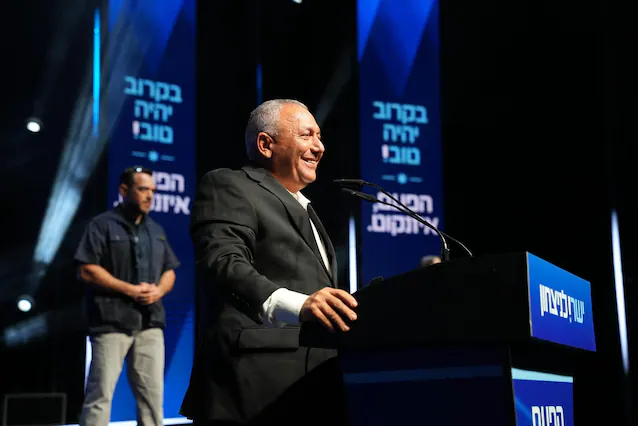
At the moment the opposition bloc is made up of Yashar, Beyachad (centrist alliance founded in April 2026 by Naftali Bennett and Yair Lapid), Yisrael Beitenu and Yair Golan’s social democrats. But according to the polls, the seats may not be enough to reach a majority (the latest polls give the four parties together between 52 and 56 seats).
To reach 61 seats, Yashar could rely on Mansour Abbas’ Arab-Israeli Islamist Ra’am list, but it is a remote possibility (Eisenkot has ruled it out in recent months) if only for the fact that an alliance with this party could drive away the Zionists Bennett and Lieberman. Bennett, in particular, has pledged to govern only with Zionist parties.
Alternatively, Eisenkot and his party colleagues could attempt a complicated dialogue with the religious parties, but the Haredim would not back down on the issue of compulsory military conscription for their community, and it is therefore very unlikely that this will happen.
If Yashar fails to find a solution, the risk is that of an institutional stalemate in which Israelis would have to return to the polls (while Netanyahu would remain at the helm of the government).