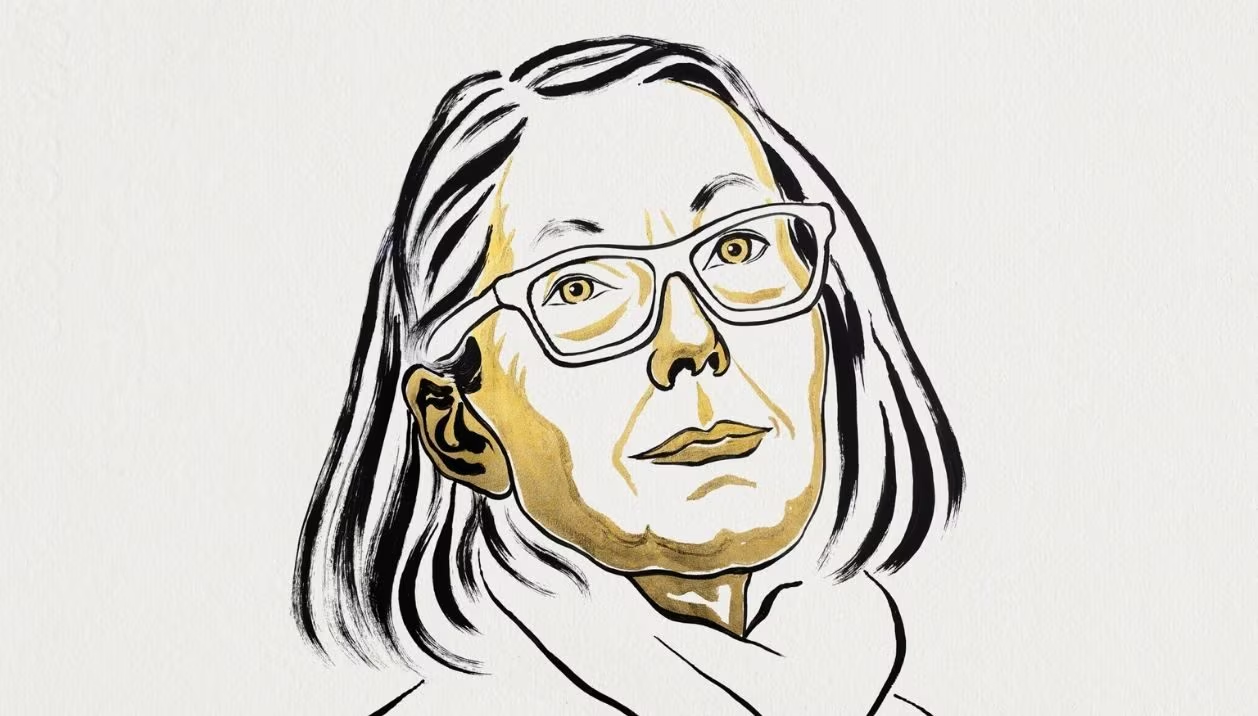
The Nobel Peace Prize was awarded to the South African jurist and activist Navanethem “Navi” Pillay, 85, for «her commitment to the promotion of peace and international law». The Norwegian Nobel Committee justified its choice on the basis of “the decisive role in ensuring that war crimes, crimes against humanity and genocide are prosecuted”.
Born in 1941 in Durban, South Africa, into an Indian family of Tamil origin during apartheid, Pillay became a lawyer and legal pioneer, facing profound structural discrimination, segregation and exclusion: during her long career as a jurist and magistrate, she held the role of interim judge at the High Court of South Africa and at the International Criminal Tribunal for Rwanda (the body established to try those responsible for the 1994 Rwandan genocide). His contribution there was decisive: he played a fundamental role in the development of innovative jurisprudence that recognized rape as an act of genocide, a precedent that changed the way international law deals with crimes of sexual violence in armed conflicts.
In 2003, Pillay was elected as a judge of the International Criminal Court in The Hague, where she served on the Appeals Chamber until August 2008. That same year, the United Nations Secretary-General proposed her as High Commissioner for Human Rights, an appointment subsequently approved by the General Assembly on 28 July 2008, continuing the role until 2014.
In 2015, among other things, Pillay became the sixteenth commissioner of the International Commission against the Death Penalty: and almost as if it were a coincidence, just today the USA announced that the shooting of Nidal Hasan (sentenced to the death penalty for killing 13 people in a shooting at the Fort Hood military base in 2009) will be broadcast live on December 3rd.
His international rights work continued as an ad hoc judge at the International Court of Justice during the proceedings between Gambia and Myanmar on the Rohingya genocide. Until last year, he also served as Chairman of the UN Commission of Inquiry into the Occupied Palestinian Territory and Israel, accusing Tel Aviv of waging genocide in Gaza.
Today Navi Pillay works as a judge at the International Court of Justice in the case in which Myanmar is accused of genocide.
In the press release announcing its victory, the Oslo Committee also wanted to send a broader message, underlining that «in an era in which the number of wars and conflicts is increasing and in which judges and institutions of international law are under political attack, the ability to resolve conflicts without resorting to force or violence depends on respect for the rule of international law (…). The Norwegian Nobel Committee wishes to remind the world that the rule of law – national and international – underpins the system we have created to ensure peace and resolve conflicts non-violently. Peace requires justice.”
This year, moreover, marks the 125th anniversary of the Nobel Peace Prize: from 1901 to today the prize has been awarded 107 times, respectively to 113 individuals and 31 organizations. On 19 occasions the prize was not awarded because none of the works considered were of adequate importance and, in general, the scope of international law expanded after the Second World War, especially after the creation of the United Nations institutions.
The South African magistrate is the 21st woman to obtain this recognition: last year, the award went to Maria Corina Machado, Venezuelan activist and politician, leader of the opposition to Maduro’s authoritarian government.
In addition to international prestige, Navi Pillay will also win a prize worth 12 million Swedish crowns (approximately 1.07 million euros), which will be awarded to her in Oslo on 10 December 2026, on the anniversary of Alfred Nobel’s death.