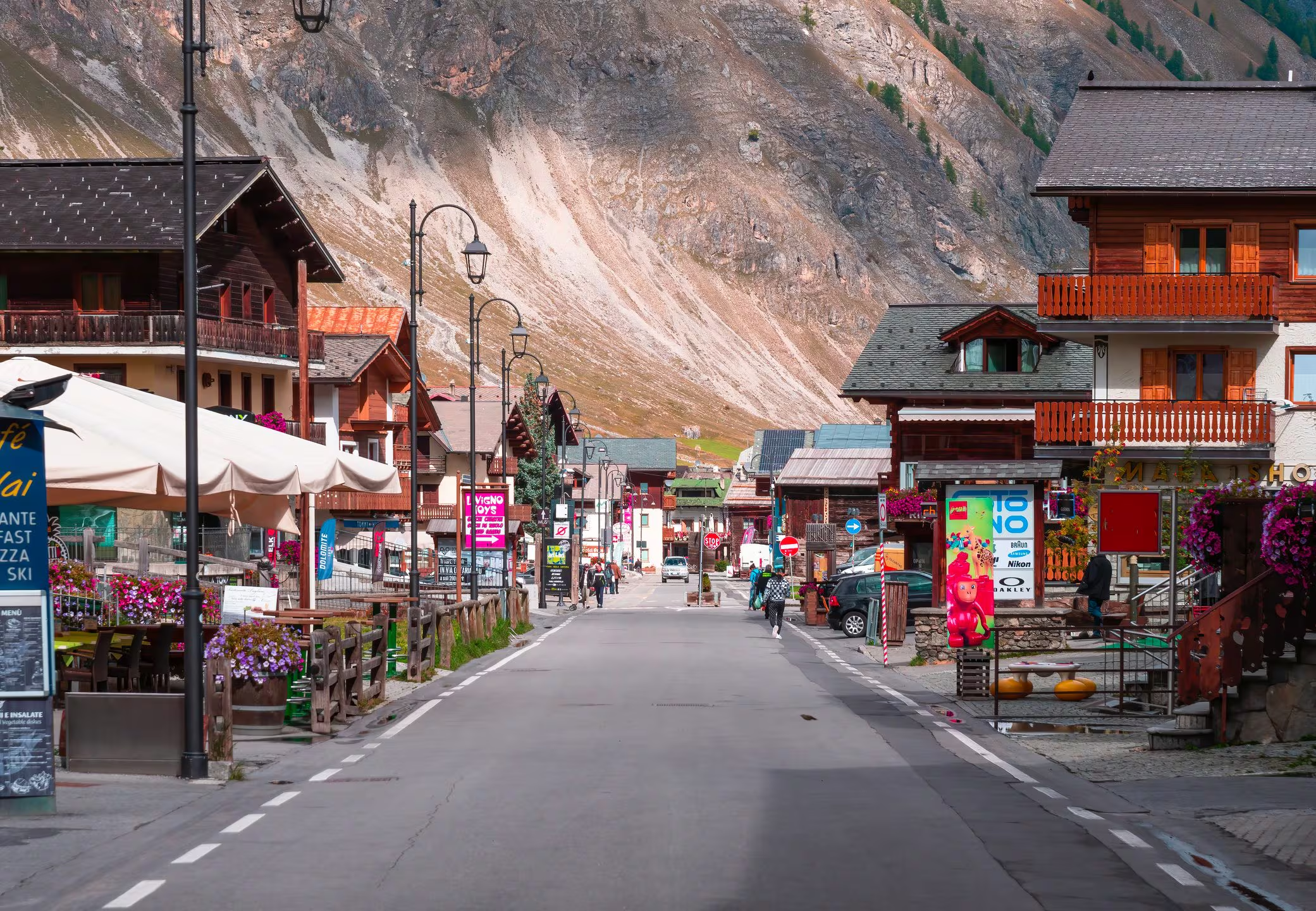
Livigno is a Lombard municipality in the province of Sondrio, located in Alta Valtellina. Since 1500, Livigno has been one duty-free zone, that is, a territory where there is exemption from duties or other taxes and taxes on the importation of goods: this means that the goods purchased are exempt from VAT and state excise duties. This makes items such as fuel, tobacco, alcohol, perfume and more more affordable.
The reason why Livigno is exempt from VAT is that, until the early 1950s, for the entire winter period remained completely isolated: in fact, since the road to the Foscagno pass was not open, for six months of the year nothing and no one entered or left the city. This meant an inequality in economic and commercial management, officially recognized with VAT exemption.
The name Livigno probably derives from Latin labineusor “territory subject to avalanches”, which confirms its historicity as a complex area from a geographical point of view.
The historical reasons linked to the city’s isolation date back to 1538
The Municipality of Livigno has been officially declared duty-free zone from the law no. 516 of 17 July 1910. In reality, its status as a “free” zone dates back well to 1538the year in which he obtained special exemptions on trade from the Grisons, then rulers of the nearby Bormio county.
Livigno managed to sanction these particular provisions, which were then confirmed later, because until 1952 – year in which the Foscagno pass was opened – the city remained completely isolated during the winter: for six months of the year, therefore, it could not carry out any type of exchange with the rest of the world, and this obviously had repercussions on the economyas well as on the culture and integration of society.
Already in 1500, therefore, Livigno claimed its autonomy for the payment of tithes to the Curia of Como, for the maintenance of roads and bridges and for the management of pastures and woods.
Napoleon recognized the customs benefit in 1805, then confirmed in 1818 by the Imperial Royal Austrian Intendency of Morbegno and subsequently extended in 1841 by the Kingdom of Lombardy and Veneto.
In 1861, Livigno became part of the Kingdom of Italy: it asked for confirmation of the benefits obtained, which were officially granted with the law of 1910.
How to buy in Livigno without VAT: rules and prohibitions
Precisely because there is no VAT, just as happens in duty free of the airports, in Livigno the goods – both necessary and valuable – they cost less.
Precisely for this reason, a real movement has developed over the years “commercial tourism” which aims to purchase tobacco, coffee, sugar, alcohol, but also goods considered “expensive”, such as perfumes, luxury objects, etc., the provisions of which can be consulted in the product tables on the website of the municipality of Livigno.
Among these goods there is also petrol: getting petrol in Livigno clearly costs less.
The established rule says that the tank can be filled with fuel up to its maximum capacity, but it can only be taken outside the borders in specific approved cans with a capacity of no more than 10 liters and must contain the same type of fuel as the vehicle transporting it.
The purchase limit “by value” is also set: those over 15 can purchase for a maximum of 300 euros, those under 150. The official product table in fact states that “purchases that fall within the exemption must not be of a commercial nature, therefore they must be of an occasional nature and concern goods reserved for the personal or family use of travelers or intended to be given as gifts and which do not reflect, due to their nature and quantity, any commercial intent”. This, obviously, to avoid tax evasion and incorrect resale!