This was the Worst week for Wall Street Since March 2020, when the Covid-19 pandemic messed up the global economy and sent the markets to tilt. Today, a new wave of financial panic was triggered Donald Trumpreturned to the protagonist of the world political scene with an explosive move: the announcement of new (and greater) duties on all imports, from each country, without exception.
The result? A vertical collapse of the main world bags.
Summer bags after the introduction of Trump’s duties
The reaction of the markets to the new tariff policies imposed by Donald Trump was immediate and brutal. On the day of Friday 4 April 2025, theS&P 500 index – Considered the thermometer of the entire US equity market – Ha lost almost 6%.
It is a drop that alone would be enough to describe a dramatic session, but the picture is even more worrying if we consider that the main shareholders, such as Dow Jones and Nasdaq, have officially taken the road to the so -called Bear Marketor one Reference market phaseafter losing 6% respectively and over 20% of their value compared to the maximums recorded in December.
The expert alarm
According to the latest analyzes of the JP Morgan business, the combined effect of the new rates could cause a significant slowdown of the US economy, with a contraction of the gross domestic product (GDP) estimated at two percentage points for the current year, which would have a more serious impact – globally.
JP Morgan saw the rise there probability of a world recession In 2025, bringing it from 40% to 60%. In other words, there is a concrete possibility today that the global economy will enter a new contraction phase – a risk that until a few weeks ago seemed remote.
The reason is simple: the imposition of generalized bodies on a wide range of products from dozens of countries, including strategic partners such as China, the European Union, Vietnam and even Italy, not only raises import costs, but risks paralyzing global supply chains, feeding inflation and reducing the competitiveness of companies. The market has already begun to serve these effects, and the losses recorded by some giants of the US economy clearly demonstrate it.
What is risky globally
In this context, the response measures adopted by other countries – such as China’s counterattacks, which has imposed 34% duties on several American products And he limited the export of strategic raw materials – they risk triggering a negative spiral difficult to arrest. The combination of commercial barriers, the financial instability and the slowdown of international exchanges form a potentially explosive mixture for a global economy still fragile after the pandemic crisis.
The risk is that we are going to a new phase of economic stagnation synchronized worldwide, aggravated by political tensions and one decline by companies and consumers. The investment decisions are postponed, consumption brakes, and the most exposed companies – in particular the SMEs – risk not surviving the double shot represented by the increase in costs and by the contraction of the application.
Not surprisingly, the financial earthquake did not stop at the United States. The FTSE 100 English (the most important stock exchange index of the United Kingdom) recorded a Loss of 4.9%the worst since 2020. The French one (the CAC 40) went down to 4.3% and the German one (the Dax) left almost 5% on the ground. In AsiaJapanese Nikkei has lost 2.7%while the Japanese premier has openly spoke of a “national crisis”. As a demonstration of the global scope of the phenomenon, the price of oil has also affected the climate of uncertainty, with the Brent falling of 6% and residential prospects reduced in a context of generalized commercial slowdown.
The “Trump Shock” opens to a new era of economic chaos
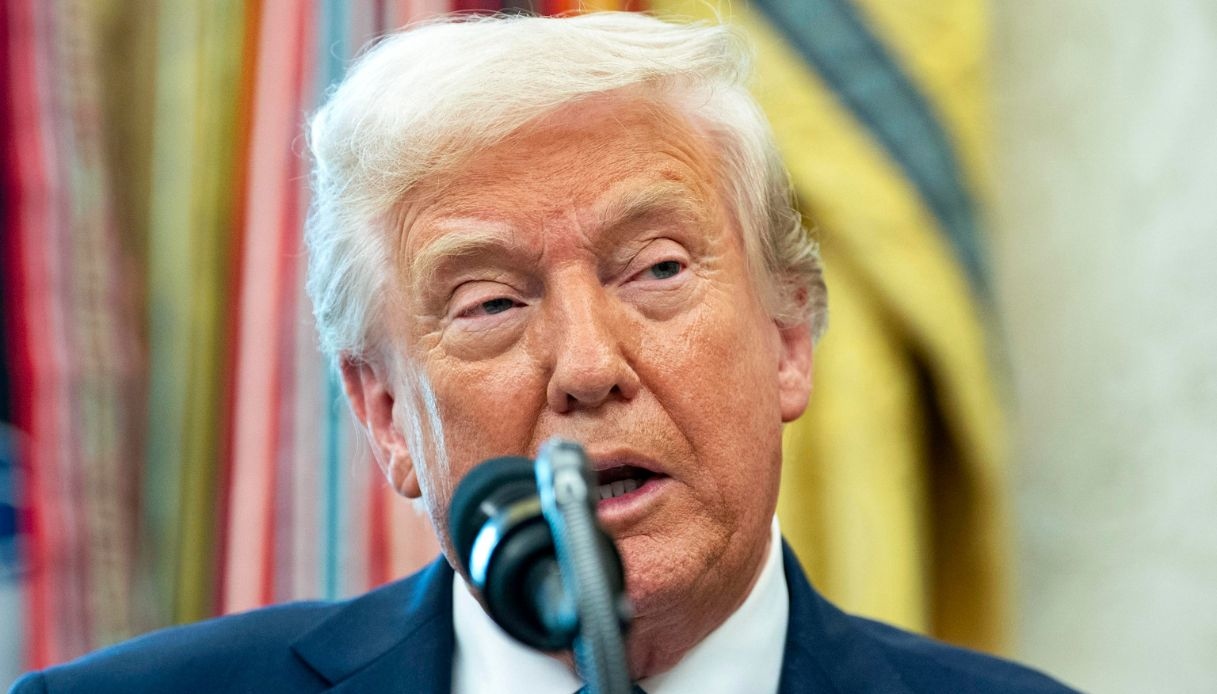
Yet, to date, President Donald Trump does not seem intent on removing. “Hang Tough, we can’t lose”he wrote on social media by addressing his supporters, claiming the action as necessary to correct historical imbalances in international trade. A hard line It is promised in the election campaign, but which ignores – or worse underestimated – the chain effects on the global economy.
Jerome Powell, president of the Federal Reserve, also intervened to reassure the markets, speaking of an economy still “solid”, thanks to positive data on employment. But Powell himself then admitted that i duties are “higher than expected” And that the inflationary effects could slow down growth in the coming months. His words, however, did not calm the panic: the Sell-off involved all the sectors, including those theoretically most immune to the commercial war, such as public services and health care.
In the midst of all this, the confusion between investors, companies and consumers grows.
What is certain is that the “Trump Shock” of April 2025 It will be remembered as a watershed. Not only for the American economy, but for the entire international commercial system. Its consequences, such as those of Covid-19, risk changing the paradigms of globalization for how we have known them to date.
And while Wall Street looks fear of the future, the question is only one: will the world be able to find a new balance, or are we just entering a new era of economic chaos?