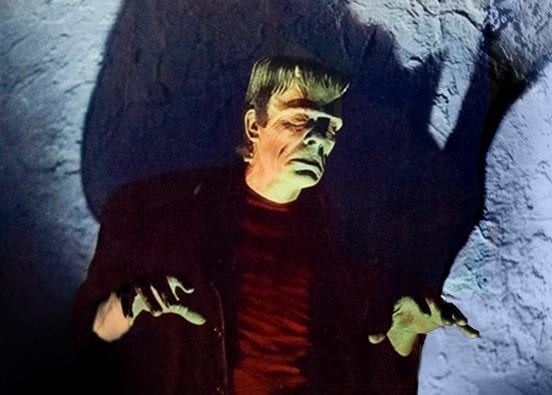
To create the character of Frankenstein’s monster, Mary Shelley was inspired by the experiments of an Italian scientist, Giovanni Aldini. Based on Luigi Galvani’s theories about animal electricity, at the beginning of the 1800s Aldini made experiments on animal bodies, causing movements through electrical discharges and making them almost seem alive. In a study of 1803, Aldini even hypothesized that, with electricity, corpses could be brought back to life. The theory is without foundation, but at the time, when some scientists still believed in the spontaneous generation of living beings, it aroused a certain charm. Based on Aldini’s experiments, Mary Shelley imagined that a Swiss doctor, Viktor Frankenstein, had created a monster by assembling pieces of corpses and had then infused his life through electricity.
The story of Mary Shelly’s Frankestein’s monster and Giovanni Aldini
Frankenstein’s monster is one of the best known characters in horror literature. He was created by an English author, Mary Shelley, between 1816 and 1817 Since it was very cold (it was the “year without summer”), the group was forced to spend a lot of time at home. On the inspiration of the poet George Byron (lover of Mary Shelley’s half -sister), the young people decided to engage in a singular challenge: write the most frightening novel possible.
As part of the challenge, Mary Shelley created the character of Frankenstein’s monster. The story he invented is, in a nutshell, the following: the Swiss doctor Viktor Frankenstein, expert in natural philosophy and medicine, decides to do an experiment to create a living being by assembling corpses. It appropriates the “pieces” that they need in cemeteries and, through electric discharges, manages to animate the monster it has created. Frankenstein is therefore not the name of the monster, as usual is believed, but that of its creator. When the monstrous creature runs away, Dr. Frankenstein abandons her to his destiny. However, the Serbian monster grudge towards mankind and therefore returns to Switzerland and kills some people, including Viktor Frankenstein’s younger brother and his promised bride. After the death of its creator, the monster takes away, setting fire to see how no one can see how it is done and create similar beings.
Mary Shelley’s novel, entitled “Frankenstein or the modern Prometheus”, was published in 1819 and, in updated version, in 1831. The monster character had great luck: there are no films, comics, video games and other forms of expression of which he is the protagonist.
To create the monster character, Mary Shelley drew inspiration for the experiments carried out at the beginning of the 19th century by the scientist Giovanni Aldini, who applied electricity to bodies of men and animals. Aldini’s experiments were based on the theory of animal electricity, developed by the Italian physiologist Luigi Galvani (Alfini’s uncle), according to which living beings contain a “intrinsic,” controlled by the brain and deposited by the muscles. Today we know that the theory is inaccurate, although not completely unfounded. Based on Galvani’s theories, Aldini made experiments by connecting electrodes to the bodies of animals which, thanks to electricity, made movements as if they were alive. He also used human bodies with a severed head, causing movements in the limbs, and cut heads that, thanks to electricity, opened the eyelids. In 1803 he published a study, entitled “an Account of the Late Improvements in Galvanism“, that is” report of the latest improvements of galvanism “, in which he hypothesized that corpses could be brought back to life.
The theory, of course, is unfounded, but the scientific knowledge of the beginning of the 19th century does not allow to categorically exclude plausibility. In fact, a part of the scientists believed that life could be born for spontaneous generation.
The theory of spontaneous generation
Alfini’s experiments and ideas were facilitated by the spontaneous generation theory of life, according to which living beings can generate from inanimate matter. According to theory, simple beings, such as worms and insects can be born “spontaneously” from elements such as the carcasses in putrefaction or the mud. The theory, which has very ancient origins, had already been refuted in the 17th century by scientists such as Lazzaro Spallanzani and Francesco Redi, but had returned in vogue in the century of the next. It was definitively denied by Louis Pasteur in 1864: the scientist showed beyond any reasonable doubt that life can only be born from other living beings and that the generations that appeared spontaneously were actually due to the action of microorganisms. At the beginning of the 1800s, the idea of the spontaneous generation was still popular and provided a “base” for the hypothesis according to which the corpses through electricity could be infused. In an indirect way, therefore, it was of inspiration for the character of the Frankenstein monster.