In the heart of El Salvador stands one of the most dangerous and discussed prisons in the world: it is the Cecot (Centro de Confinamiento del Terrorismo), a maximum security prison wanted by the Salvadoregno President Nayib Bukele and designed to locate the criminals affiliated with the most violent gangs of Latin America inside. Inaugurated in 2023, the penitentiary structure has been defined by some humanitarian organizations such as “the black hole of human rights” and it is not uncommon for the Czech to also end some innocent, as in the case of Kilmar ábrogo García, a young Salvadoran victim of a summary judicial process that led him to be detained unjustly.
So let’s see how the Czech prison and the doubts raised regarding the violations of the human rights of prisoners is made.
As the Cecot prison of El Salvador is made and because it was built
Inaugurated in 2023, the Cecot is located about an hour from the capital San Salvador. It has been designed to host up to 40,000 prisoners, even if the real number has never been revealed “for safety reasons”: according to estimates, it should be half full in the moment. To have a comparison, the largest prison in Italy (the Opera prison in Milan) hosts about 1,300 prisoners.
The structure, along all its perimeter, is surrounded by a reinforced concrete wall and each of the 4 prison blocks is in turn enclosed by some electrified wire fences. Each block is then composed of 2 pavilions, each of which houses 32 maxi-celle of about 90 square meters, capable of hosting between 65 and 70 prisoners each.
In total, the prison is monitored by 600 soldiers and 250 civil police officers, with an area of insulation of telephone communications extended for 2.5 km around the structure.
The construction of this prison, launched at the end of 2022, is part of the policy of the “hard hand” and “zero tolerance” adopted by the Salvadoran President Nayib Bukele against crime and street gang. Elected President in 2019, Bakele’s goal was immediately to lower the crime rate of El Salvador, who in 2021 recorded a rate of 17 murders per 100,000 people (34 times more than Italy) because of the violence exerted by the gangs such as Mara Salvatrucha (also known as MS-13) and the 18th Street Gang (or Barrio 18).
Bokele therefore conferred an almost absolute power to the police and army to arrest and imprison anyone who was even suspected of being affiliated with a few gangs, even in the absence of real tests. The result was drastic: in a few years, El Salvador went from one of the most violent countries in the world to the one with the highest imprisonment rate: about 2% of the population was imprisoned, while the number of murders decreased by about 50 times between 2015 and 2023.
Life inside the most dangerous prison in the world: the maxi-cells
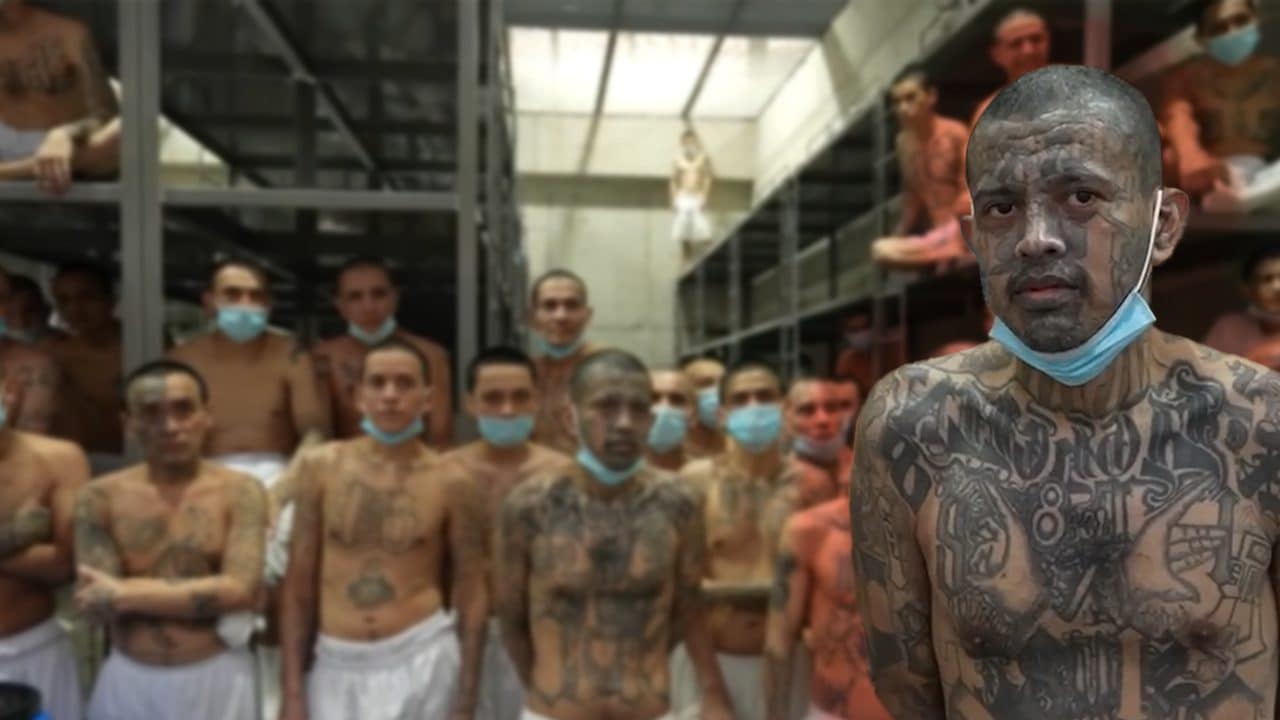
As you can guess, the living conditions within the Cecot are extreme: each 90 square meter cell host between 65 and 70 prisoners, without personal effects and forced to sleep on metal beds without mattresses. The prisoners have only two bathrooms, two sink and two cubes available, while the lights remain on 24 hours a day and the only moment of “freedom” is the daily half hour dedicated to physical activity, which takes place in the corridor.
As for food, however, each meal is the same as the previous one and is based on rice, beans, boiled eggs or pasta, to eat strictly with your hands. That of the meal, however, is an important moment because it is the only one that allows prisoners to keep track of the time that flows, given the impossibility of distinguishing between day and night due to the lights always on.
In case of rebellion, the prisoners can end up in total isolation and be locked up in a dark and narrow cell, with a single small opening on the ceiling, for days or even weeks.
Criticisms for human rights violations in prison
The main critical issues obviously have to do with the inhuman conditions in which the prisoners live: each of them has a living space of just 0.6 square meters and no prisoner is allowed to see their loved ones in person, if not through video call and always under the surveillance of the guards.
But there are also problems related to the stop procedure. Police and army, in fact, have the power to arrest anyone who can be considered a potential terrorist or criminal, even in the absence of evidence, and a toll -free number has been activated to allow the population to denounce presumed terrorists.
All this, of course, can lead to the incarceration of innocent people, as in the case of Kilmar ábrogo García, illegally emigrated to the United States to escape violence in their country and subsequently deported during the Trump administration without receiving a fair process. Its history, which has quickly become a media case, ended with its release, an outcome not obvious for the other innocent imprisoned to the Czech.
In any case, access to prison is forbidden to journalists and humanitarian organizations: consequently, all the information available to us are that provided by the same Salvadoran government, which has often advertised their work (showing images of the detainees charming or piled up in the cells) to demonstrate the use of state repression towards the gangs and, above all, to celebrate the results of the “zero tolerance” policy for safety in the country.