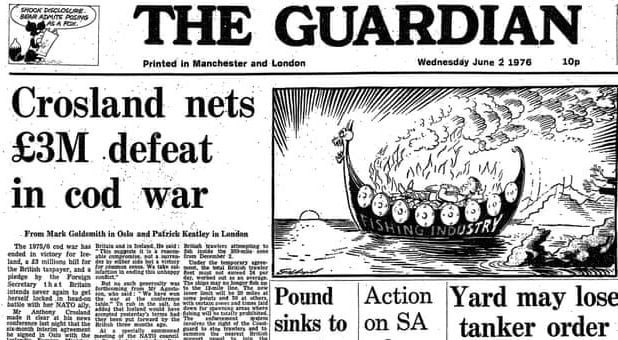
What are called “cod wars” are three diplomatic conflicts, for a short time not degenerated in military clashes, which developed between Iceland and the United Kingdom for the right of fishing in the waters of the northern Atlantic. The clashes took place in the years 1958-61; 1972-73; 1975-76. In all three cases the cause was the unilateral extension, by the Icelandic authorities, of the limit of their exclusive economic zone (in which the fishing boats of the other countries could not enter); All three times the United Kingdom did not recognize the decision and protected its fishing boats with military ships, but was forced to give in by the pressure of the United States. Iceland, despite being a small town, had a fundamental card on its side: threaten to get out of NATO and move on to the alliance with the Soviet Union. All three cod wars, therefore, ended in favor of Iceland.
The premises of the cod wars: the principle of the “cannon coup”
The “cod wars” have ancient roots: already in the medieval and modern age between Great Britain and Iceland (part of the Kingdom of Denmark) some contrasts arose for the control of the Atlantic Ocean sector located between the two islands, in which the fishing ships of both countries were present, which were mainly supplyed with cod. At the time there were no international treaties on navigation law, but the custom wanted each state to exploit an area of 3 nautical miles exclusively, that is 5.5 km from the coast. According to the principle developed in the seventeenth century by the Dutch jurist Cornelis Van Bynkershoek, the States had an exclusive right on the band that can be reached by a cannon shot shot by the shore. All the rest of the waters was considered open sea: anyone could cross it, fish and exploit their resources.
The principle of cannon blow became obsolete at the end of the nineteenth century, because the spread of steam ships and the evolution of technology made it easier to fish far from the coast. Consequently, conflicts for the right of fishing arose in different areas of the world. Even between the United Kingdom and Denmark tensions developed, but in 1901 the two countries signed an agreement lasting 50 years, which confirmed the principle according to which the exclusive area of each country was extended only three miles. The treaty was in favor of the British, who could continue to fish up to a few kilometers from the coasts of Iceland.
The independence of Iceland and the First Cod War: 1958-61
Iceland made itself independent in 1944 and seven years later, when the 1901 agreement expired, did not renew it, unilaterally extending the territorial waters to 4 nautical miles, that is, 7.4 km.
The context was favorable: the application of the principle of cannon coup was now difficult all over the world and between the 1950s and 1960s some international treaties on the law of the seas were signed. Iceland was not satisfied with the 4 miles provided and in 1958 the Reykjavik Parliament approved a law that unilaterally extended the exclusive area of fishing at 12 miles, that is 22 km. The country could afford to challenge the British thanks to the changes in international strength relationships and, in particular, at the beginning of the Cold War. Iceland, like the United Kingdom, was a NATO member country and had great strategic importance because the bases located on its territory, occupied by US soldiers, allowed to control access to the Northern Atlantic. Iceland could therefore threaten to close the bases, if not to go directly to the alliance with the Soviet Union. In addition, the United Kingdom, which was rapidly losing its empire, had less international political weight than the past.
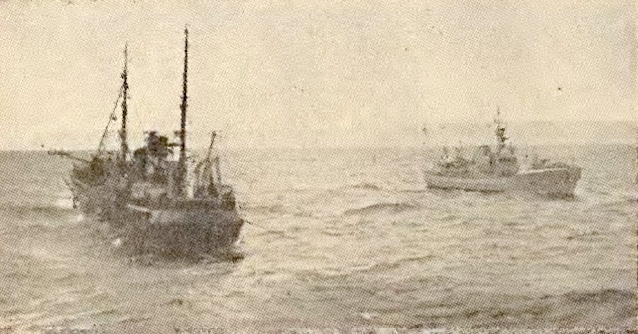
In any case, the London government did not accept the unilateral extension of the exclusive area and British fishing boats continued to fish in the “prohibited” area, protected by wars ships. However, when Iceland threatened to get out of NATO, the United States inserted themselves in the dispute with the role of mediators and in fact imposed on the United Kingdom to accept the Icelandic decision: an agreement from 1961 recognized the exclusive area of 12 miles, while guaranteeing the British was a limited fishing right inside.
The second cod war: 1972-1973
The agreement remained in force until 1972, when the Icelandic government unilaterally decided to extend territorial waters up to 50 miles from the coast, that is, 93 km. Also in this case, the United Kingdom did not accept the decision, which was also contested by the other NATO countries and even by some states of the Warsaw Pact. British fishing boats continued to fish in the area declared exclusively by the Reykjavik authorities, but the Icelandic Coast Guard intervened several times, cutting the nets of the ships. The United Kingdom sent military units to protect the fishing boats.
Armed clashes did not occur, but an Icelandic man lost his life in an accident caused by the collision between two ships. The tension increased and the hypothesis that Iceland abandoned NATO became a concrete possibility. With the mediation of the alliance, however, in November 1973 the conflict ended: the United Kingdom accepted the extension of the Icelandic exclusive area, retaining the right to fish up to 130,000 tons of fish inside.
The third cod war between Iceland and the United Kingdom: 1975-76
The agreement remained in force only until 1975, when the Icelandic government decided again to extend the limit of the exclusive area, bringing it to 200 nautical miles (370km) from the coast. In this way, the Icelandic fishermen could have exploited the most fishy waters.
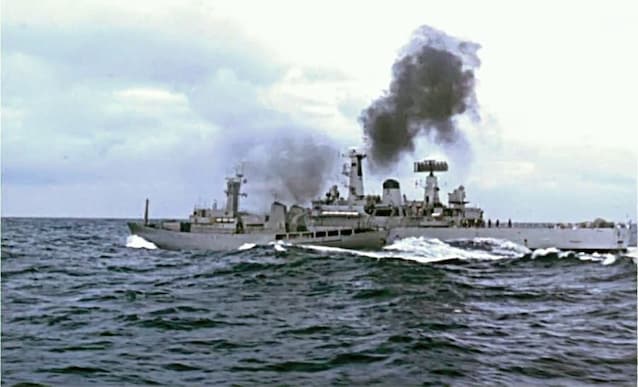
The United Kingdom, also this time, did not accept the decision and the scenes of the previous years were repeated: the Icelandic Coast Guard intervened to cut the goals of the British fishing boats, spurs and collisions occurred, the English military navy depicted some military units, the Reykjavik authorities threatened to close the NATO bases on the island. However, unlike what had happened in the two previous conflicts, during the “third war” Iceland decided to completely end the diplomatic relations with the United Kingdom.
In June 1976, thanks to the mediation of NATO, a new agreement was found, favorable, like the previous ones, to the Icelandic: the exclusive area of 200 miles was recognized, but the British preserved a limited fishing right inside.
After 1976 there were no other “cod wars” and the 200 mile principle was recognized internationally. In 1982 many countries, including the United Kingdom and Iceland, signed the Montego Bay Convention, in force since 1994, according to which the exclusive economic area of each country extends for 200 miles from the coast.