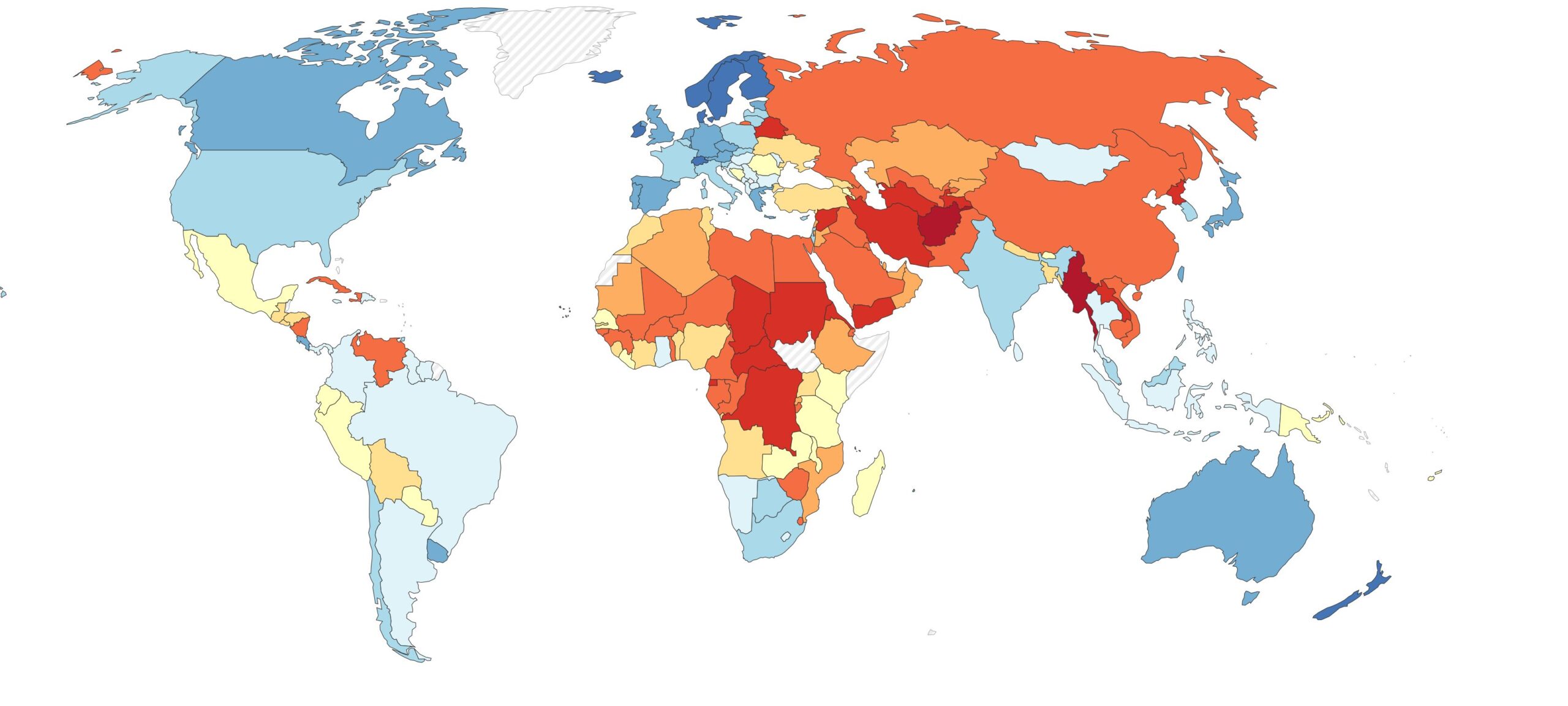
In recent years, the number of democratic governments in the world has decreased, marking a worrying trend globally. According to the Global Democracy Index 2024On 167 countries analyzed only 25 can be considered “full” democracies, while another 46, including Italy, fall into the category of “imperfect” democracies. Although 2024 has been called “the year of the elections” for the record number of electoral consultations all over the world, the global index of democracy has reached a historical minimum: the average world score came from 5.52 in 2006 to 5.17 in 2024. 130 countries recorded a drop or did not show any improvement in the score, reflecting the crisis of representative democracy and the rise of authoritarian regimes, Today they govern more than a third of the world population.
Recently, the growing political polarization and the distrust in the institutions have fueled consent towards populist and anti-system parties, contributing to the erosion of democratic processes. In fact, the report underlines that 20% of countries saw a decrease in the credibility of the elections, with a lowering of the electoral participation.
The map of countries in the world that are a democracy: the Global Democracy Index
Every year theEconomist Intelligence UnitDivision of Business Intelligence of the homonymous British newspaper, elaborates a report that photographs the state of democracy all over the world. Each country receives a score from 0 to 10 and is classified in one of the four types: “full” democracies, “imperfect” democracies, hybrid regimes and authoritarian regimes.
In 2024 only 25 out of 167 countries (15% of the total) reached a score greater than 8 and were indicated as full democracies, representing about 6.6% of the world population. Imperfect democracies, with a score between 6 and 8, cover about 38.4% of the world population, with 46 countries out of 167 (27.5%). Unlike the full ones, imperfect democracies, while maintaining free and right elections and guaranteeing civil freedoms, can present some weaknesses, such as less effective governance, limited political participation or occasional restrictions on civil freedoms.
The index also identifies two categories of non-democratic systems: hybrid (score 4-6) and authoritarian (score 0-4) regimes, which represent over 54% of the countries analyzed, the majority in the world. By “hybrid” regime (15.7%) we mean a country, such as Mexico or Romania, which combines regular elections with authoritarian practices, such as limited independence of the judiciary, widespread corruption and repression of the opposition. The authoritarian regimes (39.2%), such as Afghanistan or Venezuela, instead present an almost total absence of political pluralism, with non -free elections, violations of civil and media freedoms controlled by the state.
How democracy changed: what are the most democratic and risk countries
Scrolling through the ranking, it is possible to note the supremacy of the countries of Northern Europe: in the first 10 positions we find Norway, Iceland, Sweden, Finland, the Netherlands and Denmark, all with a vote greater than 9.
In particular, Norwegian democracy remains a model of stability and inclusiveness, with a score of 9.88 out of 10 which reflects the excellence of the Scandinavian country in all key indicators. This important position has also been confirmed by other studies, such as the Global State of Democracy Report 2024 of International Idea, which positioned Norway in 4th place, together with Finland.
To draw up this ranking, the index monitors 60 indicators divided into five categories, evaluated from 0 to 10:
- Electoral process and pluralism: presence of free, equitable and competitive elections.
- Civil freedoms: protection of civil and political rights and independence of the judicial system.
- Political participation: degree of direct involvement of citizens in political life, not only through the vote, but also through forms of civic commitment.
- Political culture: diffusion and support of democratic values in society.
- Government functioning: concrete ability of governments to translate the will of citizens into policies and actions.
On the basis of these criteria, Italy is positioned among imperfect democracies, placing itself in 37th place with a total score of 7.58 out of 10. To penalize our country were factors such as poor political culture, disaffection towards democratic institutions and the inefficiency of the government. Those of the Economist are not isolated concerns: according to an investigation by Civil Liberties Union for EuropeItaly has been identified as one of the five European countries that are significantly weakening the state of law. Despite this, a very high score in the other categories of index attenuates concerns about the state of Italian democracy.
Among the countries most at risk of democratic regression, on the other hand, we find Hungary, Turkey and Poland, all with drop -down and below 5 evaluations. With Viktor Orbán’s leadership, the Budapest government has seen a progressive decrease in its score, due to limitations to civil society and the judiciary, media control and centralization of power.
Similar dynamics are observed in Türkiye, with the strengthening of the presidential power of Recep Tayyip Erdogan, and in Poland, where the Sovereign Pis party has reduced the independence of the judiciary, limited the freedom of the media and increased political polarization. Finally, outside Europe, the position of the entire Latin America stands out, a region that has recorded a worsening of democratic conditions, with an increase in hybrid and authoritarian regimes.