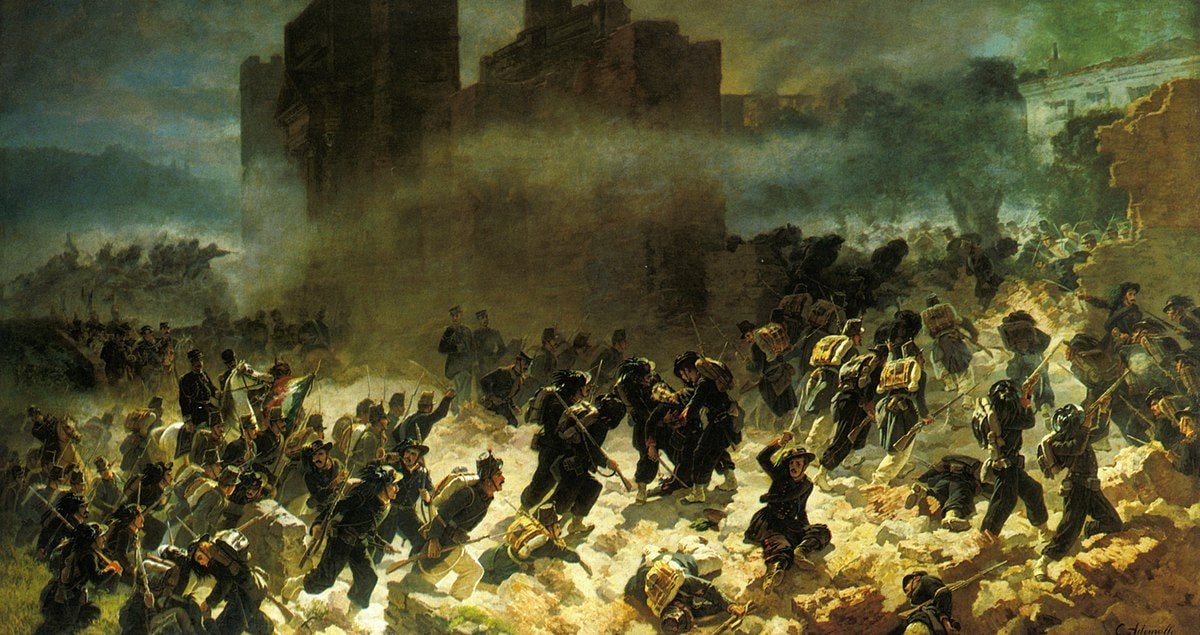
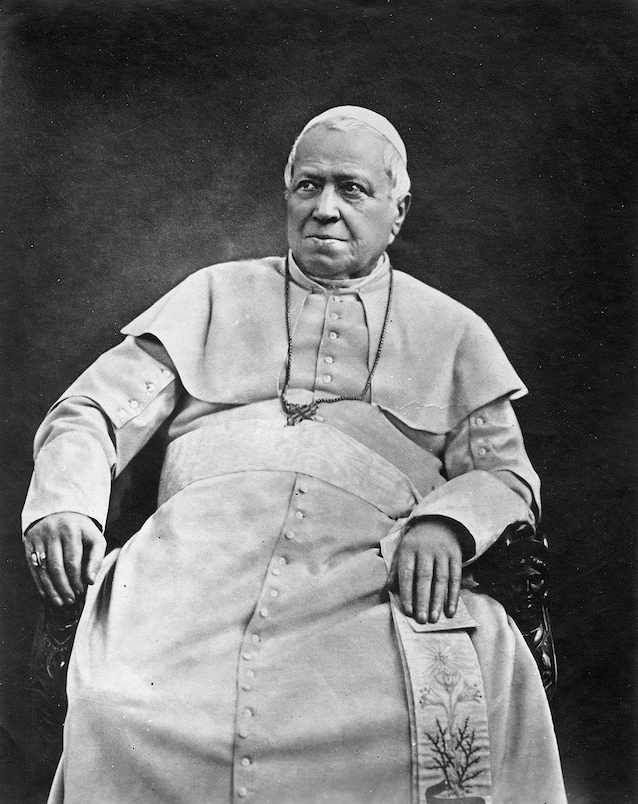
The Kingdom of Italy, unified in 1861, remained without its capital for ten years. Rome belonged to the Papal States, governed by the Pope and protected by Napoleon III France. The Pope, Pius IX, refused to give in to temporal power (that is, the political government of the territory, distinct from the spiritual power over the Church, which the Pope still exercises). In 1870, when the empire of Napoleon III collapsed, the kingdom of Italy was finally able to proceed with the occupation of the eternal city. The Italian soldiers opened a breach in the walls of Rome near Porta Pia and penetrated the city. Rome was proclaimed the capital the following year, but, although the government had issued a law to protect the Pope and guarantee him to exercise his spiritual authority, the Church did not recognize the annexation and imposed on the Catholics not to participate in the political life of the Kingdom of Italy. The question would have been resolved only after sixty years.
The unification of Italy and the Roman question
The city of Rome and the surrounding area have been governed by the Church for more than a thousand years, by the eighth century AD. C. to 1870. Before the unification of Italy, the Papal State extended over most of central Italy. When the unit was built, between 1859 and 1861, the Kingdom of Italy occupied a significant part of the territory (Romagna, Marche, Umbria), but was forced to leave Rome and Lazio to the Pope.
The pontiff was in fact “protected” by Napoleon III, emperor of the French, who needed the support of Catholics to maintain power in France. Since 1849 French troops had been stationed in the Eternal City and against Napoleon, it was not possible to act, also because it had been the main ally of the Kingdom of Sardinia in the process of Italian unification. Initially the capital was therefore set in Turin.
However, the Italian ruling class was aware that the true capital of the new kingdom of Italy could only be Rome, due to the immense symbolic value of the city and for the fact that the Pope’s temporal power appeared increasingly anachronistic. On March 27, 1861 Camillo Cavour, Prime Minister, solemnly declared in Parliament that Rome was to be considered the capital of the new state:
Rome is the only city of Italy that has no exclusively municipal memories; The whole history of Rome from the time of the Caesars now is the history of a city whose importance extends infinitely beyond its territory, of a city, that is, intended to be the capital of a great state.
It was a purely symbolic proclamation, given that the Kingdom of Italy did not control Rome, but it entered the government’s intentions.
From Aspromonte to Mentana
Even the Democrats believed that Rome should become the capital. In 1862 a group of volunteers, led by Garibaldi, organized an expedition to conquer the city. The Italian army, however, was forced to intervene and stop them by force, at the request of Napoleon III. In the clash, which took place in Calabria on the Aspromonte massif, Garibaldi brought a leg wound.
Two years later, the government signed the September Convention with the Empire of Napoleon III: in exchange for the gradual withdrawal of French troops from Rome, the Italian government undertook to respect the Pope’s territory, to block any attempt to invasion from the outside and transfer the capital from Turin to another city, thus sanctioning the renunciation of Rome. Florence was chosen, which became the capital in 1865. The following year, following the war between Prussia and Austria, the Kingdom of Italy conquered Veneto, with the city of Venice, and attention to Rome further increased. In 1867 Garibaldi and his volunteers again tried to conquer the city, organizing a revolt inside, but were stopped in a battle at the town of Mentana with a papal army and by the French soldiers still present in Rome.
In the meantime, the government also tried to obtain the sale of the Eternal City by diplomatic way, but the Pope refused any compromise and in 1864 he published the syllable, a list of the “errors” of modernity, condemning the idea of nation and liberal regimes in no uncertain terms. Four years later he summoned the Vatican Council and proclaimed the dogma of papalphalability, declaring that, when he speaks Former cathedrathe pontiff is inspired by God and therefore cannot make mistakes: it was a way to strengthen his authority.
Porta Pia breach
In 1870 the pontiff was forced to give in power. On September 2, Napoleon III’s France suffered a heavy defeat in the battle of Sedan, the second empire collapsed and was replaced by a republican regime: Pius IX had lost its protector. The Italian government, led by Giovanni Lanza, tried again to convince the Pope to give in power but, in the face of the refusal, he decided to act by force. He therefore organized a shipping body, made up of over 60,000 effective, and entrusted the command of General Raffaele Cadorna. On September 10, the body, divided into various columns, penetrated the papal territory, which was defended by about 13,000 soldiers. On day 20 the Italian soldiers began the cannoniment of the walls of Rome. The first breach opened near Porta Pia, at the beginning of the Via Nomentana. A group of bersaglieri entered Rome through the breach. The papal army, after opposing a little more than symbolic resistance, had to surrender: the Pope’s temporal power was over. During the battle 49 Italian soldiers and 20 pontifies died.
The consequences of Rome socket: from the law of guarentigie to the pacts of the Lateran
In February 1871, the Italian government officially announced the transfer of the capital to Rome, which was completed in July. The government also tried to regulate relations with the Holy See and on 13 May the law of guarentigie (ie “of the guarantees”) issued, with which he committed himself to guaranteeing full freedom to the Church and proclaimed the extraterritoriality of the Vatican and Lateran buildings. Basically, the government wanted to put the pontiff in the conditions of exercising spiritual power over Catholics. Pius IX, however, refused to recognize the annexation of Rome, refusing any relationship with the Kingdom of Italy. In 1874 he issued the well -known provision as “Non Expedit” (literally “not convenient”), with which he imposed on Italian Catholics not to participate in Italian political life. The Roman question would have been resolved with the Lateran pacts in 1929, from which Vatican city was born.