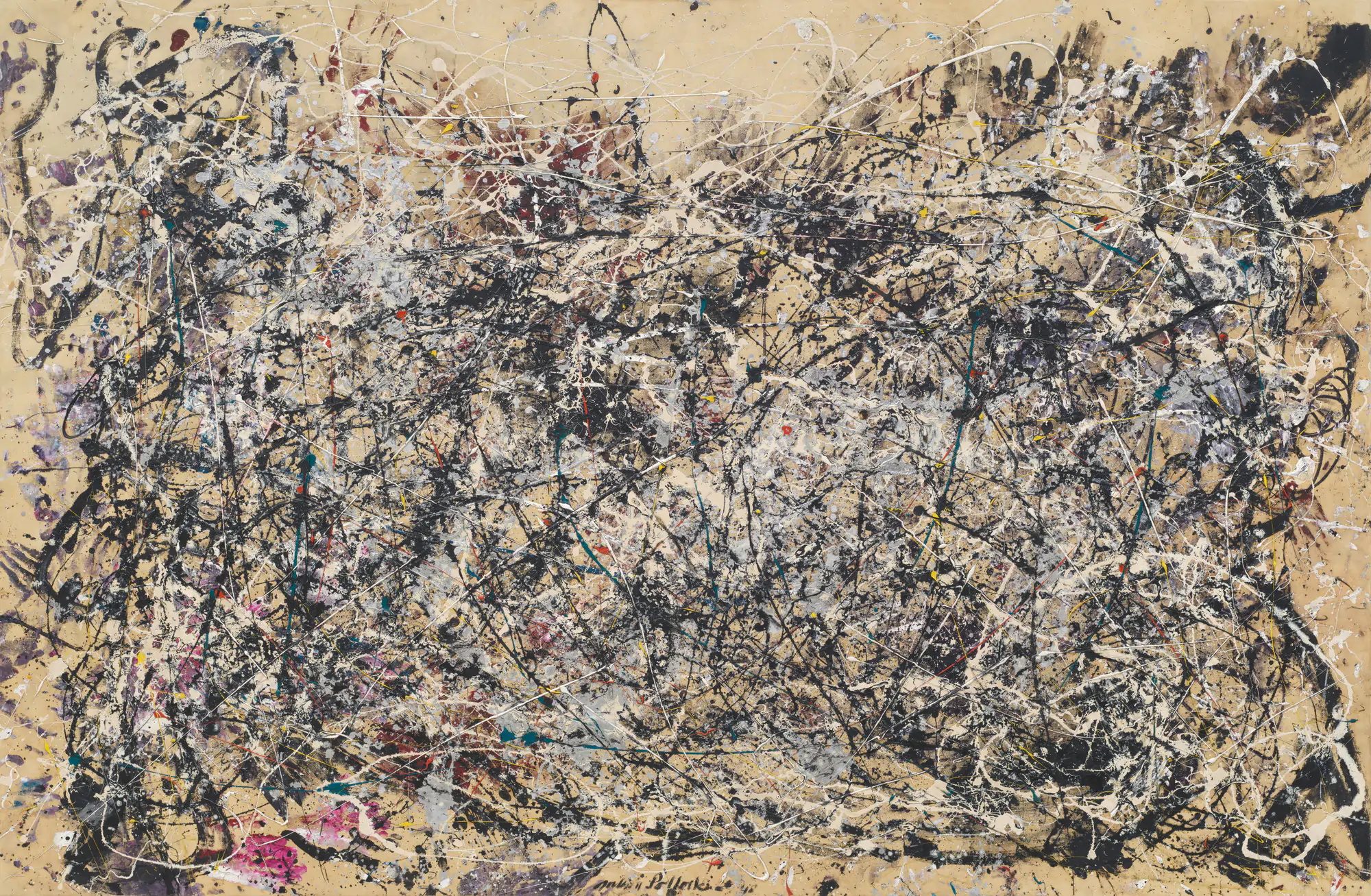
The huge painting “number 1a” by Jackson Pollock, from 1948, has since hidden the secret of the blue pigment: in fact, over the years several studies have identified the red and yellow pigments that are part of its main palette, while the vibrant blue of the painting has remained indefinite for a long time. This until the famous “action painting”, currently exposed to the Museum of Modern Art in New York, was not exposed to spectroscopic light.
Even just by observing the “number 1a”, there are immediately details that make the Pollock painting unmistakable: the typical style of “drip” painting, that is, counted from above, the imprints of the artist’s hands at the top right, or even the “title -title” represented by a simple number -habit that the artist Lee Krasen, his wife, explained to be a way to make the observers concentrate only on the painting – Finally, the vibrant colors that have always intrigued scholars and art enthusiasts.
The study published in the US magazine Proceedings of the National Academy of Sciences He established that this blue is a vibrant synthetic pigment known as “Manganese blue”. To identify the exact origin of the pigment, the researchers took fragments of blue painting and used laser used to spread the light and measure the vibration of the painting molecules. This provided them with a unique chemical imprint for color, which identified just as “Manganese blue”: it is the first confirmed test of the use of this specific blue by Pollock.
This pigment has often been used by artists (as well as to color the cement of the swimming pools) because it is equipped with high stability in light, temperature and humidity. In the 90s, however, it was gradually eliminated for environmental and safety reasons: the Manganato of Barium, this is the scientific name of the pigment, is in fact toxic (by inhalation), which is why it has been replaced by new industrial compounds that produce the same color.