The Autopen, a machine to automatically sign documents also used by the US presidents, is an object that has returned to the limelight in recent months because of some American political vicissitudes. There is a lot of talk about it especially in these days, given that the current President of the United States, Donald Trump, in presenting the new gallery that hosts the portraits of the various “Potus”, instead of the portrait of his predecessor Joe Biden, has placed the photograph of one of these machines, indicating under the name and mandate dates. A deliberately symbolic gesture, which recalls the accusations launched by the Republicans according to which Biden would have abused the Autopen to sign not only routine correspondence, but also delicate acts, such as the presidential graces, all to mask his cognitive decline.
When the autopen was born and how it works
We take a step back and retrace the historical origins of the autopen. The idea of automatically replicating writing is not a recent invention. Just think that already Thomas Jefferson, at the beginning of the 19th century, used a device called polygraph and that, in some ways, we could consider an “ancestor” of the Autopen. While writing a document, secondary mechanical arms of the polygraphic simultaneously traced an identical copy on another sheet. It was a rudimentary, and effective way, to which the 3rd US president resorted to save time.
The actual autopen, however, appeared more than a century later, in the 1930s. In those first versions the signing of the owner was engraved on a rigid matrix and a mechanism made of shaped discs capable of transforming the rotary motion into linear movements, called cams, led the stylus along the engraved route. The result was a faithful and always identical reply of the original signature, useful in institutional or commercial contexts where hundreds of authenticated copies were needed.
The public was able to access automated writing tools only in 1937, thanks to the invention of the “Robot Pen”, published in Popular Mechanics (May 1937, p. 657). A few years later, in 1942, a certain Robert M. De Shazo Jr. developed a model that soon became popular in the rooms of the United States government: among his users, for example, Gerald Ford and Harry Truman were among his users.
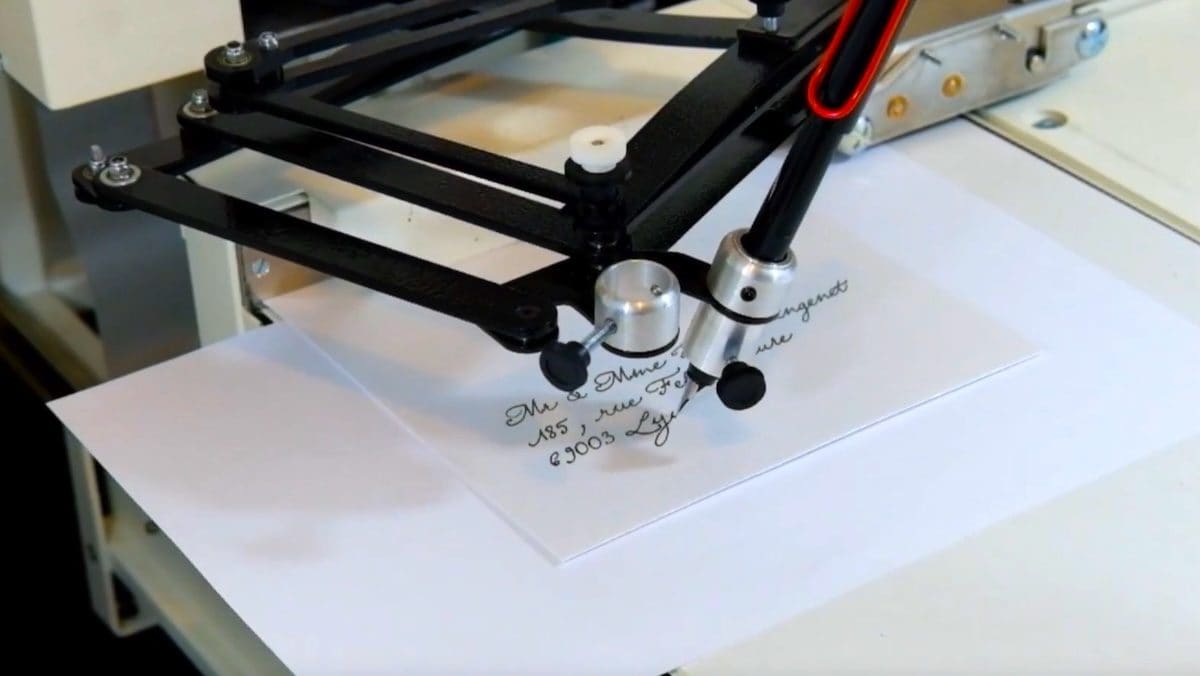
In the 1950s, the models evolved into electromechanical versions similar to today’s platter. In these appliances, two independent engines move an arm that holds a common pen along the X and Y axes, following pre-recorded coordinates. The most recent models use Stepper engines, capable of checking precisely speed, corner and pressure of the stretch. Some devices integrate memories with authorized signatures, non -zeroing users and automatic power supplies to sign hundreds of pages below.
From a practical point of view, the autopen works like a robot pen. Unlike a simple digital image, the car really writes, and this technical detail is important because it makes the signature more credible from a graphic and, above all, legal point of view.
How widespread the use of the autopen between the US presidents is
Speaking of the term “autopen”, this spread thanks to theInternational Autopen Company by Arlington, producer of the machines with that denomination. One of their best known models, model 50, was used intensively by the staff of John F. Kennedy to affix its signature to various documents. The first American president publicly admitting the use of a tool to automatically sign was Lyndon B. Johnson, who even granted permission to make Autopen photograph the White House. In 1968 the photo in question appeared in National Enquirerin an article entitled “The robot that sits in for the president” (that is to say, “The robot that replaces the president“).
Over time, the use of the Autopen took root so much in the US institutions that, in 2005, the Department of Justice officially sanctioned the legitimacy of this practice, recognizing the Presidents the possibility of signing legislative documents through automatic devices. This is why Barack Obama, in 2011, was able to sign an extension of the Patriot Act Thanks to Longpen, a variant capable of reproducing also the biometric dynamics of the gesture, from rhythm to pressure. And, as far as he criticized his predecessor, Donald Trump has also resorted to the use of the autopen, both in the previous mandate and in the current one.