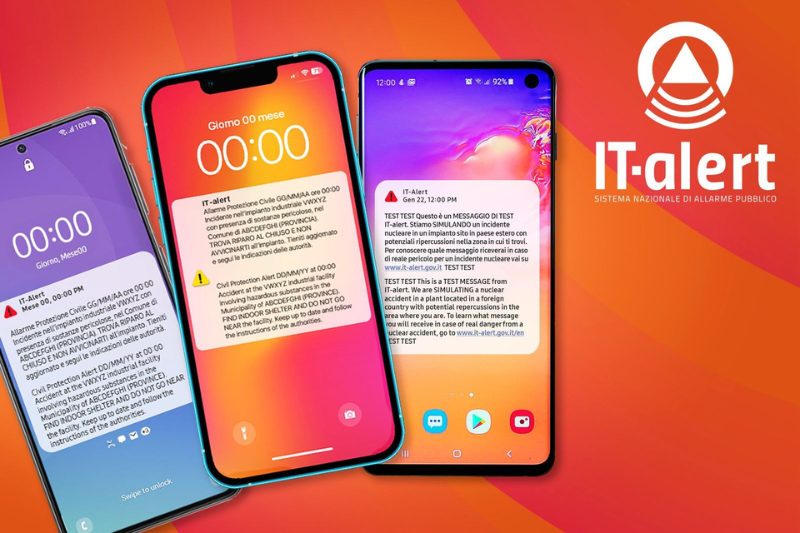
On 1 October 2025, at 10:00 am, a new test of the IT-Art Alarm System will be held in Lombardy for the risk of collapse of a large dam: the simulation will concern the Reggio dam, located in the municipality of Garzeno (CO), and will involve three municipalities in the Como which could be affected by the wave of full result in the possible collapse of the dam (Garzeno, Gravedicona and Uniteda). The test consists in sending a message to all mobile phones – even not connected to the Internet – present in the telephone cells of the target area. Citizens will also be proposed a questionnaire to evaluate the functioning of the alarm system.
But where are we with the experimentation of It-Alert after 2 years from the first public alarm experiments? For the moment, the system works only for four of the seven risk scenarios provided by the EU directive 2018/1972: nuclear accidents, industrial accidents, collapse of a large dam and volcanic activity; While Maremoti, the volcanic activity of Stromboli and intense rainfall, in fact, are still in the test phase.
After a dense test program between 2023 and 2024, in 2025 another 6 simulations were made (7 with that of 1 October), dedicated to specific risk scenarios to verify the correct functioning of the system and identify the parameters to be optimized to improve their effectiveness.
At what point we are with the experimentation of the It-Alert alarm system
IT-ALORT was launched in 2023 on the basis of the provisions of the directive of the Minister for Civil Protection and the Policies of the Sea: over the past two years he has been tested on a national scale with numerous periodic simulations, from a hypothetical earthquake in the Strait of Messina to a possible eruption at the Flegrei camps. At this moment, however, the system works only for 4 specific risks:
- Nuclear accidents or radiological emergency situation.
- Relevant accidents in industrial plants.
- Collapse of a large dam.
- Volcanic activity in the areas of the Flegrei fields, Vesuvius and on the island of Vulcano.
In the event that one of these natural disasters or disasters should happen, the public alarm system should promptly report it, notifying the risk of all citizens of the neighboring areas.
However, there are 3 types of risks for which it-art is still in the experimentation phase, namely:
- Possible tsumer generated by an earthquake.
- Stromboli volcanic activity
- Intense rainfall.
For these three scenarios, the experimentation will last at least another year: the tests, in fact, are essential to verify the correct functioning of the system, evaluate that the telephone cells present in the affected area guarantee the necessary coverage, but also to ensure the efficiency of the communication flows.
Since it was launched It-Art has only started on two occasions: on 9 December 2024, following an explosion in the Eni refinery of Calenzano, in the province of Florence, and on April 25, 2025 on the occasion of the funeral of Pope Francis, to warn the population of the enormous influx of people in Piazza del Vaticano and indicate the escape routes in the event of an emergency.
The simulation of 1 October for the risk of collapse of the Reggio dam
As mentioned, the seventh simulation of the IT-Art system for 2025 will be held on 1 October, which will concern the collapse of the Reggio dam, located in the municipality of Garzeno (CO). The test message will be sent to all the telephone cells active in the three municipalities of the Como which could be affected by the wave of full consequent in the collapse of the dam, that is, Garzeno, Gravedona and Uniti and Dongo.
The notification will contain the following text:
Test test this is a message of it-art test. The simulation of the collapse of a dam is underway in the area where you are. To know the message you will receive in case of real danger and to fill in the questionnaire go to www.IT- allert.gov.it test test
As always, the notification will be accompanied by a sound alarm that will resonate in all smartphones: the population concerned, however, will not have to do anything, but can choose to fill in a questionnaire (not mandatory) to communicate whether the Alert has been received or not and ensure the efficiency of communication flows in the future.