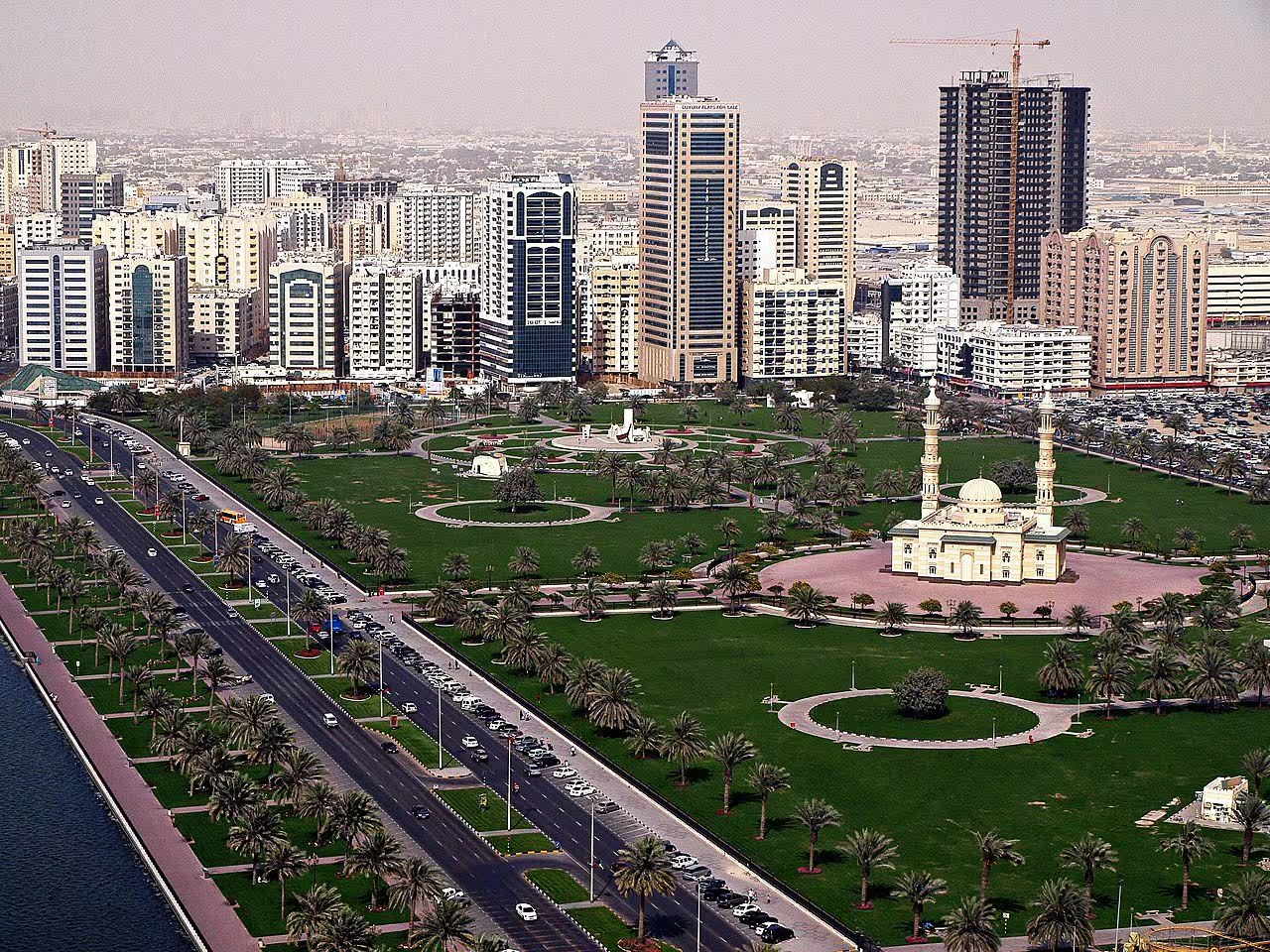
After almost four years since the start of the Russia-Ukraine war, the first trilateral meeting between Russia, the United States and Ukraine was held yesterday, January 23, in Abu Dhabi, in the United Arab Emirates, to try to find a diplomatic agreement for the end of the war between Russia and Ukraine. The focus of the meeting also concerns the issue of security and stability of post-conflict Ukraine in the event of a permanent ceasefire with Russia, and above all the issue of disputed territories, in particular the Donbass region. The negotiations are taking place in Abu Dhabi, in the United Arab Emirates, a country that is taking on an increasingly central role among the Gulf countries as an international mediator.
Because the trilateral is taking place in the United Arab Emirates
The United Arab Emirates (UAE) has played the role of mediator for numerous international negotiations in the past, such as between India and Pakistan, and also for international conferences such as COP28 in 2023. There are various factors to consider to understand why they are chosen as the place for diplomatic agreements and international negotiations.
This is for various reasons. First of all, for the strategically balanced position of cooperation with both Russia and the USA. In fact, if on the one hand the United Arab Emirates maintain solid relations with the United States, on the other they are also strengthening ties with Russia, offering themselves as a neutral place in which international negotiations can be held.
Another element to take into consideration is that the United Arab Emirates is a growing and strong economic power from an energy point of view, with an economy based on resources such as gas and oil, therefore it has a strong will to maintain regional stability and solid relations with alliances outside the Gulf countries, especially in a context of major conflicts and instability from a geopolitical point of view.
Furthermore, the geographical position, together with the infrastructures and advanced technologies create a favorable context for diplomatic agreements. The United Arab Emirates, together with other Gulf countries, are also strengthening their ties with China and are establishing themselves as international technological powers, including in the field of artificial intelligence, which for superpowers like the United States is also crucial for issues related to national security.
The highlights of the negotiations in Abu Dhabi
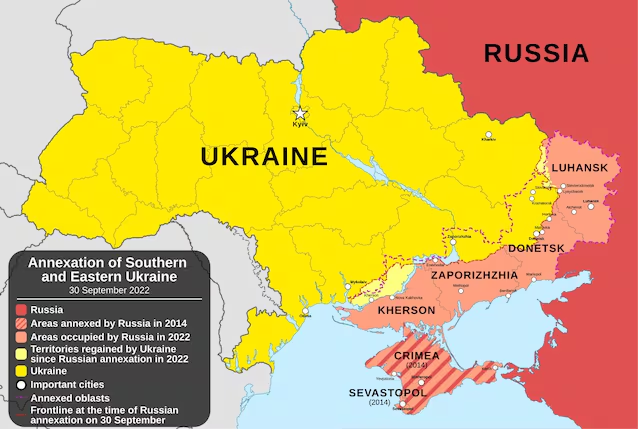
One of the issues in the ongoing negotiations between Russia and Ukraine concerns the control of the territories of eastern Ukraine, in particular Donbass. In fact, Russia claims entire control over the Donetsk and Lugansk regions, and in particular over areas such as Slovyansk and Kramatorsk, still under Ukrainian control.
Steve Witkoff and Jared Kushner and Secretary of the Army Dan Driscoll are participating in the Abu Dhabi trilateral. On the Ukrainian side, Rustem Umerov, Kyrylo Budanov, diplomatic advisor Serhii Kyslytsia and Ukrainian military chief of staff Andrii Hnatov. Russia sent Kirill Dmitriev and the head of military intelligence, Admiral Igor Kostyukov. This also makes clear the desire to underline the military and defense strength as well as the political one.
Another important point in the negotiations, besides Donbass, is Russia’s demand for Ukraine to give up its ambition to join NATO and reject any presence of NATO troops on Ukrainian soil even following a peace agreement.
The results of the first day of negotiations
The first day of negotiations between Russia and Ukraine did not lead to the signing of an agreement. The initial draft was not well received by Kiev as it was considered unbalanced towards the Russian counterpart who then rejected the subsequent drafts. The crux remains the territorial question.
Meanwhile, Ukrainian President Volodymyr Zelensky said he had agreed with US President Donald Trump on a new supply of the Patriot air defense system, with PAC-3 missiles. Meanwhile, a plan for reconstruction was also announced by the European Commission on the future of Ukraine, entitled Roadmap to prosperity: a vision for Ukraine 2040which envisages an investment plan of 800 billion dollars over 10 years, between public and private capital, after reaching a peace agreement.