
Doping generally refers to the illegal use of drugs or medical practices to improve sporting performance. It is the most common, but not the only, way of cheating in competitions and, although sporting institutions have waged a tough fight to combat it, it is still very widespread. Doping has existed since sport was born, but in the past it was perfectly legal: there were no controls and athletes could take any substance they wanted. Only since the 1960s have sports institutions banned the taking of specific drugs and introduced anti-doping controls to ensure that athletes were not taking them. Doping, however, continued to be practiced on a large scale, in some cases even in the form of state doping, i.e. with the incentive of national sports institutions.
What is doping
Doping means the intake of pharmacological substances or the use of medical practices to improve sports performance. Among the most common drugs taken by athletes are anabolic steroids, which increase physical endurance and muscle mass; stimulants, which reduce the feeling of tiredness. Doping substances can have serious side effects on those who take them and, in extreme cases, even cause death.
For these reasons, doping is prohibited: if athletes could take any substance, in the competition their sporting ability would not be measured, but rather their willingness to risk their health; the more an athlete would be willing to risk, the more his performance would improve.
Legal doping. From the origins to the 60s
Doping has always existed: it was practically born together with sport. Already in the Greek world, athletes made use of foods, such as herbal infusions, which according to the beliefs of the time improved performance. In modern sport – born, as we know, in the nineteenth century – doping has been present since its origins and is based above all on the intake of industrially produced drugs.
In 1896, at the dawn of modern sport, the first confirmed case of death occurred during a competition due to taking drugs. A cyclist, Arthur Linton, suffered cardiac arrest while taking part in the Bordeaux-Paris race. More fortunate was Thomas Hicks, an American runner whose coach gave him two injections of a stimulant, strychnine sulphate, during the 1904 Olympic marathon, which allowed him to reach the finish line first.
Doping was present in many sports. One of those most affected was cycling: in the 40s and 50s almost all runners took the so-called “bomba”, a drink composed of various doping substances, and admitted it without difficulty. An interview with Fausto Coppi, one of the most famous cyclists of all time, who joked without any embarrassment about the use of the “bomb” has remained famous.
The introduction of anti-doping
Until the 1960s, public opinion and sports institutions tolerated athletes taking substances to improve performance. The attitude changed due to some tragic events. The first was the death during the 1960 Rome Olympics of the Danish cyclist Knud Enemark Jensen, who fell ill due to drug abuse. In 1967 another cyclist, the Englishman Tommy Simpson, died during the Tour De France.
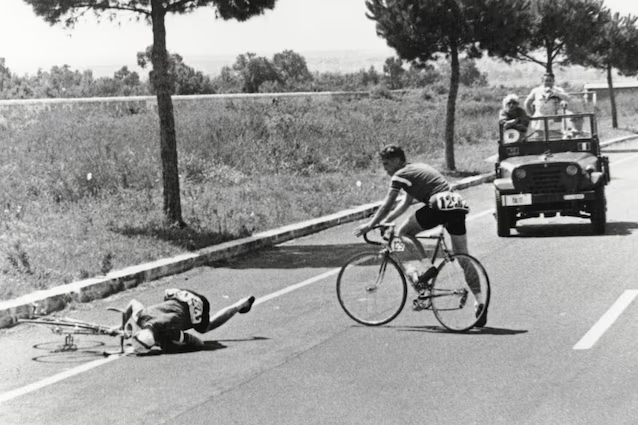
Faced with events of this kind, during the 1960s most sports federations banned the intake of certain substances, establishing medical checks (blood and urine tests) to ensure that athletes did not use them: doping had become illegal and, at the same time, anti-doping was born.
The IOC, for example, introduced anti-doping at the Mexico City Olympics in 1968. The first Olympic athlete disqualified was Sweden’s Hans Liljenwall, who had won a bronze medal in the team pentathlon.
The list of prohibited substances has since been updated many times.
Doping during the Cold War
Despite the introduction of controls, doping continued to be practiced on a large scale. In some cases, national Olympic committees have promoted “state doping”, encouraging athletes to use prohibited substances. This was what happened between the 1960s and 1980s in several Eastern European countries, including East Germany. The drugs had serious side effects and in one case altered the psychosomatic characteristics of an athlete to such an extent that they forced her to change sex: Heidi Krieger, European shot put champion in 1986, underwent surgery in the 1990s to become male, taking the name Andreas.
Doping, however, was not only widespread in Eastern Europe, but also in Western countries, including Italy, sometimes with the complicity of national sports institutions. In the Olympic context, some of the most egregious cases occurred at the 1988 Seoul Games, sometimes called the doping Olympics. For example, the hundred meter race was won by Canadian Ben Johnson, who three days later was disqualified because tests proved that he had taken illegal substances. Strong suspicions of doping have also been raised for other protagonists of the Seoul Olympics, such as Carl Lewis, the famous American sprinter who won the gold medal in place of Ben Johnson.
The situation today in sport
In recent years, doping has continued to be practiced on a large scale. One of the most affected sports was, as in the past, cycling. In the 1990s and 2000s, most professional runners used banned substances. Some events have caused a particular stir, such as the one involving Marco Pantani, who was excluded from the Giro d’Italia in 1999 (although not disqualified) because a test revealed that a blood value, the hematocrit, was outside the norm. Pantani, who died a few years after the disqualification, always professed his innocence, but his values were also found to be altered on other occasions and furthermore, analyzes proved that he had taken illicit substances during the Tour de France which he won in 1998.
An even more famous case is that of Lance Armstrong, the American cyclist who survived testicular cancer in the 1990s. Armstrong managed to recover and, upon returning to racing, became a great champion, to the point of winning seven consecutive Tours de France from 1999 to 2005. The story aroused strong emotion throughout the world, but in 2012 it was discovered that the successes were due to the doping system organized by the cyclist together with his teammates. Faced with overwhelming evidence, Armstrong was forced to admit his responsibility and the International Cycling Union declared all his victories null and void.

In recent decades, to combat doping, national agencies have been established in individual countries and in 1999 a global agency, the Wada (World Anti-Doping Agency). The phenomenon, however, has not been eradicated.
In recent times, a widespread doping system was discovered in Russia. In 2015, a WADA investigation brought to light that many athletes in the country were taking illegal substances with the complicity of the national anti-doping agency. After the investigation, Russian athletes faced heavy sanctions. Doping, however, is not only widespread in Russia, but continues to be present on a large scale throughout the world.