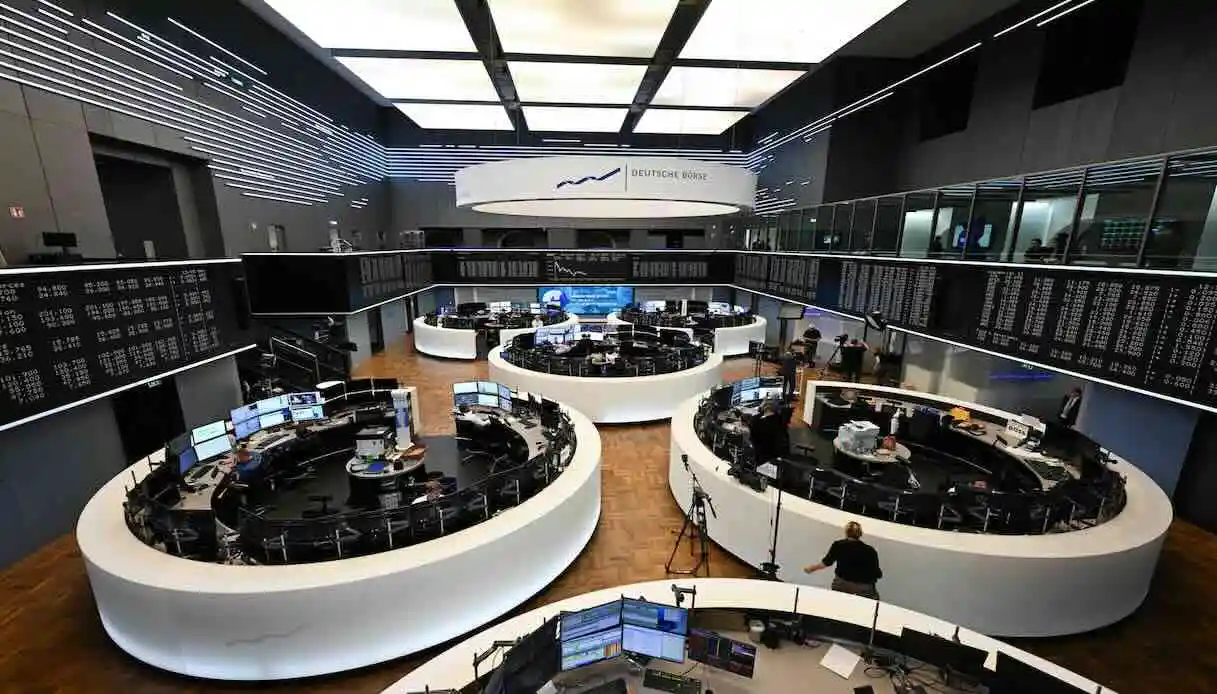
European stock markets closed both the last session and the entire week in the red, with the conflict in the Middle East continuing to weigh on sentiment, fueling fears about energy, inflation, future moves by central banks and global growth. The STOXX 600 is down about 9% since the beginning of March.
There continues to be great confusion about the real status of indirect talks between Washington and Tehran. Steve Witkoff, the US special envoy, spoke of “strong signals” pointing to a possible solution and confirmed that a 15-point de-escalation plan had been conveyed, but several Iranian officials again criticized the proposal, calling it “unbalanced” and insisting that no acceptable option was put on the table. US President Donald Trump has extended by 10 days the deadline for Iran to reach a deal with the United States or face attacks on its energy sites, saying talks were progressing very well. Just a few hours later, the White House hardened its stance again, declaring that the president was ready to “unleash hell” if Tehran made “a grave error of judgment.”
On the macroeconomic front, in the Eurozone in February the inflation expectations of families recorded by the ECB showed a decline to +2.5% from +2.6% on both horizons (1 and 3 years). In the United States, the final reading of the University of Michigan index for March was worse, with a value of 53.3 compared to the preliminary 55.5.
European price lists
Among the European stock markets, Frankfurt slips, with a clear disadvantage of 1.38%, London remains close to parity (-0.05%), and Paris is in the red, showing a sharp decline of 0.87%.
On Piazza Affari, the FTSE MIB is decreasing (-0.74%) and stands at 43,379 points at closing; along the same lines, a negative day for the FTSE Italia All-Share, which closed the session at 45,646 points, down by 0.71%. The FTSE Italia Mid Cap (-0.23%) is just below parity; as well as negative changes for the FTSE Italia Star (-1.03%).
Italian titles
At the top of the ranking of the most important stocks in Milan, we find Inwit (+3.26%), Amplifon (+1.31%), ENI (+1.21%) and Terna (+0.91%). The worst performances, however, were recorded on Leonardo, which closed at -3.35%. Buzzi’s negative performance stands out, falling by 3.25%. STMicroelectronics drops 2.75%. Sharp decline for Moncler, which marks -2.57%.
Among the best stocks in the FTSE MidCap, SOL (+14.69%), Philogen (+2.73%), Pirelli (+0.82%) and Cembre (+0.78%). The worst performances, however, were recorded on Avio, which closed at -6.25%. GVS is under pressure, with a sharp decline of 3.40%. D’Amico suffers, showing a loss of 3.07%. Prey of CIR sellers, with a decrease of 2.94%.
The energy market
Brent oil prices remain around $110 a barrel, very close to the levels of a week ago. The price trends of many refined petroleum products diverged markedly from that of crude oil in some areas, as the war had an uneven impact on global refining capacity. For example, the price of gasoline increased relatively more moderately than that of diesel or kerosene. Trump’s post announcing the postponement of attacks on Iranian energy infrastructure calmed the market on Monday, but sentiment weakened again at the end of the week. Trump’s deadline for negotiations has now been postponed to April 7.
Next week
Looking ahead to next week, on the macro front all eyes are on the March Eurozone inflation report, due on Tuesday, which will provide the ECB with very important information on the impact of the war in Iran on prices; the market predicts an acceleration of inflation to 2.6% (February: 1.9%). As a preview, the report on Spanish inflation, published today, recorded a more moderate acceleration than expected (3.3%; forecast 2.5%; consensus 3.8%). Also important will be the March US job growth report, due on Friday.