The identity of theIran it does not simply coincide with the Persia: while the latter represents the historical and linguistic cradle of the Persian people, Iran has embodied a broader concept for millennia, namely that of “Land of the Aryans”. It is a complicated mosaic of different peoples, in which the Persian component acts as a glue.
This driving function was born with Cyrus the Greatthe architect of history’s first universal empire. Under his leadership, Persia stopped being a single region to become a cutting-edge political model: a vast domain capable of uniting different peoples and faiths under a single, unprecedented administration based on tolerance.
Indo-European roots: from Cyrus the Great to the first universal empire
The Persians, about 50-60% of the population of today’s Iran, are an Indo-European people who, between the 10th and 7th centuries BC, migrated to the Iranian plateau. Simplifying. it is a civilization that, from a linguistic point of view, has much more in common with us Westerners than the various Semitic ethnic groups of the region, such as Jews or Arabs.
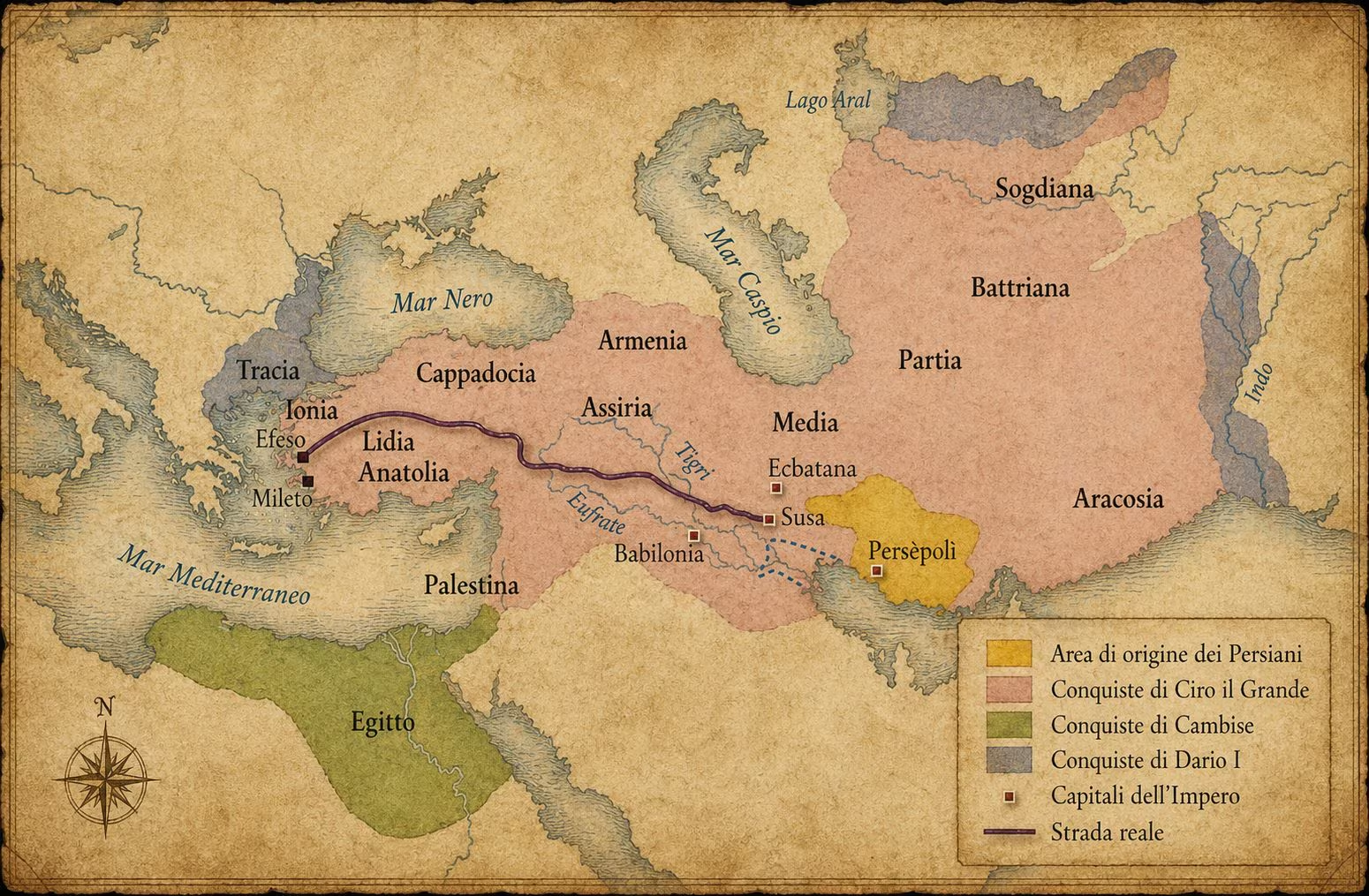
The history of the Persian Empire officially began in 550 BC with Cyrus the Great. He created an empire that extended, also thanks to his successors, from Egypt to India: 5.5 million square kilometers. A kingdom held together not only by force, but by religious tolerance, as demonstrated by the famous Cyrus Cylinder. With this ancient document, made of terracotta, the sovereign grants freedom of worship to all subjugated peoples. Not only that: he authorizes the Jewish prisoners in Babylon to return to Israel, where they build the Temple of Jerusalem.
In doing so, the Persian kings do not present themselves as simple conquerors, but as protectors of the freedom and well-being of their subjects. It is no coincidence that in 1971 the United Nations Organization (UN) translated the Cylinder into all the official languages of the world, defining it as a “forerunner of human rights”.
However, the Persians are not only skilled politicians, but also extraordinary engineers. They create numerous futuristic works such as:
- Qanat: underground channels to transport water into the desert without letting it evaporate.
- Paradises: lush gardens that gave their name to the very concept of an idyllic place (from the Greek paradeisos and the Persian pairi-daeza).
It is with the advent of the dynasty Achaemenid that the concept of Iran is beginning to crystallize politically. Darius I, in his monumental inscriptions such as that of Naqsh-e Rostam, proudly claims his ethnic and spiritual identity: «Pārsa, Pārsahya puça, Ariya, Ariya ciça»that is to say «Persian, son of a Persian, an Aryan, of Aryan lineage». While not yet using the name “Iran” in its modern form, Darius places himself as the ruler ofAryānām khšaθrathe “Kingdom of the Aryans”, defining for the first time an imperial identity that went beyond the borders of the single province of Fars.
From Satraps to Magi
A sovereign, however capable, certainly cannot govern such a vast territory alone. For this reason the Persian empire was divided into provinces, the satrapies, each administered by a governor (the satrap) and connected to each other by a road infrastructure: the Royal Road. This network allowed communications and troops to move with unprecedented speed, while Aramaic (the language that centuries later would also be spoken by Jesus) served as a universal glue for trade and diplomacy.
As the royal court moved between the splendid imperial cities of Susa and Persepolisthe spiritual heart of the kingdom beat around the Zoroastrian religion. At the center of their cult burned the Sacred Fireworshiped not as a deity, but as a symbol of Ahura Mazda (the Wise Lord). For the Persians, fire represented the light of truth and absolute purity; keeping it lit was a cosmic act to protect order against chaos.
Guardians of fire and knowledge were the magi, priest-scientists from whose term the words magic and magician derive. This philosophical vision was revolutionary, introducing for the first time in history the dualism between Good and Evilthe concepts of heaven and hell and the idea of a final judgment. Concepts that then profoundly influenced Judaism, Christianity and Islam.
From Alexander the Great to the clash with Rome
As early as the 4th century BC, Greek philosophers theorized it “clash of civilizations”: on one side the free West, on the other the despotic East. An idea born from the scars of legendary battles such as Thermopylae and Salamis. But history loves surprises: when Alexander the Great overthrows the Persian Empire, does not erase its identity. On the contrary, he marries her, fusing the Greek world with the oriental one and giving life toHellenism.
However, the legacy of Cyrus the Great does not fall into oblivion: the dynasties of the Leave and gods Sasanians they forcefully claim it, erecting themselves as a bulwark against the new rising superpower: Rome. After having defeated Carthage, Rome begins to look insistently towards the east, and the rivalry immediately turns into a bloodbath. Illustrious names pay the price: the triumvir Crassusthe richest man in Rome, ends up annihilated and killed in battle at the hands of his eastern enemies. Even Julius Caesarbefore falling to the stabs on the Ides of March, was finalizing preparations for a colossal punitive expedition against them.
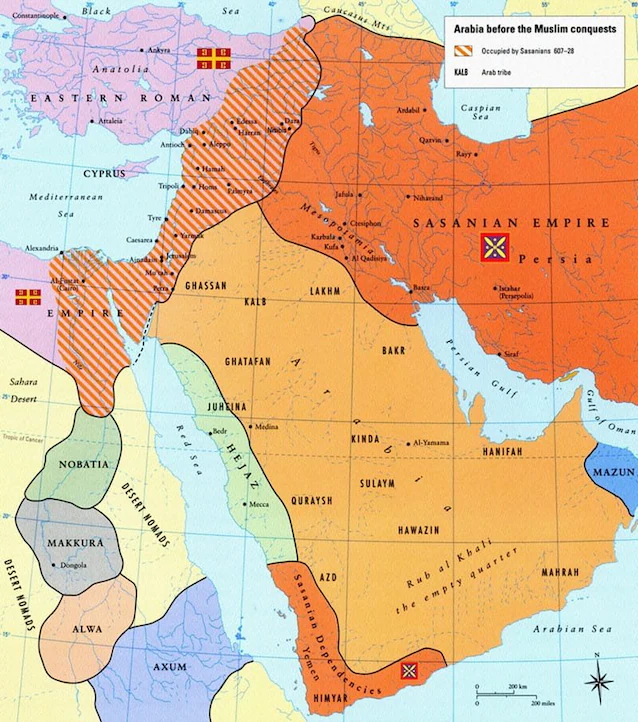
For seven centuries, the river Euphrates it was the “red line” of antiquity, the border between two titans who look at each other with hostility. An epic clash which, however, ended in a real one geopolitical suicide: in the 7th century AD, exhausted by endless wars and with empty state coffers, the two giants collapsed in on themselves, leaving the field open to a new, unstoppable protagonist: the Arab advance.
The metamorphosis: the engine of the Islamic Golden Age
In 636 AD, the Arab invasion – unexpected – marked an epochal turning point, determining the political collapse of ancient Persia and the end of the ruling dynasty, the Sasanian one. However, this event did not lead to the end of Persian civilization. While other regions conquered by the Arabs were simply assimilated, the Persians mounted widespread cultural resistance.
Staunchly defending the Farsi as a language of expression and identity, Persian integrated into the structures of the new Islamic world, becoming its mind. Since their Arab conquerors had no experience in managing a large empire, they relied on the Persians, who became the true “policy engineers” of the caliphates, especially during the Abbasid dynasty in Baghdad.
This fusion between the overwhelming Arab religious drive and the thousand-year-old Persian wealth of skills has lit the fuse of Islamic Golden Age. It is a moment of intellectual grace unique in history: while Europe was experiencing the “dark ages”, giants of thought flourished in the area of the former empire.
Let’s think about Al-Khwarizmithe mathematician who literally invented algebra (the term itself comes from his treatise al-Jabr), or ad Avicenna (Ibn Sina), whose “Canon of Medicine” was the sacred manual of European physicians until the 17th century.
In essence, a fascinating geopolitical paradox occurred: Persia lost its political independence for centuries, submitting to the caliphates, but ended up conquer culturally its own rulers. The Arabs brought religion and the language of administration, but to manage such a vast empire they had to adopt the bureaucracy, art, architecture and philosophy of the Persians.
Other peoples who later conquered this region also underwent the same fascination. Not surprisingly too Mongols, or Turks, after conquering Iran militarily, they ended up adopting Persian as the language of court and culture.
The Zoroastrian religion survived Arab domination for several centuries, especially in the mountain areas, saved from oblivion thanks to the escape by sea to India (in Gujarat), where the Parsi community still preserves the sacred texts and traditions today.
The Rebirth and the current mosaic
Independence returned in 1501 with the dynasty of Safavidswho have chosen the Islamic current of Shiism, as opposed to Sunni, as the state religion. The choice, rather than deriving from an ideological reason, was of a political nature, wanting to distinguish itself from the neighboring Ottoman Turks, the new powerful enemies located to the west.
At the same time, the Persians had to face European colonial interference, especially English and Russian ones, which repeatedly threatened the sovereignty of the ruling dynasties. It is in this period that Iran consolidates its nature of Imperial mosaic statewith a delicate balance between different peoples.
Today the country is inhabited by approximately 88 million people, distributed in a delicate balance:
- Persians (about 50-60%): The beating heart of the country. They live in the large central cities (Tehran, Isfahan, Shiraz) and are the custodians of the Farsi language and imperial heritage.
- Azeris (about 16-24%): In the northwest (Tabriz). They are a Turkish-speaking people but of Shiite faith, perfectly integrated into central power and the economy, so much so that they represent the most influential minority.
- Kurds (about 10%): Perched along the Zagros Mountains to the west. Indo-European people of Iranian lineage, they consider themselves the descendants of the Medes and preserve thousand-year-old mountain traditions, colorful clothes and a visceral connection with nature.
- Luri (about 6%): Also children of the Zagros, they are closely related to the Persians but maintain a distinct tribal and nomadic culture, famous for resilience and independence.
- Arabs (about 2%): Concentrated in the southwest (Khuzestan). They speak an Arabic dialect but are predominantly Shia; they live in the region that holds 80% of Iranian oil, a vital strategic piece.
- Baluchi (about 2%): They inhabit the arid south-east, bordering Pakistan and Afghanistan. I am of Iranian descent but of faith Sunnia detail that makes them a religious as well as ethnic minority, with a desert and proud culture.
- Turkmen and Qashqai: In the north-east and in the nomadic areas of the south, they carry the legacy of the Asian steppe tribes, with their Turkic languages and famous geometric carpets.
For centuries, the outside world called this land “Persia”, a name that derived from only one of its regions (Fars). However, in 1935Reza Shah Pahlavi’s government formally asked foreign nations to use the name exclusively Iran. It wasn’t just a change of label but an act of national pride. A reference to the Indo-European roots common to all the peoples of the plateau and a way to close the era of colonial influences.