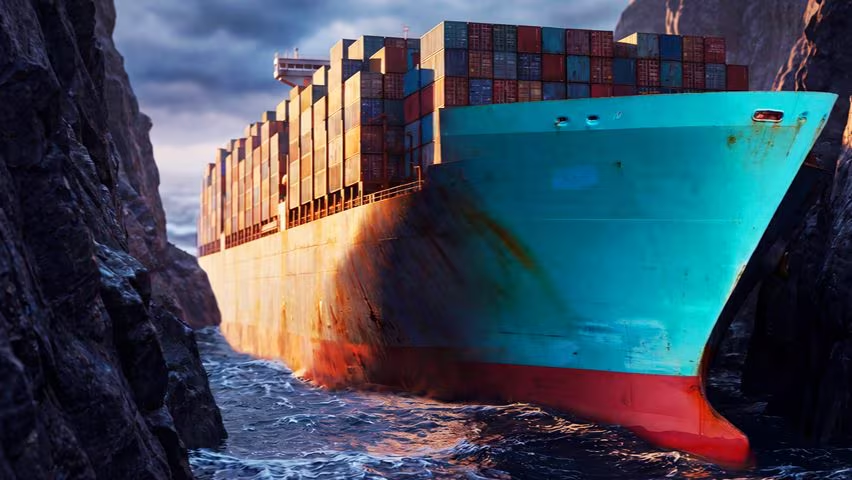
Nearly 80% of world trade travels by sea. Not by ideological choice, but by pure economics: a ship carries in a single voyage a quantity of goods that would require thousands of trucks or planes to transport by land or air. The consequence is that geography still decides the flows, with global trade being forced to pass through a few maritime corridors, i.e. the natural bottlenecks that the English call “choke points”.
There are nine key choke points around the world: of these, only one is not in Western hands, the Strait of Hormuz. And in 2026, for the first time in recent history, four of these bottlenecks are simultaneously under pressure.
What are the 8 “choke points” and why do they govern traffic on the planet
The maritime corridors that support global flows are the Suez Canal, the Strait of Bab el-Mandeb, the Strait of Hormuz, the Strait of Malacca, the Panama Canal, the Strait of Gibraltar, Bosphorus and Dardanelles (often considered together) and the Cape of Good Hope, which although not formally a strait is an obligatory crossing point in the open sea.
Each of these has different characteristics and a different exposure to geopolitical and climate risks: for example, the Strait of Malacca, between Indonesia and Malaysia, is the busiest in terms of number of ships and manages around 25% of global maritime trade, with a decisive role for energy flows towards China, Japan and South Korea. The Suez Canal and the Bab el-Mandeb Strait combined are worth around 12-15% of global traffic, while the Panama Canal manages another 5%. Finally, the Strait of Hormuz is the key to world energy: approximately 20% of the oil traded by sea passes through it and a similar share of liquefied natural gas.
Why the Strait of Hormuz is different from the other eight
Since the mid-twentieth century, the United States, alone or through allies, has militarily and diplomatically presided over almost all the great maritime corridors of the planet. Gibraltar is British territory, historical allies of the USA, Bosphorus and Dardanelles are in the territorial waters of Türkiye, a NATO member. Panama, Suez and Malacca see a strong Western or allied presence. The only big exception is Hormuz, where Iran is on one side. It is the flaw in the global system and it is precisely there that the crisis arises today.
When a choke point closes, the alternative route almost always drastically lengthens both distances and times. To be clear, between Singapore and Rotterdam, the classic route via Suez is approximately 15,350 kilometres. Going around the Cape of Good Hope (in South Africa) you reach 21,770 kilometres, with over 6,000 kilometers more and an extension of navigation times between 8 and 18 days depending on the type of ship.
Without the Panama Canal, however, the route between the Atlantic and Pacific coasts of the United States could triple, passing through Cape Horn. For Malacca, in the event of a blockade, the larger ships would have no maritime alternative, because the seabed in the nearby straits is too shallow.
The closure of Hormuz and the naval blockade today
As we all know, on February 28, 2026, the United States and Israel struck Iran directly, in an attack in which the Iranian Supreme Leader, Ali Khamenei, was also killed. On March 2, the Pasdaran formally announced the closure of the Strait of Hormuz to maritime traffic. In the following weeks, traffic in the strait collapsed by more than 95% and on April 13, 2026, after the failure of negotiations hosted in Pakistan, the Trump administration imposed a naval blockade on Hormuz, physically preventing entries and exits from Iranian ports.
The message is simple. Global trade rests on nine geographical keys: eight are in Western hands, one is not. And the one that is in other people’s hands is precisely the one that is currently slowing down the energy of a fifth of the planet. With each passing day, the blockade of the Strait of Hormuz turns into volatility on energy markets, pressure on gas and oil prices, and a cascade on consumer goods.
This is because the alternatives to Hormuz are not sufficient to completely replace the energy supplies that would normally pass through the Strait.
In fact, there are two large pipelines that bypass Hormuz: the East-West (Petroline) of Saudi Arabia, over 1,200 kilometers long between Abqaiq and Yanbu on the Red Sea, and the Abu Dhabi Crude Oil Pipeline (ADCOP) of the United Arab Emirates, which instead brings crude oil directly to the port of Fujairah, on the Gulf of Oman.
The combined nominal capacity is important (up to 7 million barrels per day for the Saudi pipeline alone, plus 1.8 million for the Emirati one), but almost all of it is already occupied by ordinary flows. In an emergency, the EIA estimates that the truly free capacity to bypass Hormuz is about 2.6 million barrels per day, compared to the 20 million that normally pass through the Strait of Hormuz, almost eight times less. And there is a detail: the Saudi pipeline ends in the Red Sea and if that sea is also in crisis, we are back to the top.
For Qatari liquefied natural gas the situation is even more critical because there are no alternative routes to export natural gas from Qatar and the United Arab Emirates, except through the Strait of Hormuz.
What Italy risks (gas, prices and drugs) and what Europe is doing
And here we come to the point that concerns us most: Italy is particularly exposed on the gas front. In 2024, Qatar covered approximately 45% of the liquefied natural gas imported by our country; in 2025 the share has fallen to around 30-35%, also replaced by greater US volumes, but Doha remains one of our two main LNG suppliers. A prolonged closure of the Strait, therefore, sooner or later translates into an increase in bills.
Then there is the issue of drugs: India is one of the main global hubs for the production of active pharmaceutical ingredients and an important part of the raw materials arrives or transits by sea from the Gulf. When a route like Hormuz closes, medicines such as paracetamol or basic antibiotics risk price increases, because transport times are extended and transport costs rise.
The European Union is also taking action in the face of this crisis: on 17 April 2026, French President Emmanuel Macron and British Keir Starmer co-chaired an international conference in Paris, with the presence of Giorgia Meloni and Friedrich Merz (German Prime Minister) and the connection of around fifty countries. The initiative, formally called “Strait of Hormuz Maritime Freedom of Navigation Initiative”, involves a purely defensive multinational mission with mine clearance and protection of commercial traffic tasks, to be activated only when conditions permit. The mission, however, is explicitly separate from the American naval blockade, with European countries having repeatedly reiterated that they do not want to enter the conflict.









