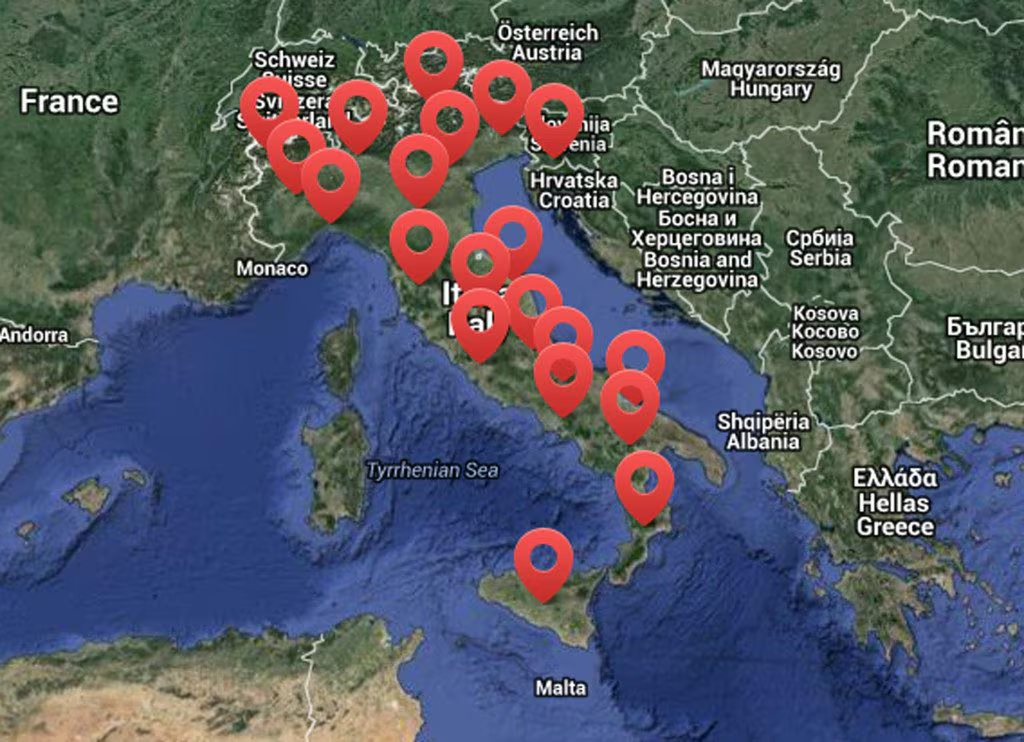
During the Second World War, Nazis and fascists killed thousands of civilians and unarmed partisans outside of armed clashes, with more than 23,000 victims from North to South.Atlas of Nazi and Fascist massacres is a database created to make what happened in Italy between September 1943 and May 1945 measurable, intelligible and therefore more comprehensible.
In the context of the German occupation, Nazi (mostly) and fascist (secondary but consistent) violence spilled over into Italian society in different forms and modalities, even outside the strictly war dimension. In particular against the civilian population and against many unarmed partisans (i.e. not killed in battle).
There were massacres, reprisals, roundups, targeted or indiscriminate killings committed during anti-partisan repression operations, cleansing of the territory or patrols, or pre-planned executions against anti-fascists and opponents, real or presumed.
The research, promoted in collaboration by the National Institute for the History of the Liberation Movement in Italy (INSMLI) and the National Association of Partisans of Italy (ANPI), made it possible to define a complete picture of the episodes of violence: 5626 were recorded episodes of violence e 23662 victims.
Nazi and fascist violence in Italy: the war on civilians
Starting from 8 September 1943, therefore after the landing of the Anglo-Americans in Sicily, the collapse of Mussolini’s regime and the announcement of the armistice signed by the provisional government of Pietro Badoglio with the Allies, Italy plunged into a serious crisis.
Much of the central-north was occupied militarily by the troops of the Third Reich (already an ally of the fascist regime, starting from the Rome-Berlin Axis). King Vittorio Emanuele III moved away from Rome towards the south – together with the royal family, the military and government leaders. There was also the disbandment and partial dissolution of the national army and a great general disorientation.
The peninsula found itself, in fact, cut in two. In central and northern Italy the Nazis faced the Anglo-Americans who were slowly rising from southern Italy. To do so, they imposed strict control of the territory and allowed Fascism to rise again with the foundation of the Italian Social Republic (RSI), an embryonic collaborationist state led by Mussolini.
Within this scenario Italy was severely destabilized. During the German occupation, facilitated and supported by the RSI, an offensive was also launched to crush the Italian Resistance, one of the largest and most widespread armed anti-fascist movements in Western Europe.
Among the most well-known massacres there is for example that of the Fosse Ardeatine in Rome (with 335 deaths among civilians and soldiers, Italians and non-Italians). Or that of Sant’Anna di Stazzema in the province of Lucca (with 560 deaths, all civilians), or the series of massacres in the Monte Sole area in Emilia-Romagna, in the municipalities of Marzabotto, Grizzana Morandi and Monzuno (with over 770 deaths, always civilians).
Such brutal, drastic and dramatic actions represented the maximum expression of violence exercised by the Nazis and fascists. They were not the norm, because they did not happen always and everywhere, but neither were they an isolated or unpremeditated event. They fell into a larger one terror strategy.
Especially in the centre-north (but not only), there was a real war on civilians which affected, in alternating phases, cities and countryside. The bloodiest period in terms of the number of defenseless, unarmed or even previously captured victims (as in the case of the partisans taken into consideration) was between the spring and summer of 1944with 2,521 incidents of violence and 11,774 deaths.
In addition to the homicidal violence, there were further “related violence”: theft or looting, torture and abuse, deportations and rapes.
The numbers of the Atlas of Nazi-Fascist massacres
THE’Atlas of Nazi and Fascist massacres was created on the basis of a previous collaboration between the Italian Republic and the Federal Republic of Germany. It is curated by the Ferruccio Parri National Institute and the Italian Partisans Association, involved more than 90 researchers and produced a database, geographical mapping and a collection of period materials and documents. Here is the data resulting fromAtlas. As already mentioned, 5,626 acts of violence against defenseless people were recorded, which caused 23,662 total victims, according to 2016 data. The most affected regions are in order:
- Emilia Romagna: 4,536
- Tuscany: 4,413
- Piedmont: 2,872
- Veneto: 2,311
- Campania: 1,406
Wanting to provide an identikit of the victims, the data collected shows that the majority of victims are men (87% compared to 13% women). The age group most affected is between 17 and 55 years old: 4% of those killed were aged between 0 and 11 years old, another 4% between 12 and 16 years old, 15% over 55 years old and 77% between 17 and 55 years old. Added to this is the data on the killings of civilians: 12,788 are civilians, while 6,882 partisans died outside of war scenarios.
The study also allows us to extrapolate other characteristics of the victims, the most interesting ones are summarized: linked to the partisans (384), anti-fascists (315), soldiers (277), deserters (225), dodgers (194), stragglers (181), Jews (175), carabinieri (142), religious people (140), prisoners of war (120) and “undefined” (1,839).
In addition to providing detailed data on victims, theAtlas it also provides a series of data that allow the executioners to be identified and described. To do this, the origin of the violence must first be identified, and therefore the origin of those who committed it:
- Nazi alone: 3,407 episodes and 15,110 victims
- Fascist alone: 1,099 episodes and 2,893 victims
- Nazifascist (collaboration): 764 episodes and 4,667 victims
- Unknown: 356 episodes and 992 victims
A classification of the type of episodes is also proposed, such as roundups (7,406 victims) and reprisals (6,215). Shooting, however, was the most used killing method (14,060 victims).
The contexts of Nazi-fascist violence between 1943 and 1945
The factors that led to the countless acts of violence collected and contextualized byAtlas there were many.
The political use of violence – well present in the political cultures of Fascism and Nazism – was further increased by pressure exerted by Anglo-American forces and by the awareness that, on a European scale, the prospect of defeat was becoming more concrete month by month.
On the German side, an attempt was made to eliminate any obstacle to full dominion over Italy. In those circumstances, the Nazi posture towards Italian civil society was also driven by the belief that Italian men and women had proven to be unreliable and uncontrollable.
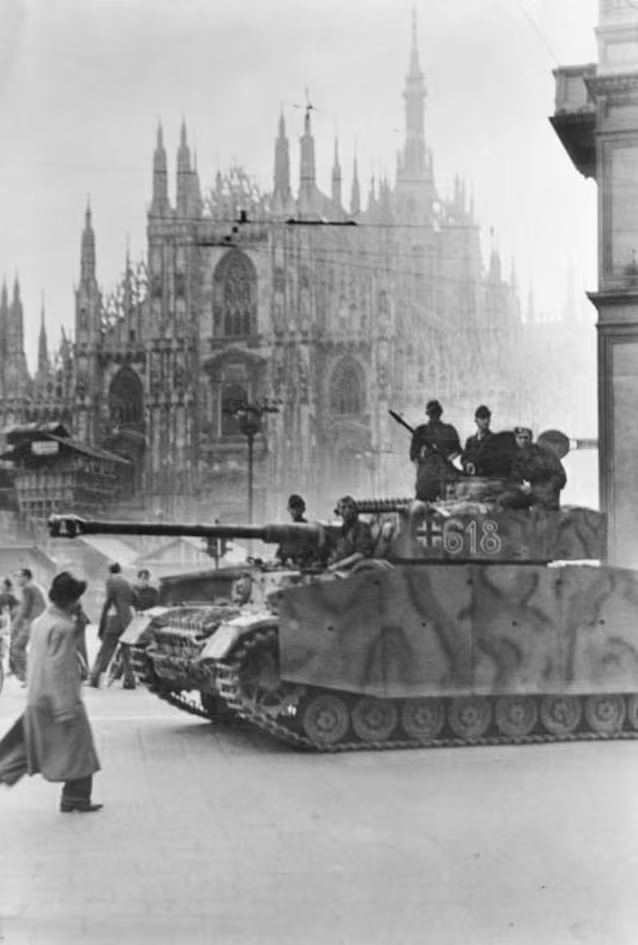
For the Italian Social Republic the use of violence was also a lever to try to reaffirm the legitimacy and legality of the fascist order. It is no coincidence that the enormous difficulties encountered in administrative activities and the shadow of the partisans – considered anti-national terrorists or ferocious criminals – radicalized the RSI.
Already taking place directly, even within the Resistance, Nazi-fascist violence caused discussions, friction and trauma. However, it should be noted that this form of violence was practiced, to a large extent, regardless of what the partisans did. And even in spite of the concrete relationships that linked civilians and partisans (which ranged from complicity to distrust).
The war on civilians carried out by the Nazis had in fact a structural character in many of the countries occupied during the Second World War and on the peninsula it was linked with the will of the fascists to regain power.
In Italy it was unleashed above all for what the Resistance represented – an organised, substantial and expanding nucleus of dissent – even before being justified on the basis of the attacks or attacks that the Resistance itself carried out. In some places Nazis and fascists acted even in the absence of large partisan formations or particular subversive actions.
Ultimately the Nazi-fascist war against Italian society was one war on disobedience; whether real, latent or potential. And it was a lost war.