Every time we think of the capital of a country, it comes naturally to imagine a single large city that hosts the major institutions, from Parliament to the Government. Yet, there are states where it doesn’t work exactly like that: South Africa, for example, is the only country in the world with three official capitals. These are Pretoria, Cape Town (Cape Town) and Bloemfontein, each hosting a different seat of state power. Specifically, Pretoria is the administrative capital, Cape Town is the legislative capital, while Bloemfontein is the judicial capital.
This choice, however, is not at all random, but is the result of a precise state organization designed as early as 1910 to balance the powers over the immense South African territory, which extends for approximately 1,220,000 km2approximately 4 times the surface area of Italy.
What are the three capitals of South Africa
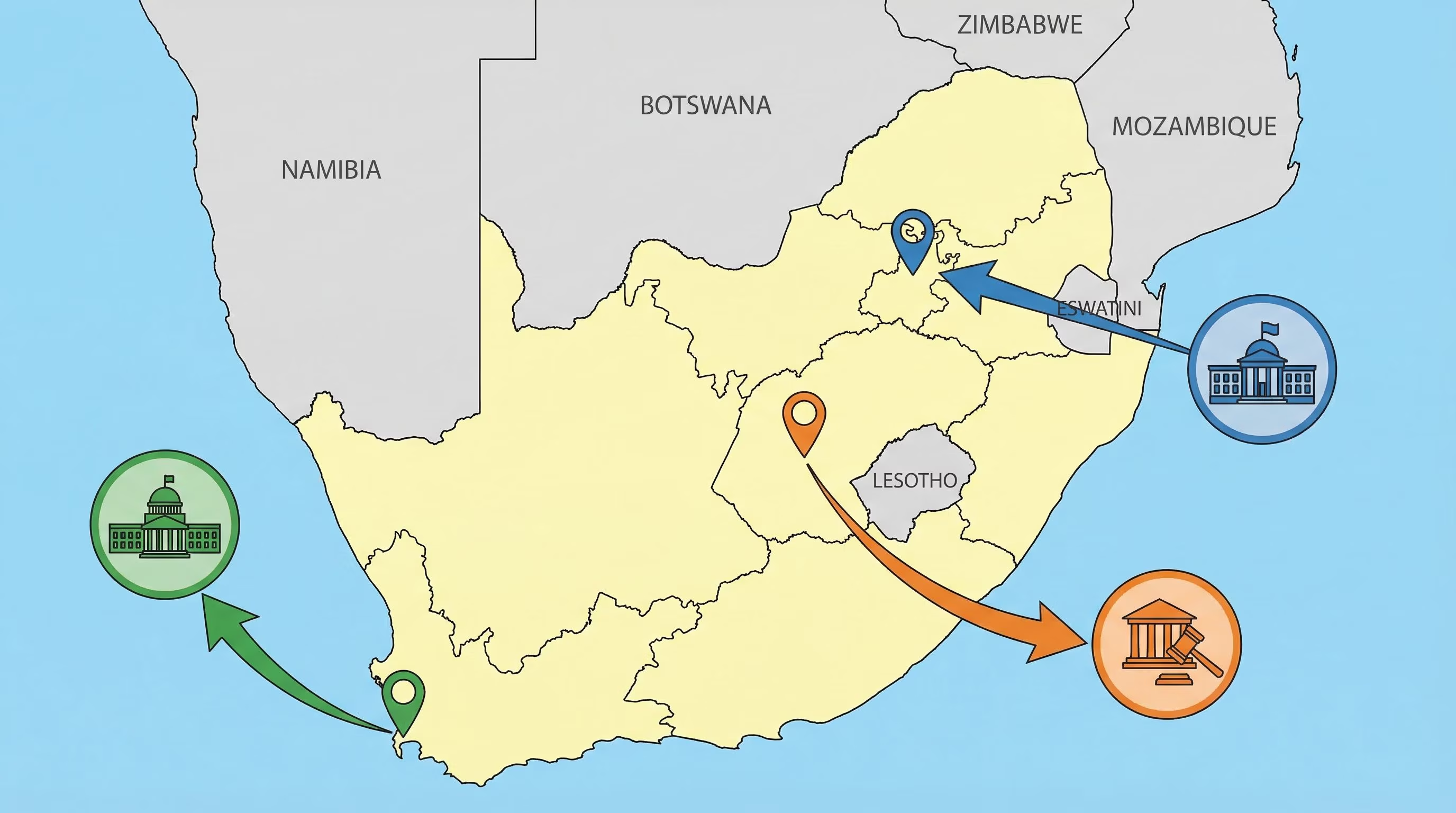
South Africa’s three capitals – Pretoria, Cape Town (Cape Town) and Bloemfontein – are physically distributed so that no urban center can claim an absolute monopoly on power within the country.
More specifically, Pretoria is the executive and administrative capital: the city hosts the seat of the President, the government offices and most of the embassies of foreign countries. As can also be seen in the map below, it is located in the north-east of South Africa, in the province of Gauteng, and is one of the most inhabited urban centers in the state, with approximately 2.8 million inhabitants.
It is instead located in the center of the country Bloemfonteinwhich represents the judicial capital of South Africa as it hosts the seat of the Supreme Court of Appeal, one of the highest judicial bodies in the nation, subordinate only to the Constitutional Court. The city has approximately 670,000 inhabitants and is located in the heart of the country, in the province of the “Free State”.
Last but not least is Cape Town (Cape Town), which plays the role of legislative capital, hosting the seat of the National Parliament, where laws are physically discussed and approved. It is the second most populous city in South Africa – with approximately 4.5 million inhabitants considering the entire urban agglomeration – and is located in the “Western Cape” region, directly overlooking the Atlantic Ocean.
Because there are three seats of state power in South Africa
But why was a system of this type established in South Africa? This division between capitals is not at all random and dates back to 1910the year of the foundation of the Union of South Africa. At that moment, the birth of the new state required the unification of four previously distinct British colonies with a history of strong conflicts – including armed ones: the Cape Colony, the Transvaal, the Orange River Colony and Natal.
It was in that year that, during the negotiations, heated discussions broke out over which city should have the privilege of becoming the capital and hosting all the seats of power. In fact, none of the regions was willing to cede hegemony to the others: in order not to compromise the creation of the South African Union and avoid the failure of the negotiations, the political leaders thus chose to implement a territorial compromise, distributing the seats of legislative, executive and judicial power in three different cities, located in such a way as to cover the majority of the territory.
This structure still survives today more than a century after its institution and perfectly reflects the internal differences of South Africa, a country that has a total of 12 official languages and where numerous ethnic groups coexist.