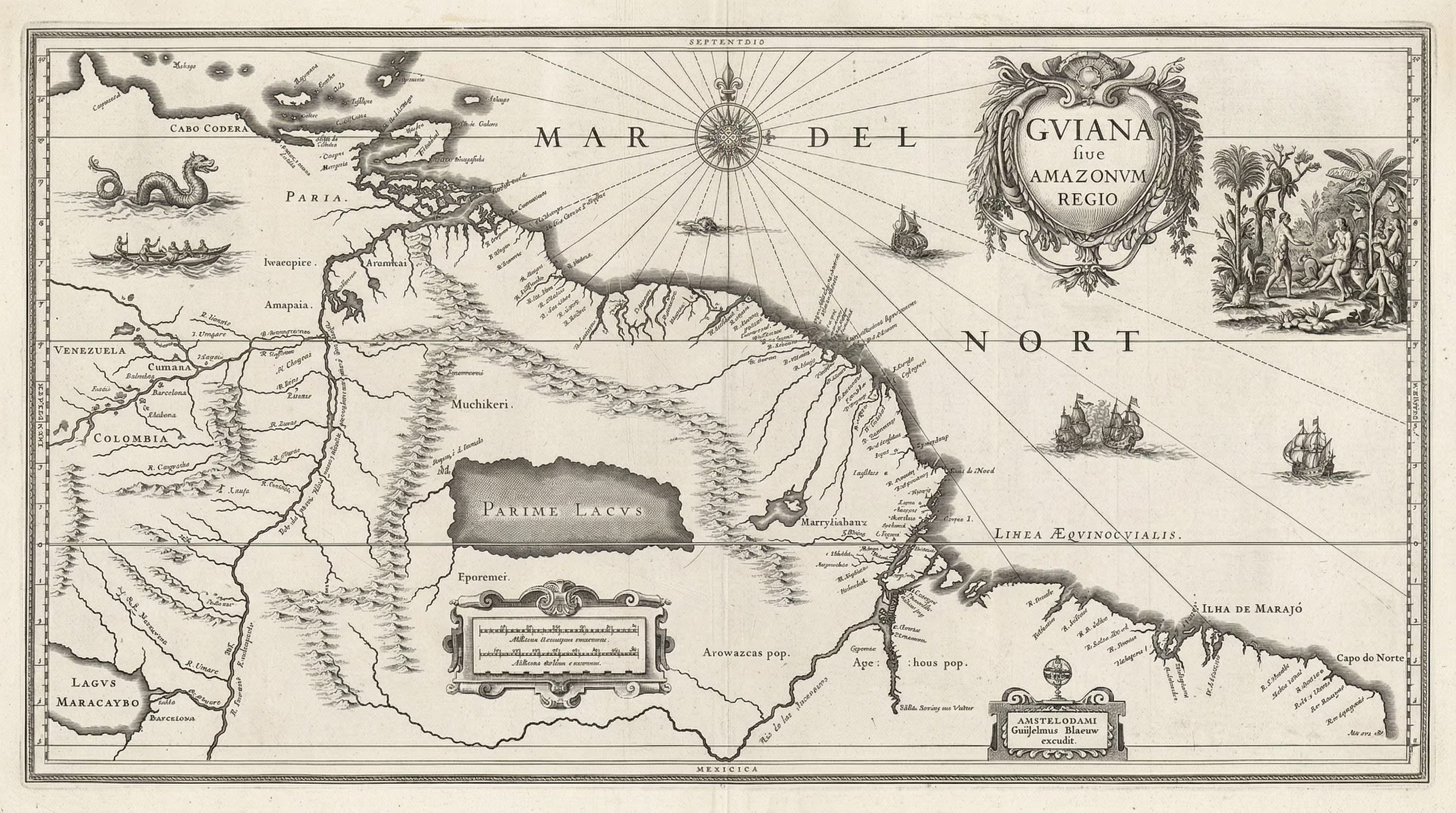
The city of El Dorado never existedbut its myth – that of a city built entirely of gold and precious stones – has fueled research and expeditions in South America for over two centuries. After the discovery of America, the Spanish continued their explorations further and further south, both to expand their colonies and to seize the enormous riches found there, think of those of the Inca empire.
Some scientific beliefs of the time linked gold to the sun, therefore to the heat and to the south, thus partly explaining the preconceived idea that enormous precious deposits would be found in South America. Furthermore, in various pre-Columbian societies the myth of a king covered in goldfrom which the European conquerors deduced the existence of a Golden City – El Dorado in Spanish – which was thought to be hidden in the jungle: she was searched far and wide, but was never found.
The myth of the golden city of El Dorado
The myth of goldin Europe, predates exploration in South America and the search for El Dorado. The tales of those who once traveled between Europe and Asia, like Marco Polo, fueled the narratives of endless reserves of extremely precious materials and immense gold constructions located in distant lands. Gold was considered the conjunction between earth and skyBetween divine and humanby some it was considered an elixir of long life, linked to the myth of the philosopher’s stone.
With the landing in America by Columbus and the subsequent explorations, the so-called “golden myths“are nourished and enriched with new details, thanks to some beliefs of the scientists of the time. For example Jaime Ferrer, an expert in gems and metals who worked at the court of Queen Isabella of Castile, wrote in 1495 that “the hotter the areas of the world, the more valuable metals and stones are found”. About a century later, in Natural history signed by José de Acosta, we read that “the proximity of the sun allows gold to flourish”.
When Christopher Columbus’ fleet arrived in America, therefore, the myth of gold was already rooted in the minds of Europeans: precisely for this reason, the conquerors began to push south, convinced that they would find great treasures.
In 1522, when the Spanish leader Pascual de Andagoya came into contact with the indigenous people of the Gulf of San Miguel, south of Panama, he heard about an empire rich in gold, the Birùtoday’s Peru. This information only confirmed the belief that one had to go “further down” to find gold.
For this in 1524 Francisco Pizarroleader and governor thirsty for glory, left for the first exploration in search of this empire rich in gold. Over the next ten years, Pizarro will manage to conquer the Inca empire and to found the capital of Peru, Lima. He managed to scrape together a enormous loot of precious materialsrarely seen before in such quantity. These wonders did nothing but fuel the “hunger for gold” in the Spaniards, who continued the exploration of South America convinced that they would always find something more.
Thus was born the actual myth of a place covered in gold, a shining city where every building and every roof was very precious: El Dorado.
The legendary lost city and the connection with traditions in South America
Between 1530 and 1540 the myth of gold pushes the conquistadors to expand more and more: during an expedition in the highlands of Colombiathe explorer Gonzalo Jiménez de Quesada comes into contact with the Muisca people and hears about the “rite of the king covered in gold”.
In Muisca tradition, the new ruler was sprinkled with gold dust, climbed onto a raft in the center of the Guatavita lagoonhe offered golden objects and precious stones to the gods and immersed himself in the water, from which he emerged washed, like a new man.
The lagoon was discovered in 1537 and, initially, it was thought that gold was born right there and therefore El Dorado it had to be nearby. Over the next thirty years, the myth of the king covered in gold it was fueled by Europeans’ imagination and lust for riches, to the point of shaping the myth of the City of Gold hidden in the jungle of which no one knew the exact location. Francisco de Orellana will set out to look for it across the Amazon and Lope de Aguirre along the Amazon River, but also the English explorer Walter Raleigh in the areas of Guyana.
Nor El Dorado nor anything similar is ever found and, during the 17th century, explorations are abandoned: the Golden City does not exist, but has become the symbol of unattainable wealth – like the pot of gold at the foot of the rainbow in Irish folklore – and of lust for conquest which characterized the Spanish conquistadors, and not only them, over the centuries of colonialism.









