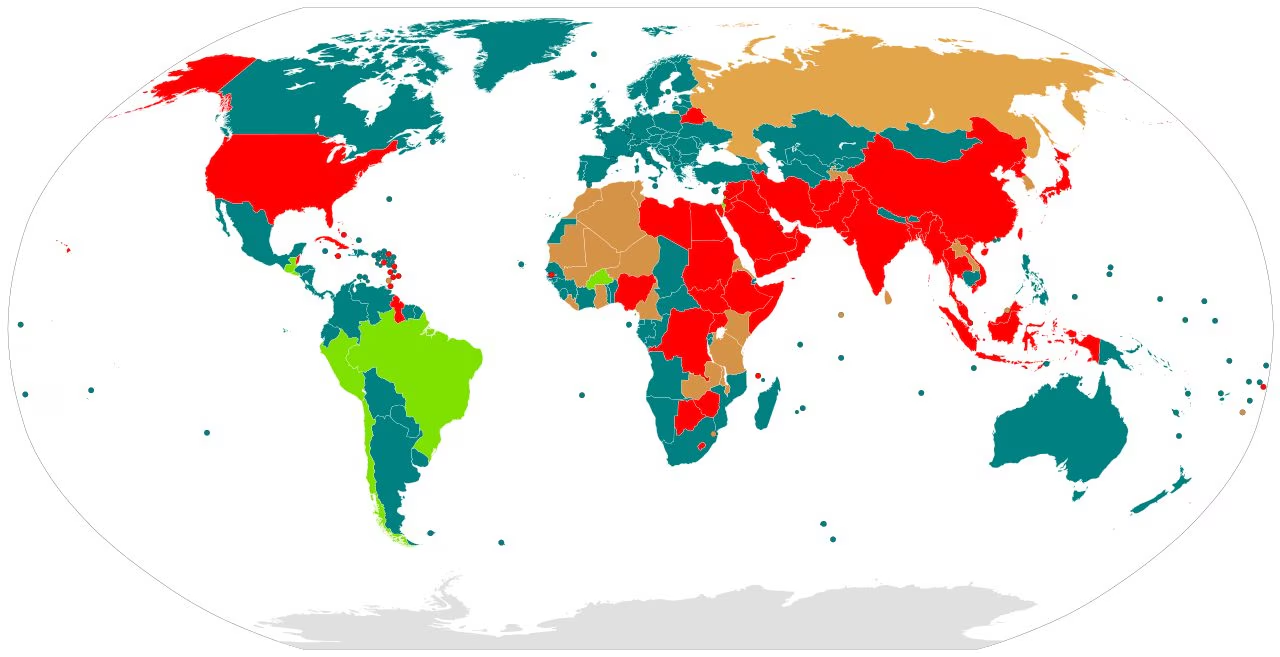
The death penalty is provided for in the legislative system of 52 countries and consists of the maximum punishment that can be inflicted on a human being: killing. Although it is inflicted more rarely than in the past, thousands of people are victims of it every year. The crimes for which one can be sentenced to death vary depending on the state: in many legislations the capital punishment is provided only for violent crimes such as murder, but in some cases other crimes are also included. The recent law of the State of Israel, which provides for the death sentence for all those accused of “terrorism” (a charge that the Israeli authorities use very casually against Palestinians) without the possibility of appeal, has sparked heated criticism around the world and has reignited the debate on the punishment.
- 1Historical notes on capital punishment
- 2Abolitionism: against the death penalty
- 3Where the death penalty is still in force today
- 4Crimes that carry the death penalty
- 5Methods of execution
- 6Capital punishment in the United States
- 7The path towards abolition in Italy
- 8The case of Israel
Historical notes on capital punishment
The death penalty has practically always existed. The oldest collection of laws we know, the code of Hammurabi (1700 BC), provided for capital punishment for numerous crimes: murder, espionage, theft, sacrilege and others. Subsequently, the death penalty was widely applied in the Greco-Roman world and in the Middle Ages.
The methods for carrying out sentences were numerous and were often deliberately cruel, in order to inflict pain and humiliation on the condemned. Among the systems in use there were burning, tearing to pieces by wild animals, crucifixion, quartering, impalement, crushing with horses or elephants.
The main motivation for inflicting death was the desire for revenge, that is, the desire to punish someone who had harmed another person or the community. It is no coincidence that in some societies it was up to the relatives of the victims to inflict the punishment or participate in the trial (a custom that is still present, in a limited form, in some systems). Furthermore, capital punishment was considered useful for public safety, because it eliminated people who committed crimes and was considered a deterrent to other potential criminals.
Abolitionism: against the death penalty
Already in the ancient world and in the Middle Ages some theologians and intellectuals expressed criticism against capital punishment, but a real debate on abolition began only in the eighteenth century, at the time of the Enlightenment, above all thanks to an Italian scholar, Cesare Beccaria. In his famous book Of crimes and punishments (1764), Beccaria argued that the death penalty was both inhumane and useless in reducing crime.
Gradually his ideas gained ground. Some states reduced the number of crimes for which capital punishment was foreseen, and some banned it altogether. The first to do so (not counting a few precedents in the ancient and medieval world) was the Grand Duchy of Tuscany in 1786.
Over the years, many states have abolished the death penalty, motivating the decision with ethical reasons, because the death sentence undermines the principle according to which the punishment must be aimed at the re-education of the condemned, and of a “practical” nature, since it has not been demonstrated that capital punishment has a deterrent effect and reduces crimes.
Where the death penalty is still in force today
The capital punishment is still in force and applied by 52 states, almost all Afro-Asian. Other countries, although not having officially abolished it, have not issued death sentences for many years.
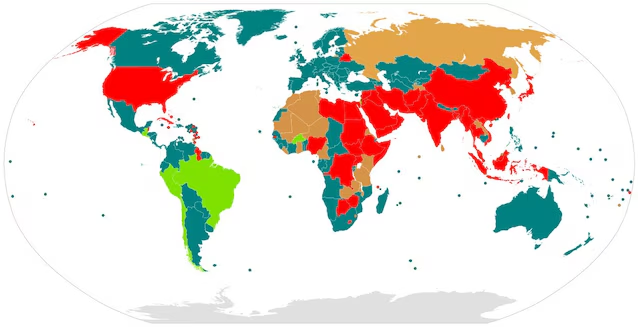
It is not known how many people suffer the death penalty each year. Amnesty international has calculated that in 2024 the sentence was inflicted on at least 1,153 people, but the data is partial because the information from some countries is incomplete. The number of convictions is increased by 20% compared to 2023but the number of countries that have applied capital punishment has decreased: only 16.
The country that executes the most people every year is certainly China, but the number of victims is not known because the Beijing authorities do not make public the data on executions, which according to Amnesty, fall “in the thousands” every year. After China, the countries with the highest number of executions are Iran, Egypt and Saudi Arabia.
Crimes that carry the death penalty
Among the crimes for which death can be inflicted there is always voluntary homicide, with or without aggravating circumstances depending on the country. In many cases, other crimes committed with violence are added, such as rape and armed robbery, and often also espionage, especially if it leads to the death of other people, and terrorism, sometimes used as an accusation to attack political opponents.
In some Islamic countries, capital punishment can also be inflicted on those who commit “crimes” against religion, such as apostasy (i.e. denying the faith), blasphemy and, in some cases, even adultery and homosexuality. Furthermore, in various jurisdictions, death is foreseen for anyone guilty of drug trafficking, as happens in various Muslim countries, Taiwan and China. In the latter country the list of crimes requiring capital punishment is particularly long and also includes various financial crimes.
The methods of execution
Today death sentences are carried out using various methods, fortunately less inhumane than in the past. In China, shooting and lethal injection (i.e. the injection of a cocktail of drugs that cause death) are foreseen, while in other countries hanging continues to be used. In Saudi Arabia, however, the most used method is decapitation, which is carried out with the sword. In some cases, certain crimes, such as adultery, can be punished by stoning (i.e. killing by throwing stones), which however is mainly inflicted in tribal societies and by non-state courts.
Unlike in the past, today executions almost always take place in prisons or in any case in non-public places, although recently cases have been recorded, as in Yemen, of sentences carried out publicly.

Capital punishment in the United States
A particular case is that of the United States, one of the very few Western countries that provide for the death penalty. However, it is not applied throughout the Union (as we know, the USA is a federal country and each state has the right to legislate on many matters), but only in 12 states. In the others it has been abolished or is subject to a moratorium or has not been applied for at least ten years.
The most used method in the USA is lethal injection. Several states also provide alternative systems, such as electrocution (electric chair) and the gas chamber, which however are used increasingly rarely. The death penalty is in fact only imposed in cases of murder, although some states provide it, in theory, also for other crimes.
Even in the United States, death sentences are decreasing compared to the past, but the hypothesis of abolishing capital punishment throughout the country, which sparked some debates in the 1960s and 1970s, is no longer taken into consideration today.
The path towards abolition in Italy
Italy abolished the death penalty in 1889 with the Zanardelli Code, but left it in force in the military code, so much so that during the First World War it was widely used against soldiers guilty of desertion or other behaviors considered illicit.
Furthermore, the punishment was reintroduced during the twenty years of fascism, during which more than one hundred sentences were carried out, partly for common crimes and partly for political crimes. The method used was shooting. Capital punishment continued to be applied in the first years after the fall of the regime, especially against those guilty of war crimes. The last execution, however, was decreed for a common crime, the Villarbasse massacre, a robbery that ended badly which caused the death of ten people. Three of the culprits were shot in Turin in March 1947.
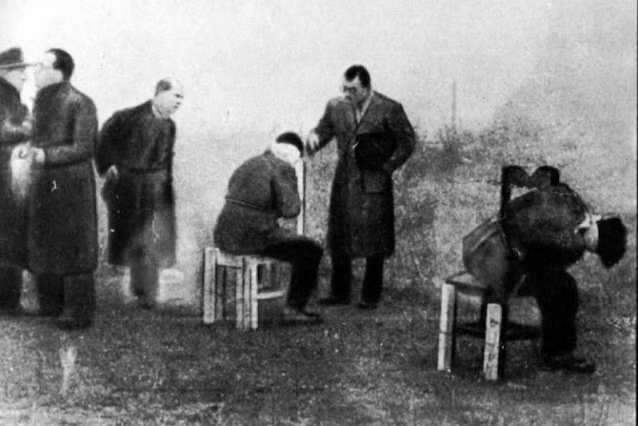
The death penalty was abolished a few months later by the Constitution, which came into force on January 1, 1948. In the military code, however, it remained in force until 1994, but was never applied after the Second World War.
The case of Israel
Since its foundation, the State of Israel has provided for the death penalty for some particularly serious crimes, including genocide, war crimes and crimes against humanity. However, until now the Israeli authorities have very rarely applied the sentence, which was inflicted on only two people: Meir Tobianski, a soldier accused of treason in the 1948-49 war; to Adolf Eichmann, the Nazi leader who was one of the organizers of the Holocaust, executed in 1962. Israel, however, has extrajudicially eliminated (without trial) numerous Palestinian militants and even foreign leaders, such as, recently, the Iranian supreme leader Ali Khamenei.
The law approved on March 30 by the Knesset establishes that all those accused of “terrorism” can be sentenced to death, without the possibility of appeal. More precisely, the capital punishment will be inflicted on “whoever intentionally causes the death of a person as part of an act of terrorism, with the intent to deny the existence of the State of Israel”: accusations that the Israeli authorities direct very casually towards the Palestinians involved in the fight against the occupation. For this reason, the law has sparked heated controversy not only on the international scene, but also in some sectors of Israeli public opinion.