In modern industrial environments, efficiency does not just depend on advanced machinery or well-organized production processes.
The management of spaces and internal flows also plays a decisive role in ensuring operational continuity and safety, as well as obviously economic sustainability.
This is why industrial doors and doors can no longer be considered secondary elements of the infrastructure, but real work tools, called upon to respond to different needs: separating environments, protecting people and goods, facilitating the passage of vehicles and contributing to maintaining optimal conditions inside buildings.
The role of industrial closures in production processes
Inside warehouses, warehouses and production plants, industrial closures directly impact the organization of daily activities.
A suitable door allows you to regulate entry and exit flows, compartmentalize areas with different functions and reduce interference between departments. It is in this context that specialized companies such as ATI Dainese operate, active since 1985 in the production and installation of solutions for industry.
The experience gained over decades of activity has contributed to spreading an approach in which the industrial door is designed as an integral part of the production process. It’s not just about “closing a gap”, but about ensuring that each step occurs consistently with the company’s operational needs, reducing slowdowns and improving overall space management.
Why is quality an economic factor and not just a technical one?
When we talk about industrial doors, quality is often associated exclusively with technical or construction characteristics, but in reality the topic also has a direct economic impact.
Reliable solutions designed to last over time help limit machine downtime, extraordinary interventions and unplanned maintenance costs.
From a safety point of view, a quality industrial door helps prevent accidents and comply with current regulations, reducing the risk of business interruptions.
At the same time, good insulation and resistance to external agents can impact the control of internal environmental conditions, with indirect effects on the energy efficiency of the building.
In this sense, investing in quality means adopting a long-term vision, in which the initial choice translates into operational and management benefits over time.
The main types of industrial doors and gates
The world of industrial closures is broad and complex, because it must respond to very different production contexts.
Among the most widespread solutions are sectional doors, appreciated for their ability to optimize spaces and for their good resistance to atmospheric agents, often used in warehouses and loading areas.
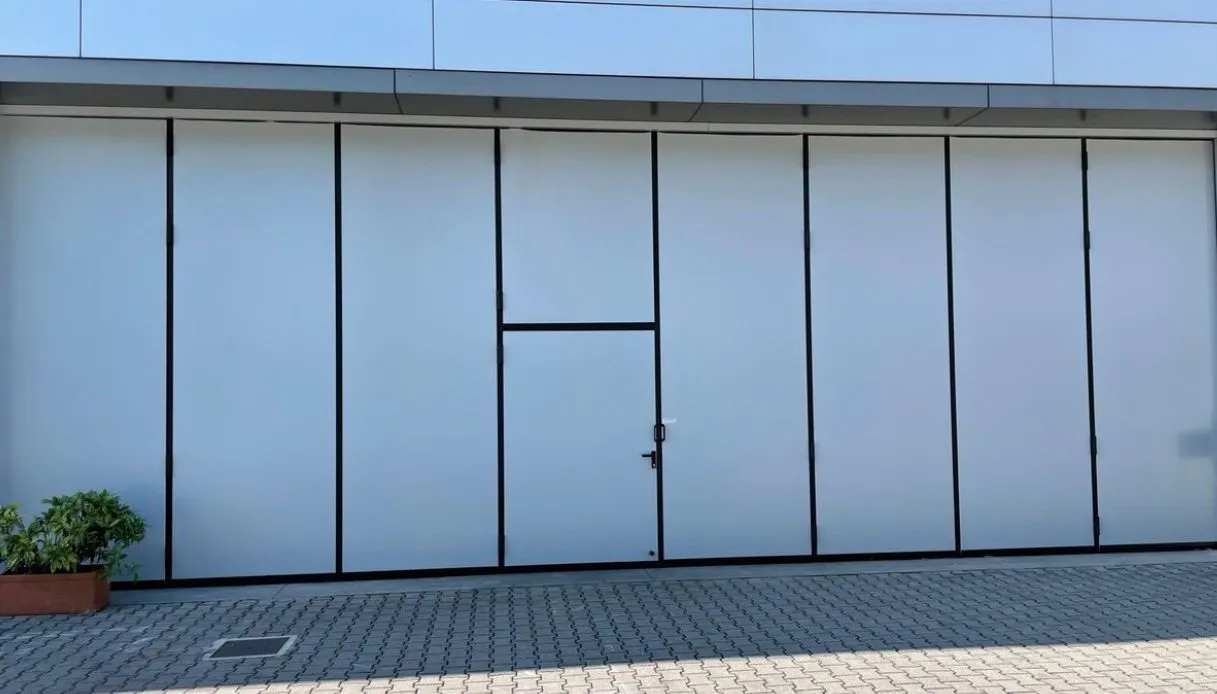
Folding doors, on the other hand, find application in large industrial openings, where robustness and stability are required, while flexible doors and strip closures represent a practical solution for separating internal environments without hindering the frequent passage of people and vehicles.
A separate chapter is that of fire doors and gates, fundamental for the compartmentalisation of spaces and for passive protection in the event of fire.
This variety of solutions allows us to respond to the needs of different sectors, from logistics to manufacturing, including all those production environments that require more rigorous access and security control.
The value of the tailor-made project
In the industrial sector, a standard solution is unlikely to be able to effectively respond to all operational needs. Dimensions of the gates, frequency of use, environmental conditions and internal organization are factors that make each context unique, which is why the tailor-made project takes on central value in the choice of industrial doors.
ATI Dainese has built its offer on a design approach that starts from the analysis of the company’s real needs, translating them into customized solutions.
The possibility of integrating design, production and installation allows you to obtain closures designed to immediately adapt to workflows, reducing the need for corrective interventions over time.
The experience of Ati Dainese: quality, safety and eco-attention
It is therefore clear that in the entire panorama of industrial closures, experience represents a distinctive and, to say the least, fundamental element.
The history of ATI Dainese is linked to a vision that places quality and safety at the centre, alongside a growing attention to environmental aspects.
The choice of suppliers close to the production site and the attention to internal processes reflect a responsible approach, which also translates into greater organizational efficiency.
Industrial doors and doors are now called upon to perform increasingly complex functions, which is why relying on a partner with consolidated skills means being able to count on solutions consistent with production needs, capable of accompanying the company over time without becoming a critical point in daily management.