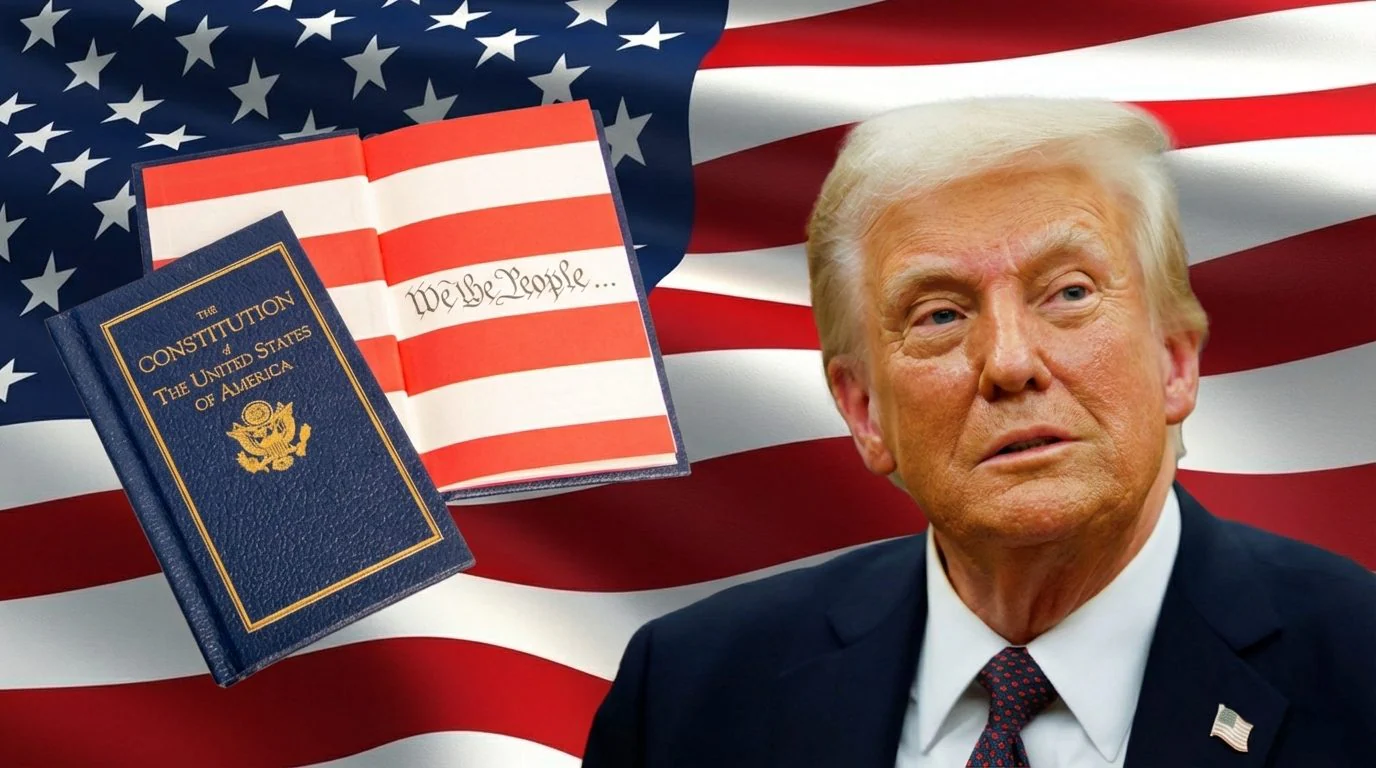
In these hours in the United States we are discussing the possibility of invoking the 25th amendment to remove Donald Trump from his office as President or of starting a procedure of impeachment towards him. The discussion was reignited by Donald Trump’s post, published on his social network Truth, in which the President threatened “the death of the entire Iranian civilization” upon expiry of the ultimatum placed in Tehran, with which a 14-day ceasefire is now in force which, however, has not yet led to the reopening of the Strait of Hormuz.
In the face of these heavy declarations – and threats of attacks which, if actually carried out, would be considered war crimes according to international law – over 85 democratic parliamentarians and even some figures close to the conservative world (including former congresswoman Marjorie Taylor Greene, Trump’s ally for years) have proposed the removal of the US President through the 25th amendment or through the institution ofimpeachment.
At the moment, however, most experts believe it is unlikely that Trump will be ousted by any means impeachment – for which the current US President has already been acquitted twice during his first term, in 2019 and 2021 respectively. Likewise, the application of Section 4 of the 25th Amendment would also seem politically impractical, as it would require the approval of, among others, Vice President JD Vance.
However, things could change over the next few months: in fact, elections will be held in the USA in November Mid Term (midterm elections), during which US citizens will vote to re-elect all 435 members of the House of Representatives and 33 members of the Senate (1/3 of the total). At that point, the current Republican majority in Congress could collapse, with a greater chance of assembling the votes needed to remove Donald Trump as the 47th President of the United States.
What is the US 25th Amendment and what does it say
The 25th amendment to the United States Constitution regulates cases of presidential succession and the president’s inability to exercise his duties: it was introduced following the assassination of John F. Kennedy in 1963, with the aim of filling a regulatory void that until then had made the transfer of power procedure ambiguous.
The amendment is made up of four sections: the one that is supposed to be invoked against Donald Trump is section 4, which is also the most complex and delicate of the amendment. Not surprisingly, this section has never been invoked in the history of the United States and the Supreme Court has never provided a definitive interpretation of what is meant by “presidential incapacity.”
Specifically, the section provides that if the vice president and a majority of the members of the Cabinet (or other body designated by Congress) believe that the president is “incapable of exercising the powers and duties of his office,” then they may let Congress know in a written statement.
At that point, the Vice President immediately assumes the duties of Acting President. The President in office, however, can respond with his own declaration denying his incapacity: at that point Congress has 48 hours to meet and 21 days to decide. If an agreement is not reached, two-thirds of the votes in both the House and the Senate would be needed to remove the Head of State.
What does it mean impeachment and how many votes are needed to remove a US President
Impeachment, on the other hand, is the instrument provided for by Article II of the US Constitution, which authorizes Congress to remove the president (and other federal officials) from office for “treason, bribery, or other high crimes and misdemeanors”. Unlike the 25th Amendment, which deals with inability to perform duties, impeachment is designed to sanction wrongdoing or abuses of power by the President, and represents one of the main mechanisms of Congressional control over the executive branch.
The procedure is divided into two distinct phases. The first takes place in the House of Representatives, which to formalize the accusation against the president must approve an ad hoc resolution with a simple majority (50%+1).
At that point, the procedure passes to the Senate, which performs the functions of a real tribunal by analyzing the results of the investigations carried out by the House Justice Commission. To actually remove a President, however, a 2/3 majority of the Senate is needed, i.e. 67 senators out of 100: an extremely high threshold, which in the history of the United States has never been reached for any President in office.
The approval of a possible impeachment against Trump becomes even more difficult if we look at the current division of the Senate, which has 53 members of the Republican Party (i.e. the majority), 45 members of the Democratic Party and 2 members of independent parties. In other words, it is almost impossible for as many as 22 Republican senators, the party to which the President belongs, to vote in favor of his removal.
Because now it’s unlikely: Trump has already been acquitted twice
According to most experts, at the moment both the 25th Amendment and impeachment are politically impracticable: both instruments, in fact, require strong cohesion among members of Congress, which today enjoys a Republican majority in both houses. Among other things, triggering Section 4 of the 25th Amendment would require the consent of Vice President J.D. Vance and a majority of the Cabinet, both strong Trump allies.
On the impeachment front, however, without the control of either House, the Democrats mathematically do not have the numbers necessary either to start or complete such a procedure.
Then there is a very significant precedent that makes this eventuality even more remote. During his first term in the White House, Donald Trump was impeached twice by the House of Representatives and acquitted in both cases by the Senate. The first impeachment dates back to 2019 and related to his actions towards Ukraine, while the second is from 2021 and was linked to incitement to the storming of the Capitol on January 6 of that year. On both occasions, the Senate – which had a different composition from the current one – did not reach the two-thirds necessary for conviction, confirming how the threshold required by the Constitution is politically difficult to overcome when the president enjoys the unified support of his own party.