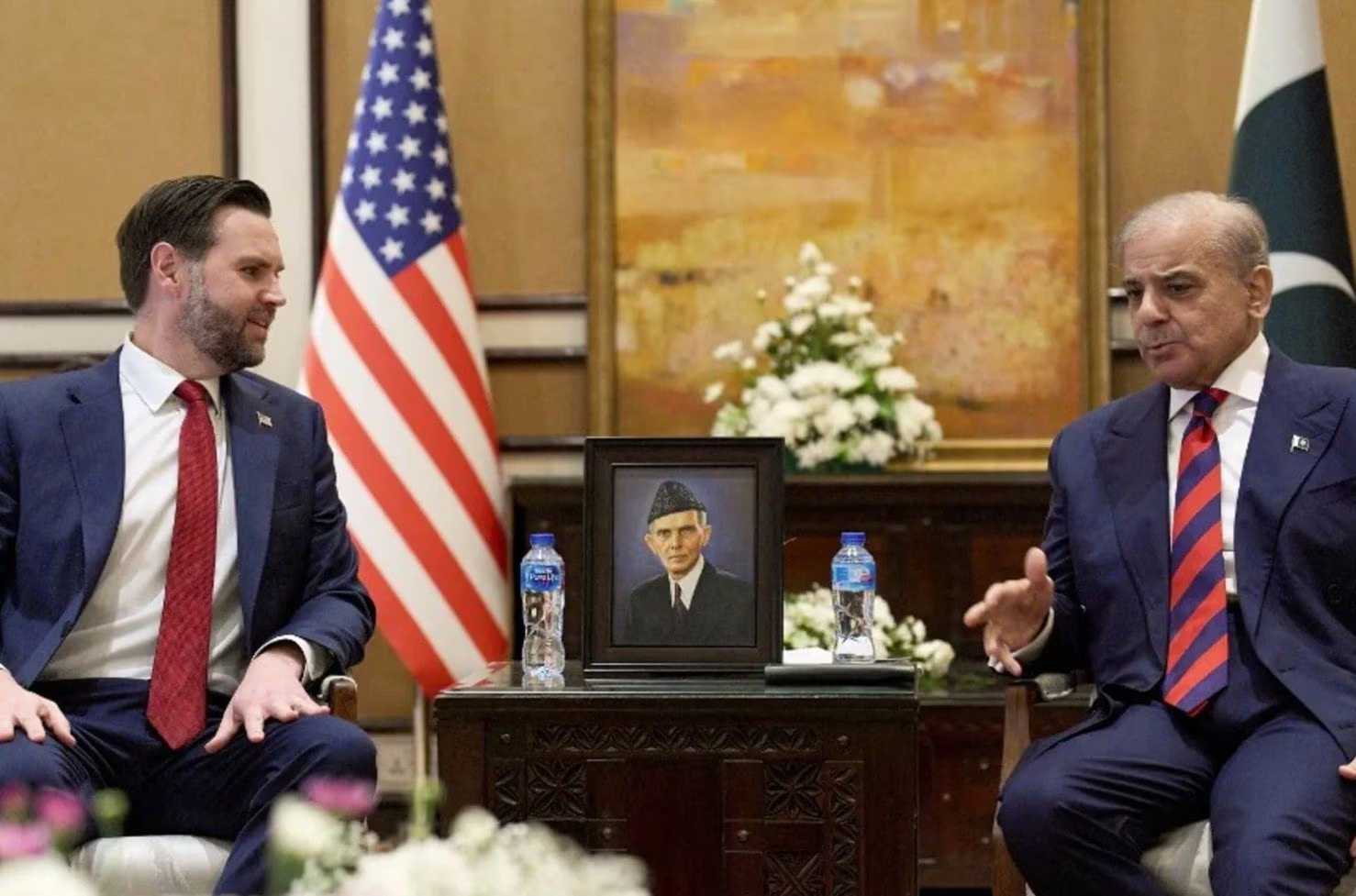
Failed negotiations between the United States and Iran: twenty-one hours of talks, the highest-ranking delegation since the 1979 Revolution, a luxury hotel in Islamabad (Pakistan) transformed into a negotiating room to decide the fate of a war that has lasted for six weeks. Then, on the night between April 11th and 12th, US Vice President JD Vance climbed onto theAir Force Two and left Pakistan empty-handed.
The bad news is that we have not reached an agreement. And I think that’s bad news for Iran much more than for the United States of America
He told reporters before leaving. On the Iranian side, the response was speculative: what blew everything up were Washington’s “unreasonable demands”, as reported by Iranian state television and reported by Al Jazeera. The two-week ceasefire, brokered by Pakistan and announced on April 7, is formally still in place. But it expires on April 22nd. And neither side has indicated what will happen next.
Why the US-Iran negotiations failed: two wars in one negotiation
The issue that blew it all up is double. Parameters set by Trump included dismantling major nuclear enrichment facilities, recovering the approximately 400 kilograms of highly enriched uranium buried underground, ending funding for Hamas, Hezbollah and Houthis, and fully opening the Strait of Hormuz without tolls.
Iran started from a different assumption: it has never officially confirmed that it wants to build nuclear weapons, but it does not intend to give up the right to enrich uranium for civilian purposes. And the deterrent value of nuclear power, see North Korea, became even more evident in Tehran after they were bombed during ongoing negotiations. The head of the Iranian delegation, Parliament Speaker Mohammad Bagher Ghalibaf, said his colleagues had brought “far-sighted initiatives”, but due to “the experiences of the previous two wars we have no confidence in the other side”, he wrote on X.
To further complicate the picture there is Lebanon. Iran and Pakistan claimed that the April 7 ceasefire also included the Lebanese front. The United States and Israel have both excluded it. Over the weekend in Islamabad, Israeli Prime Minister Netanyahu declared that his country’s military campaign against Iran is not over: “Israel under my leadership will continue to fight the Iranian terror regime.”
The Strait of Hormuz is Tehran’s real weapon
The Strait of Hormuz — just over 30 kilometers of water between the Persian Gulf and the Gulf of Oman — has become the most concrete battleground between the two sides. 20% of the world’s energy supply passes through that body of water. Experts have already called it the worst economic shock since 1973, when the oil embargo took 4.5 million barrels a day out of global supply. The current blockade is holding back twenty million. The Asian Development Bank estimates growth in the Asia-Pacific will slow to 5.1% in 2026 and 2027, with regional inflation set to rise to 3.6%, identifying conflict as the single biggest risk to the region’s outlook.
After the talks failed, Trump responded by announcing on Truth Social a naval blockade of all Iranian ports, ordering the navy to intercept ships that had paid tolls to Tehran. But Trump himself, a few hours later, admitted that making an agreement or not “makes no difference” because, in his opinion, the United States has already won. Iran responded by deploying Navy special forces along the southern coast and the Pasdaran have warned that any naval vessel approaching the Strait will be considered a ceasefire violation.
The three possible scenarios before April 22nd
With the truce expiring in less than ten days and no new round of talks planned, analysts outline three possible trajectories.
- The first scenario is that of a ceasefire that holds de facto even without a formal agreement, with both sides choosing not to resume hostilities because the costs of resuming war remain too high. This is the assessment of Ali Vaez, director of the Iran project at the International Crisis Group, quoted by PBS News: the most likely scenario is not an immediate war, but “a volatile period of pressures, signals and last-minute attempts to avoid a broader escalation”, with a possible opening to a limited and mutual agreement that buys time and lowers the temperature. This reading is consistent with what was outlined by the Congressional Research Service already at the end of March, which compared this possible phase of stalemate to the recurring crises between the United States and Iraq after 1991.
- The second scenario is that of a controlled escalation. According to the Wall Street Journal, Trump and his advisers were considering resuming limited military strikes against Iran in addition to the naval blockade, with the aim of breaking the diplomatic stalemate. Iran, for its part, responded by mobilizing naval forces and reaffirming full control over the Strait. This trajectory does not necessarily lead to a large-scale resumption of war, but opens up a phase of direct confrontation at sea with risks of accidents that are difficult to control.
- The third scenario – the most favorable but also the most uncertain – is that of a partial agreement, built not on a global agreement but on limited mutual concessions. Sina Toossi, a senior fellow at the Center for International Policy in Washington, quoted by Time, noted that both sides had incentives to continue negotiating: “The costs of resuming war are high for both.” Chatham House, however, highlights a structural obstacle: Israel’s insistence on excluding Lebanon from the agreement reveals the limits of America’s ability to manage its main ally in the region, and risks undermining any overall truce.
The problem that remains underneath it all: trust
Whatever scenario comes true, the underlying issue remains the same that scuttled the talks in Islamabad: the lack of mutual trust. Danny Citrinowicz, a senior researcher at the Institute for National Security Studies in Tel Aviv, quoted by the Associated Press, wrote that the Iranian perception of having successfully resisted “is not the mentality of a regime preparing to make compromises.” The gap between American expectations and Tehran’s self-perception “is at the heart of a growing strategic stalemate.”
Vance, before boarding the plane, left a door open: “Let’s start with a very simple proposal, the one that is our final and best offer. We’ll see if the Iranians will accept it.” It’s not a total closure. But there is very little time until April 22nd.