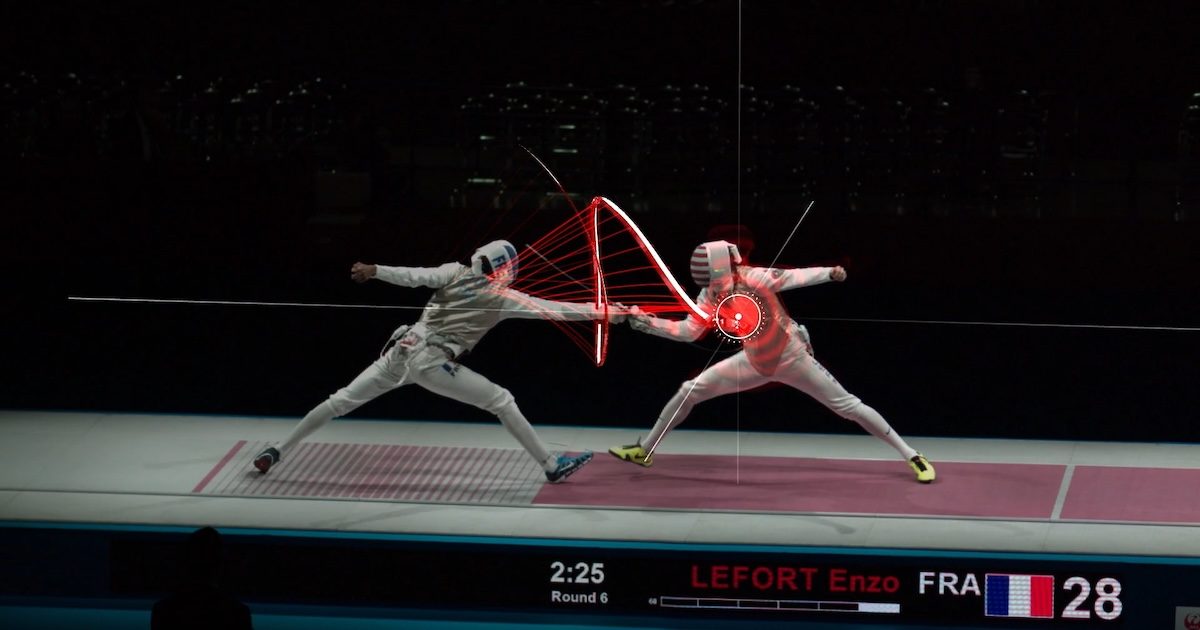
During a fencing match the two athletes advance, retreat, touch and a point is awarded. To whom? Why? The swords move at speeds that the human eye cannot follow, the actions last fractions of a second and the point of contact is often invisible even to those standing there. Fencing, despite being one of the oldest sports in the world and present at the Olympics since the first modern edition in 1896, had not yet found a way to be accessible and understandable to anyone who watches it.
A Japanese project is trying, with concrete results, which has taken over a decade of research and development to solve a seemingly simple problem: show where the tip of the foil goes. The technology developed by Rhizomatiks and Dentsu Lab is called “Fencing Visualized” and is a fencing tracking and visualization system in Augmented Reality (AR) based on the use of 24 high-speed cameras and deep learning and artificial intelligence. The innovation will be staged for the general public on April 25th during the debut of World Fencing Leaguea new competition founded by Olympic bronze medalist and World champion Miles Chamley-Watson, designed to make fencing more pop and in which the Italians Arianna Errigo and Michela Battiston will participate.
The problem of human limits: “Fencing Visualized” is born
Until now, to understand who scored a hit, fencing has relied on an electrical circuit. The tip of the weapon acts as a switch and the athlete’s target area is covered by a conductive vest (the lamé): when the weapon touches the vest, the circuit closes, instantly triggering a light and an audible signal on the platform. Electronics have always been indispensable in this sport precisely because the movements of fencers are simply too fast to be judged with the naked eye without a margin of error.
In the 2013, Yuki Ota (first Japanese to win an Olympic medal in fencing) and the creative agency Dentsu Lab Tokyo they ask themselves a question: how can fencing be made understandable and exciting for those who don’t practice it? Their answer was to make the movement of the swords visible in real time without altering the match. As documented by the research team of Rhizomatiks (the Japanese creative-technological studio that followed the project) a moving sword blade is very difficult to track automatically. A foil tip, even captured by a 4K camera, only occupies a few pixels in the image. The shape of the sword changes continuously because the blade flexes and the speed of movement exceeds what traditional computer vision systems can manage. The first attempts, in 2012, used retro-reflective markers physically applied to the tips of the swords, a solution that worked but was invasive for the athletes and unusable in official competitions.
From YOLO, to 3D to Computer Vision: 12 years of development
The leap in quality comes with the deep learning. Starting in 2016, the team begins to develop a system based on neural networks capable of detecting the position of the tip of swords directly from images, without any markers. The adopted architecture is a modified version of YOLO (You Only Look Once), an algorithm for real-time object recognition in images.
To train the model, the team photographed further 200,000 images of real matches in different lighting conditions, and then generated more than one million computer graphics images additional through digital reproductions of swords and competition scenarios in variable conditions of light, background and position. The definitive system of computer vision USA 24 cameras positioned on both sides of the platform, each capable of covering 8 metres, to ensure total coverage of the entire competition area. From the integration of the 2D information of all the cameras, the system reconstructs an estimate of the position three-dimensional of the tip in real time.
In the 2019the system was introduced for the first time in official competitions first at the 72nd Japanese Fencing Championship, then at Fencing World Cup HIH Prince Takamado Trophy JAL Presents.
The result on the screen, immediate and visual, is the trajectory of the tip which appears as a luminous trail which, lasting for a few fractions of a second, makes every thrust, every parry and every attack visible. Dentsu Lab Tokyo has also created a graphic language with a system of icons and displays that translates technical gestures such as the lunge or the parry into symbols that are understandable even for those who know nothing of the rules. The system was also used in youth competitions, where participants were given a custom scorecard with the icons of the techniques they had performed during the match.
The World Fencing League: a new format for a new audience
All this technical work is part of a broader project to rethink fencing. The April 25, 2026 the debut of the is staged in Los Angeles, at the Shrine Auditorium World Fencing Leaguea new competition founded by the athlete Miles Chamley-Watsonbronze medalist at the Tokyo Olympics and the first African-American to win a world fencing title.
The format is designed to introduce new audiences to fencing by changing the times and some rules of the classic sport. For example, the races do not end when a certain score is reached but will have an actual time. The event, designed to fit into the breaks in the calendar of the International Fencing Federation (FIE) avoiding overlaps, takes place in a single day of high intensity competitions (foil, épée and sabre), with 12 world-class athletes – including the Italians Arianna Errigo and Michela Battiston – competing for a prize fund of $100,000.