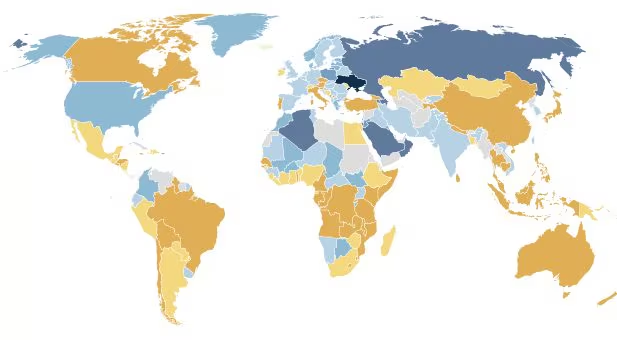
Global military spending reached a new historical record in 2025, with countries around the world spending a total of 2,887 billion dollars on armaments, an increase of approximately 2.9% compared to 2024. This is confirmed by the data just released by SIPRI (Stockholm International Peace Research Institute), one of the most prestigious research institutes in the sector: this is the eleventh consecutive annual increase. Looking at the ratio of military spending to global GDP, investments in weapons reached a global average of 2.5% in 2025, the highest level ever recorded since 2009.
Leading the investment ranking remains the United States – currently engaged in the war in Iran – with 954 billion dollars invested in the military sector in 2025, which alone represents around a third of global spending. Followed by China (335.5 billion dollars, +7.4% in real terms), Russia (190 billion dollars, +5.9%) and, for the first time in fourth position since the Second World War, Germany (113.6 billion, +23.9%). Completing the global top 10 are India (92 billion), the United Kingdom (89 billion), Ukraine (84 billion), Saudi Arabia (83 billion), France (68 billion) and Japan (62 billion).
In particular, the data shows a recent U-turn in European countries which, after having cut funding for the war sector for decades, are now the ones driving global growth, marking an increase of 14.1% compared to 2024, for a total of 863.7 billion dollars (at current prices). The combination of the Russia-Ukraine war, an increasingly complex global geopolitical situation and the increasingly pressing US requests for greater military involvement are leading the Old Continent to rearm.
Europe drives the growth of global military spending: +14% in one year
As anticipated, the most significant data from the SIPRI report concerns Europe above all: the old continent has in fact recorded a growth in military spending equal to 14.1% in real terms (the highest among all regions of the world), bringing the European total to 863.7 billion dollars at current prices (around 677 billion euros). If we look at Central and Western Europe alone – therefore excluding Russia and Ukraine, whose increase in military spending is not surprising given that there is an ongoing war – the surge is even more marked: +15.8%, with a total of 547 billion dollars.
Driving this growth is above all Germany, which with a leap of 23.9% exceeded the threshold of 100 billion dollars for the first time, positioning itself as the fourth country in the world for military spending. Even more impressive is the case of Spain, which recorded the strongest increase in the entire continent: an incredible +49.6% in just one year, reaching 40.2 billion dollars and rising to fifteenth position in the world. Followed by Poland (+23.4%, 46.8 billion), Sweden (+24.1%, 15 billion) and Norway (+49%, 16 billion). The only exception among the major European powers is the United Kingdom, which recorded a slight decline of 2%.
In short, the data processed by SIPRI confirm European rearmament, in a manner which, in terms of size and speed, has no precedent since the Cold War period: after the fall of the Berlin Wall, in fact, the funds allocated to the military apparatus were gradually reduced by European countries, a decision justified by the historical period but also by the awareness of being able to count on the US military umbrella.
To give you an idea, between 1990 and 2025 European war investments increased by 36.9%, going from 578 billion dollars to almost 864 billion dollars.
If we look at military spending in Central and Western Europe alone, while in 2015 investments amounted to 296 billion dollars, in 2025 they reached 547 billion, i.e. an increase of 85% in just 10 years.
Italy and the costs of war: 12th country in the world with 48 billion dollars
Italy has also significantly accelerated its defense spending: in 2025 our country invested 48.1 billion dollars in the military sector (around 41 billion euros), with an increase of 20.1% in real terms compared to 2024. The Peninsula therefore came to occupy 12th place in the world ranking for investments in the defense sector, a notable leap if we consider that in 2024 our spending did not reach 38 billion of dollars.
Looking at the relationship between military spending and Gross Domestic Product, in 2025 Italy allocated 1.9% of GDP to armaments, an increase compared to 1.59% in 2024 but still below the 2% threshold set by the Atlantic Alliance.
But how was it possible to finance such a sharp increase in military spending in just one year, without excessively burdening the state budget? In fact, to achieve the objective of 2% of GDP requested by NATO, the government tried to “broaden” the definition of defense spending, including for example investments for the protection of submarine cables and gas pipelines and also attempting to include the Strait Bridge project as useful infrastructure for military purposes (an initiative later rejected by NATO).
In short, the strategy aims to try to exploit rearmament into an engine for the national economy, seeking a balance between the need to protect the borders and that of not cutting funds to other essential sectors, such as health or education.
Our country, among other things, is also positioned as the sixth global exporter of weapons (we were in 10th place in the period 2016-2020) and third among European countries alone, preceded by France and Germany. As confirmed by a previous SIPRI report, in the last 5 years Italian arms exports have increased by 157%, covering a share of 5.1% of global arms exports. More than half of these exports went to the Middle East (59%), while 16% went to Asia and Oceania and only 13% to other European countries.
What’s happening outside Europe: Asia growing, Americas slightly declining
Globally, the second largest growth region was Asia and Oceania, with an increase of 8.1% in real terms and a total of $678 billion. The ones that weigh above all are China – which is close to 336 billion dollars, recording an increase for the 31st consecutive year – but also Japan (+9.7%), India (+8.9%) and Pakistan (+11%).
The Middle East area, on the other hand, remained essentially stable at around 209 billion dollars, with Israel and Iran however recording a slight decline: in 2025 Israel invested 48.3 billion dollars in military spending (-4.9%), but Israeli military spending still remained 97% higher than in 2022. Iran, on the other hand, recorded a decline for the second consecutive year, decreasing spending by 5.6% to 7.4 billions of dollars.
The Americas also recorded an overall decline of 6.6%, driven by the decline in the United States (-7.5% in real terms). Despite the decline, Washington remains by far the largest investor in the world with over 954 billion dollars, a figure higher than the sum of the next five countries in the ranking.
It must be said, however, that the data refers to 2025: considering the current war in the Middle East – which involves the USA and Israel against Iran – it is more than likely that the decline detected by these three countries will be largely reversed in 2026.
Canada, on the other hand, increased spending by 22.6%, reaching $37.5 billion after strong pressure exerted by Washington on NATO allies.
Finally, Africa represents a marginal share of global military spending, standing at 2% of the total with 54.6 billion dollars invested in 2025, still marking +8.5% compared to 2024. Spending at a continental level is dominated almost exclusively by Algeria, which alone absorbs 44% of African military investments with 24.1 billion dollars invested, followed at a great distance by Morocco (5.9 billion dollars) and South Africa ($3 billion), while Nigeria recorded the most impressive increase with growth of 54.8%, albeit from a much smaller base ($1.8 billion).