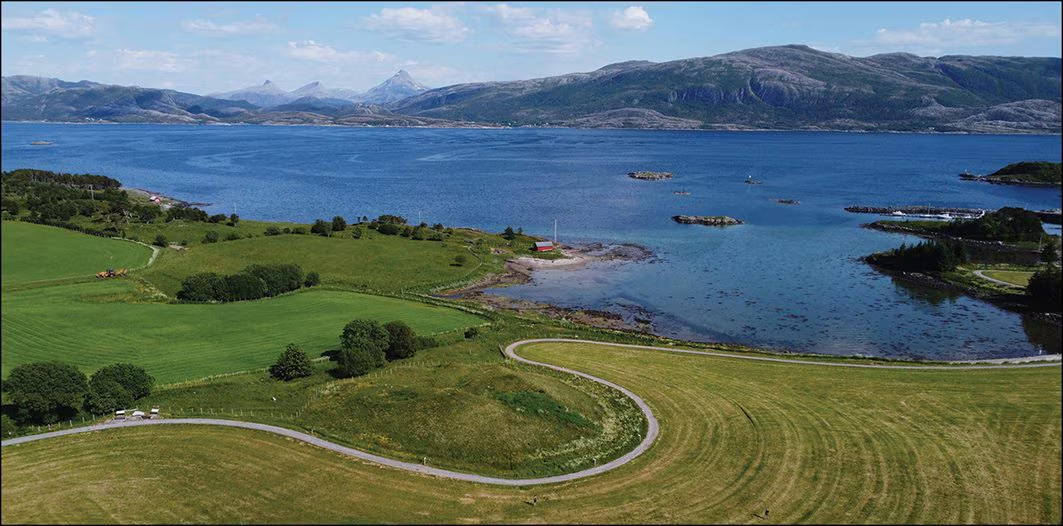
On the island of Leka, along the central-northern coast of Norway, there is one of the largest burial mounds in the country: Herlaugshaugen, with a diameter of approximately 62 meters and an original height estimated at around 12 metres. For centuries the site has been associated with a legend handed down in the saga of King Harald Fairhair, the first king of Norway, who lived between the 9th and 10th centuries AD. C., written in the 13th century by Snorri Sturluson (1179-1241). According to the tale, King Herlaug chose to have himself walled up alive in the mound along with a large quantity of food rather than submit to Harald, who was meanwhile completing the unification of Norway. Excavations carried out in the mound between 1755 and 1780 had uncovered a skeleton with a sword, animal bones and parts of an engraved bronze cauldron, which local farmers remelted into shoe buckles. Those objects were then lost, and for over two centuries another question remained open: was there perhaps a ship in the mound?
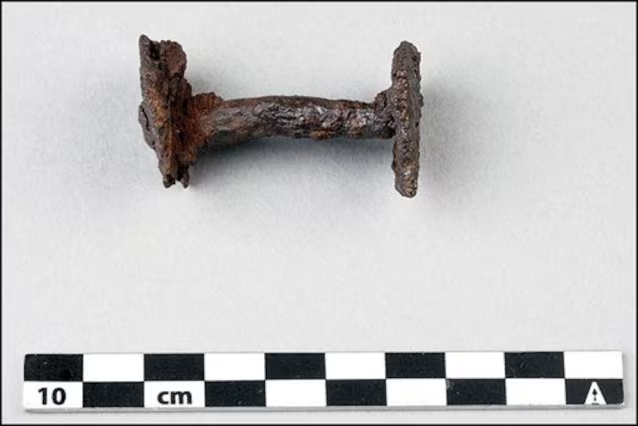
A new excavation campaign conducted in 2023 by researchers from the University Museum of the NTNU (Norwegian University of Science and Technology) and the provincial authority of Trøndelag, the county in which the site is located, has provided an answer. The results were published in the journal Antiquity. The research team dug three trenches in the mound, recovering as many as 29 large iron rivets, known as clinker nails, along with fragments of wood still adhering to some of them. Clinker nails are one of the most characteristic elements of “clinker construction”, the naval carpentry technique that involves the assembly of overlapping boards and which would define the Norse shipbuilding of the subsequent Viking era. The dimensions of the rivets suggest a ship over 20 meters long. Radiocarbon dating of the wood and charcoal samples found placed the burial between 670 and 700 AD. C. The burial and the ship that was probably inside are therefore older than the period of King Harald, and the legend around the mound was certainly born later.
The chronological data obtained from radiocarbon is very important. The oldest Scandinavian ship burials known to date are located on the island of Karmøy in southwestern Norway and date back to the late 8th century. Herlaugshaugen is therefore 50-100 years earlier than these, placing it in the Merovingian period (approximately 450-750 AD), the centuries immediately preceding the Viking Age, which began their raids from the end of the 8th century. This fact creates a chronological link with the naval burials of Anglo-Saxon England: the great burial of Sutton Hoo (celebrated in the film “The buried ship“), in Suffolk, is dated between 600 and 625 AD Between that British context and the Norwegian Viking burials of the 8th-9th centuries there was a temporal gap that made it difficult to establish whether the tradition of monumental ship burials had developed independently in the two areas or had common roots. Herlaugshaugen fits into that gap.
The authors also underline the geographical position of the site, which adds a further element to the interpretation. Leka is located much further north than the main concentration of known Norwegian naval burials. However, the island occupied a strategic point along the shipping routes: several trade routes met there. Researchers hypothesize that Leka was a node in a long-distance trade network, through which not only goods but also ideas and cultural practices, including funerary customs, circulated. The toponymy of the area around the port also suggests the presence of assemblies and gatherings, typical activities of centers with regional coordination functions.
An important aspect concerns the fate of the finds found in eighteenth-century excavations. The skeleton and sword were taken to Trondheim, where they were lost at the beginning of the twentieth century. The new excavations did not recover any further materials, nor did they identify any funerary objects. The center of the mound was disturbed by eighteenth-century campaigns, conducted without the rigorous scientific method of contemporary archaeology, which explains why researchers found an irregular distribution of rivets rather than an intact profile of the hull, signaling how eighteenth-century excavators disrupted the site. Despite this, the material context found, especially the clinker nails, is sufficient to confirm the presence of a ship.
https://www.geopop.it/i-vichinghi-avereno-davvero-i-tatuaggi-come-in-film-e-serie-tv-non-tiamo-prove-certe/
The Herlaugshaugen burial therefore represents a piece in the understanding of the social development of Northern Europe between the 7th and 10th centuries: it indicates that the advanced shipbuilding and maritime networks that would characterize the Viking Age were already operational at least a century before the conventional start of that key period for European history.