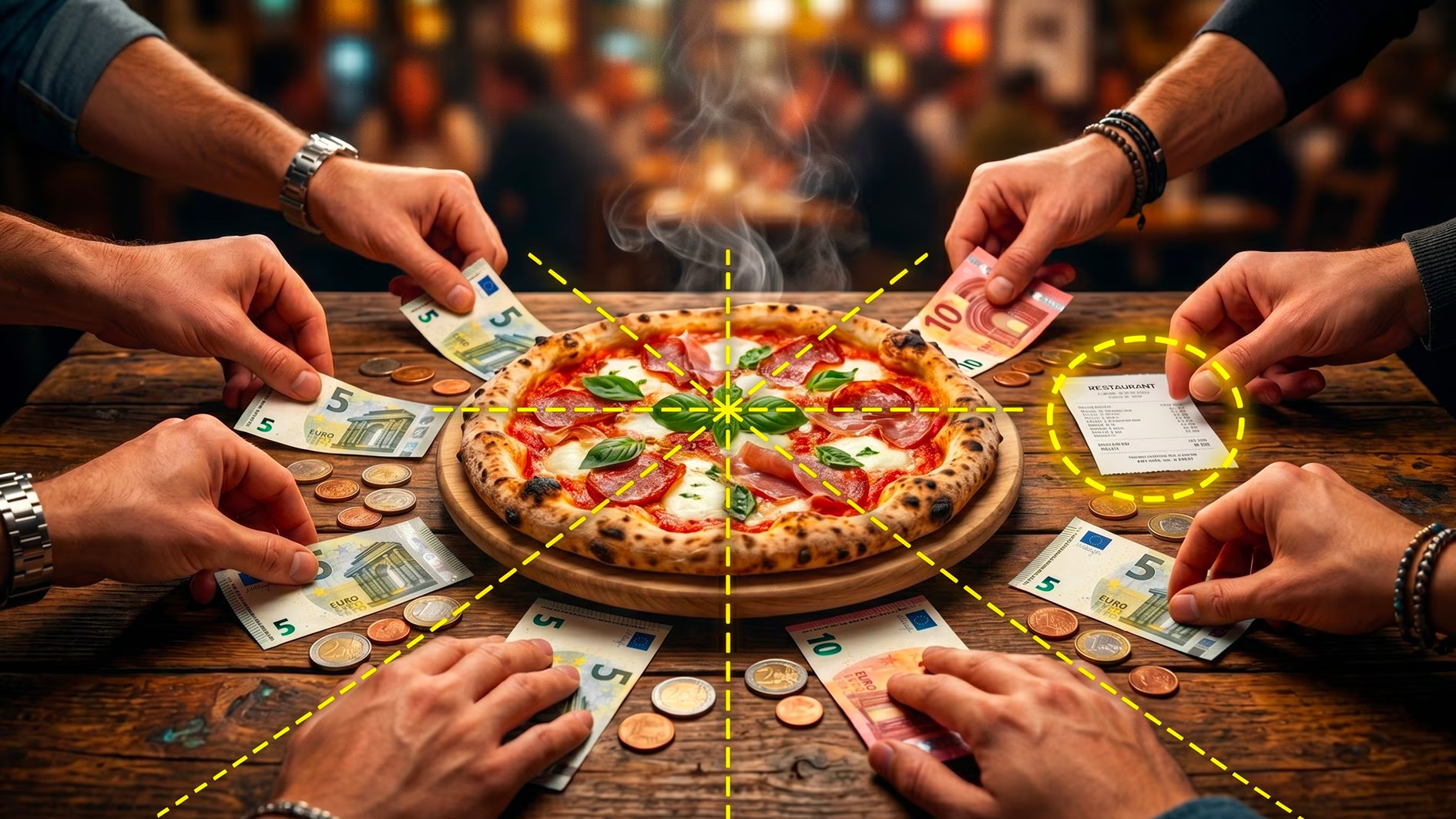
In Italian there is an expression used to indicate the action of divide the costs equally at the end of a meal in company, or more generally divide a common expense equally: “to pay in the Roman way”, or more briefly “in the Roman way”. The meaning of this phrase, now widespread throughout the peninsula, has its roots in a fascinating mix of history and literature. From the ancient trattorias of the city to the banquets in the triclinia of Ancient Rome, up to “Roman” cited by Ugo Foscolo to describe country snacks based on the spontaneous sharing of food, this saying hides a complex origin.
Origin and meaning of the convivial expression
A way of saying that has nothing to do with Rome in the strict sense, but rather a conventional way of indicating a shared social practice that has now spread across the Italian peninsula regardless of the region. Its origin, in fact, is not certain, but there are some interesting hypotheses that help to understand its meaning.
A first popular hypothesis links the expression to an ancient custom of Roman trattorias according to which the bill for the dishes brought to the table was already previously divided into equal parts for each diner.
Another more imaginative attestation, however, dates back to some literary texts of Ugo Foscolo who used the expression “Romanata” during a trip near Fiesole. On that occasion the meaning was rather curious, because with the expression “Roman” he meant a country snack taken in the company of a noble lord. It was, therefore, a convivial mealin the countryside, in which each participant contributed something, not necessarily money.
The Foscolian Romanata consisted of a pleasant outdoor snack, which at most everyone who attended could have contribute some food. This spontaneous sharing model is testimony to the idea that existed of dividing expenses equally in a group. A similar concept also exists in French pique-niquethus defining a lunch or dinner for which everyone who takes part pays a fee.
We can push this reflection even further back in time, to the habits of ancient Rome. If you think about the tricliniumthe domestic space in which the ancient Romans they ate their meals lying down on beds arranged around the canteen consuming food and fruit, including exotic ones, an idea of conviviality emerges based on sharing, on literally relaxed time and on collective participation. A banquet that was similar to a bucolic picnic, the latter made up of blankets on the grass and spontaneous contributions from the participants. From this perspective, it is not entirely far-fetched to hypothesize a cultural link, albeit indirect, between these modern convivial practices and the idea of ”romanata”, understood as a moment of simple and participatory sharing.
But why the “Roman” form?
In Italian the use of the suffix -ata is widespread in suffixal derivation and can express various meanings.
Among these, some of the most common are “expressing a blow given with something” (forkful, balloon), a “quantity contained in or taken with something” (spoonful), an “event or action” (binge, swim, stroll) or a “set” (torchlight procession, staircase).
Whereas these nuances they often carry a strong expressive or colloquial value, it is understandable that in the past the “roman” form may have arisen to add expressive charge to what it describes: a convivial moment.
Making “Roman style” and other variations in Italy and around the world
In addition to the more well-known “paying the Roman way”, there is also a variant “do it the Roman way”with the same meaning of dividing the bill equally among all participants. Curiously, however, it is not the only expression with a geographical reference of this type since it also exists “pay the Genoese way”which according to some interpretations may indicate the same practice, but with an ironic nuance linked to the stereotype of Ligurian thrift.
This aspect is important because it shows that idioms, rather than describing reality objectively, very often reflect cultural perceptions or stereotypes and this is even more evident if we take into consideration how other languages translate this concept.
The great thing is that each language has its own way of expressing the same concept, and often does so by attributing it to someone else. In Englishfor example, expressions are widespread to go Dutch (“pay the Dutch way”) o Dutch treat. In this case the reference is to the Dutch, probably due to stereotypes linked to the precision or management of expenses that the English saw in these people, but also due to rivalry and enmity.
But the examples don’t end here; then other languages we have an evident parallelism with other expressions:
- in Turkish (Alman usulü) it is said “German-style”, perhaps also here due to the myth of German precision;
- in Latin America it is used pay the American way, pay in an American way opGerman agarwhile in Argentina it’s exactly what they say pay the Roman one due to the close cultural influences it had with Italy;
- the Spanish speak of pay to the Catalan;
- to Lisbon it is said fazer as it counts in Porto fashion or pay in Porto fashion.
These latter expressions often have an ironic nuance: the behavior is attributed to a “rival” city or region, considered more stingy or money-conscious.
“Paying in the Roman way” would therefore not seem to be an exclusively Roman or Italian tradition, nor even a recent invention. It is the result of a long cultural and linguistic evolution which is linked to the convivial practices, even ancient ones, of very different peoples.